4 feet 2 mouths

walking and eating our way around the world

Archive for the month “April, 2012”

Finding Enlightenment And Darkness in Potosí (by Nathan)
Scenic drive to Potosí

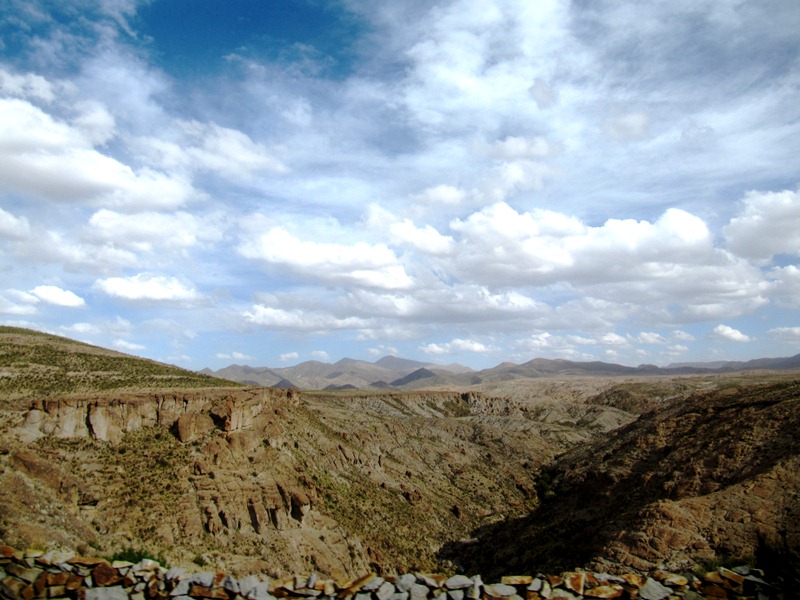
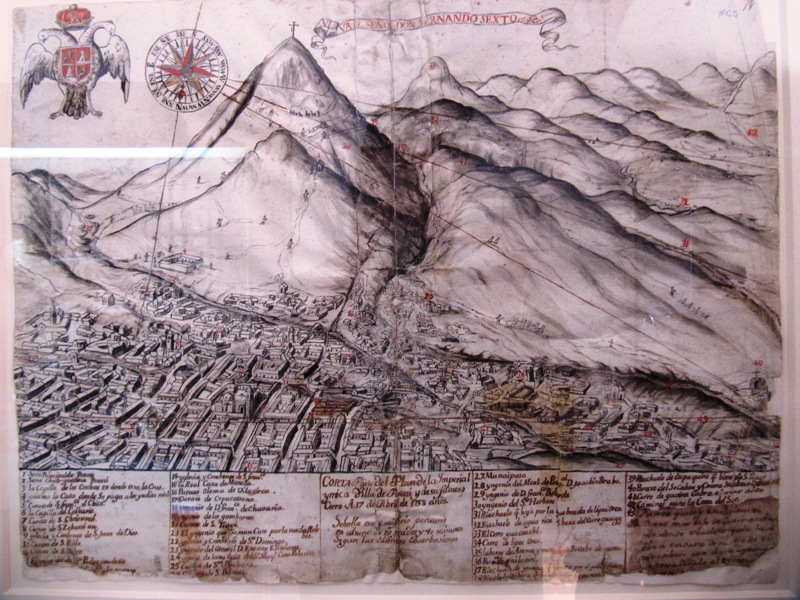
Potosí is a city of contradictions.  The contrasts of both riches and defeat are deeply rooted into the high mountains; the history of the city is glorified in majestic architecture and the poverty weathered into the faces of the people.  At first we knew little about the city other than there was a silver mine and it had an altitude unmatched by any other city of the world.  We discovered a place exploding in culture and experiences that we will never forget.
Historic map of Potosí

The city is breathtakingly high in the mountains. We avoided the taxi stand and trudged up the hillside with our backpacks on.  After a six hour bus ride a thirty minute walk at 13,500ft (4100m) seemed doable.  We are a little crazy sometimes.  At each block we sucked in deep breaths of oxygenless air and held onto our chests as our throbbing hearts tried to escape.  A little light-headed and we arrived at our hostel ready to explore the city.
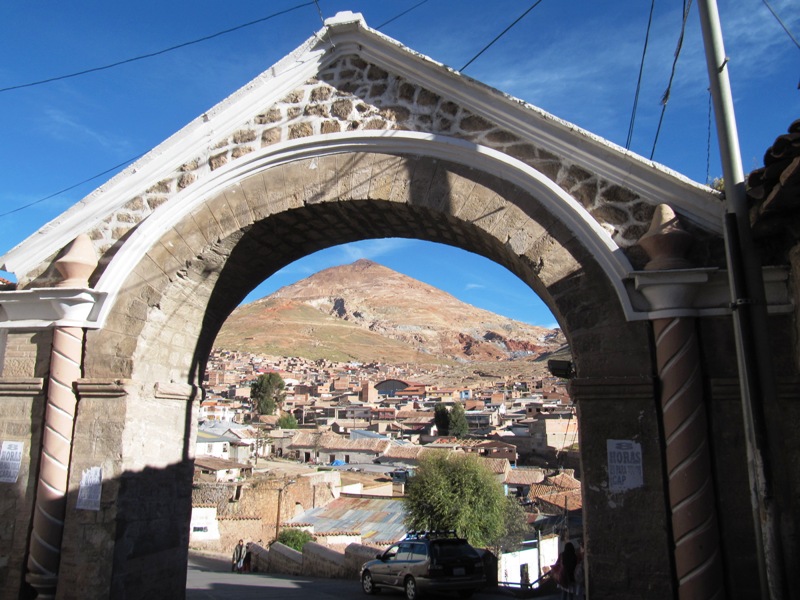
El Cerro Rico through colonial arch

Potosí has a history entwined with Spanish colonial dominance and the production of silver.  Mid-sixteenth century a meandering llama shepherd on the mountainside discovered silver flowing from beneath his campfire.  Within decades the Spanish had colonized and created the city of Potosí beneath the cerro rico (rich hill).
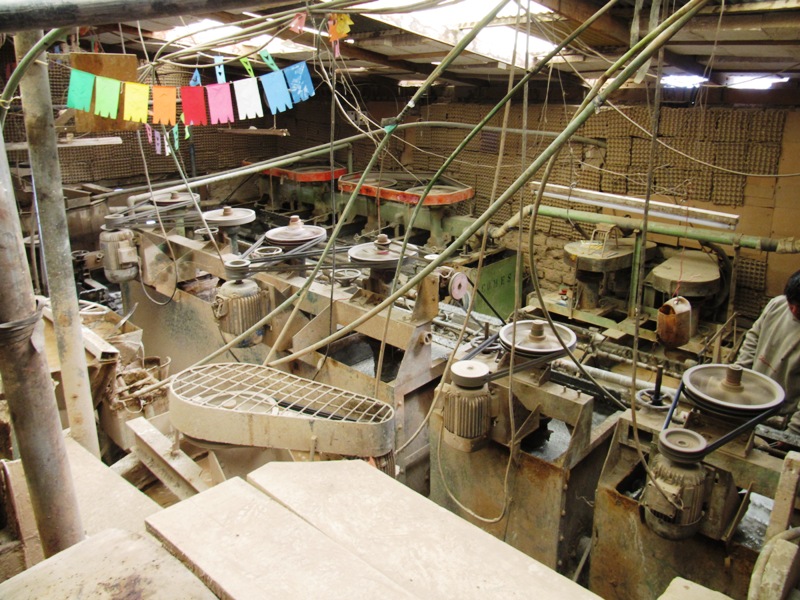
Silver extraction factory

The Spanish forced indigenous and African slaves to work the mines months at a time without seeing light.  The population of Potosí grew so much in the 17th century that over 15,000 men worked in the mines at one time and the city’s population exceeded that of Paris.  Potosí quickly became the richest and most populous city in South America.
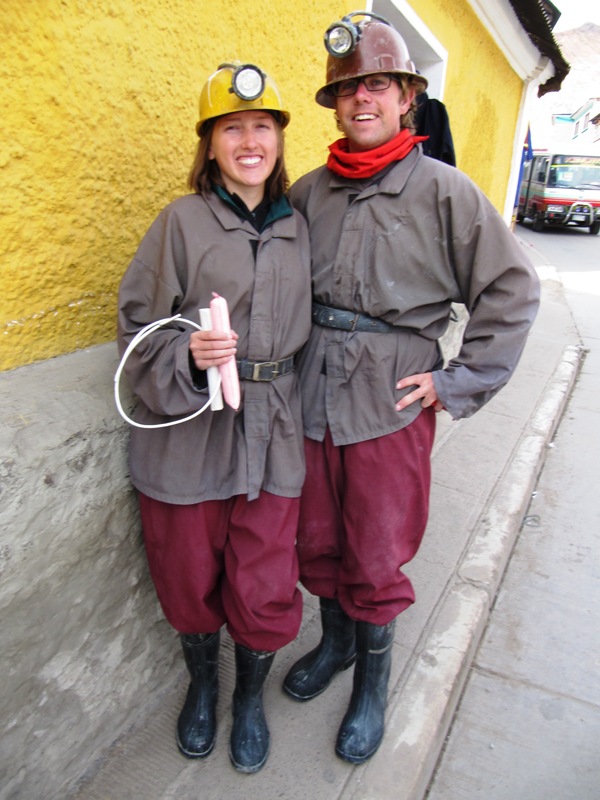
4feet2mouths Miners

The mines are still a central part of Potosí.  They are less productive than they once were, but nevertheless over 1,500 men continue to work in over 500 mines that have swiss-cheesed through the mountain.  Carmen and I decided to see the mines for ourselves.  The unique part of visiting the mines is that tourists are supposed to bring gifts for the miners within.  With our coveralls, rubber boots and headlamps we tromped our way to the miners’ market.  We purchased a stick of dynamite, a detonator and nitroglycerine as an explosive gift (only $3!) and a couple liters of soda for the other miners.
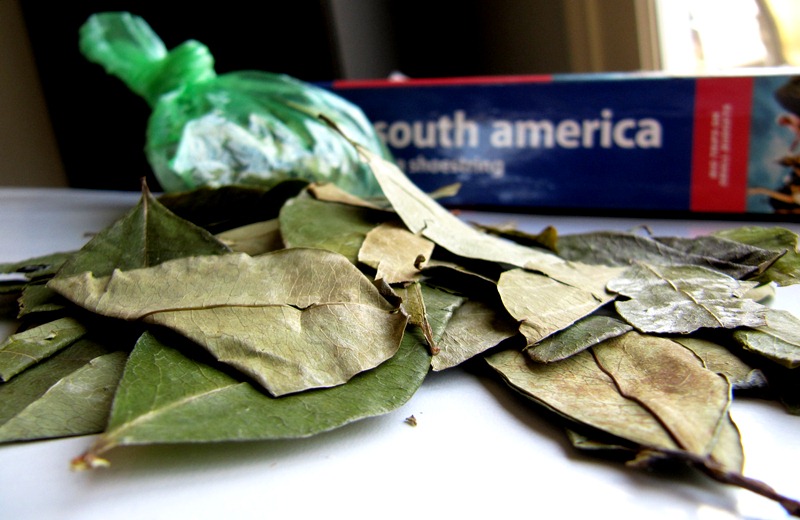
Coca leaves

Another purchase was a bulbous bag of coca leaves.  Coca has been used in these mountains for thousands of years and it is drastically different from the connotations associated with cocaine.  The miners chew and macerate 50-200 stemless leaves and they keep the wad in a huge ball in the side of their mouths.  Throughout long hours of work the coca leaves provide energy, alertness and they suppress the need to eat.  An added benefit is that they help ease the effects of altitude sickness.  It takes 1kg of coca leaves to make 1g of cocaine along with many nasty chemicals, so chastising coca is similar to relating a cup of coffee to methamphetamines.

Enormous crystal of bolivianita

The mines were hot, 95°F (35°C) and wet and dusty.  We started in the candeleria mine and we worked our way 1000ft (300m) horizontally into the mountain.  The caverns were created 300-400 years ago and unfortunately I am taller than the smaller natives that dug the mines.  I hunched and squat-walked through the water and muck.  Then there was only a seemingly solid section of rock and an obscured cavity just larger enough to crawl on our stomachs.  The air was thick and the walls wet and the rock dark with an occasional sparkle of silver or pyrite or a stripe of yellow sulfur.
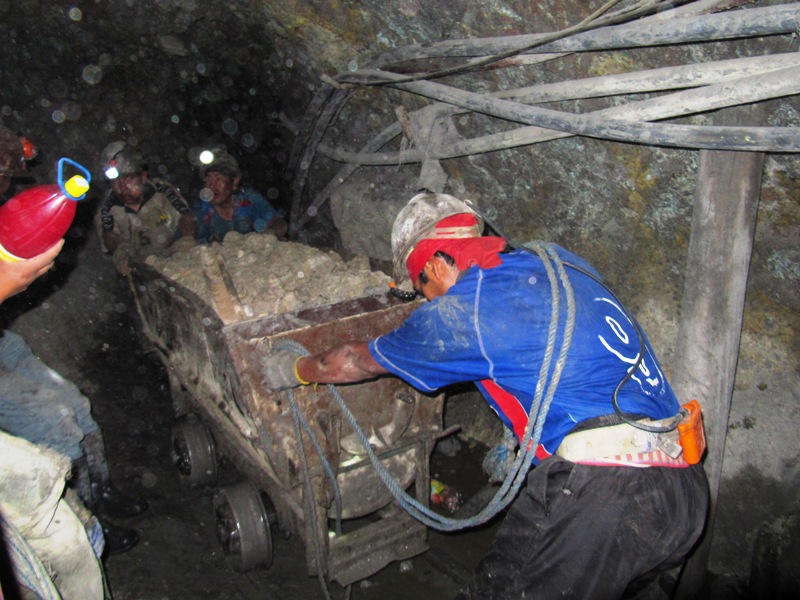
Los Mineros

“Vamos, vamos vamos!” Our guide yelled at us.  We rushed along the tunnel to an opening and he pushed us against the wall.  The slow rumble of the mine became louder; suddenly a two ton cart full of rocks rushes passed us with one miner clinging onto the back.  Our guide stuffs a bottle of Fanta in the cart and a drawn out “graciaaaas” reaches us from the depths of the darkness.

We climbed to the inner depths of the mine.  We would poke our heads down a little hovel then scale the dark cliffs within.  At first we were all cautious of the 300 year old pieces of wood that braced the openings, but when looking into the abyss all of us scratched and clung onto every foothold and support we could find.  Finally we reached the bottom, level four and 275 ft (80m) down.  We found a thirty-two year old miner that looked over fifty that spent all day hammering two holes for dynamite.  At the end of each day he would set off the charges and carry out the rocks in a backpack.
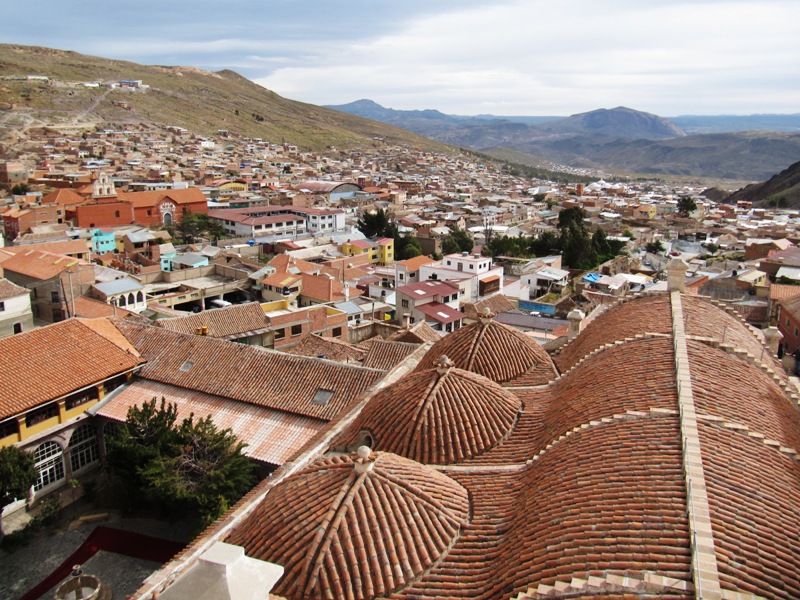
The city of Potosí

The lives of the men are hard in the mines.  The expected lifespan of a miner rarely exceeds fifty years and most die from silicosis, falling rocks or misplaced explosives.  Children also work in the mines; boys as young as ten years work to support their families.  One thing is for certain, they can earn four times more in the mines than in the city of Potosí.  So the men work extremely hard for a few ounces of silver and their lives remain difficult.
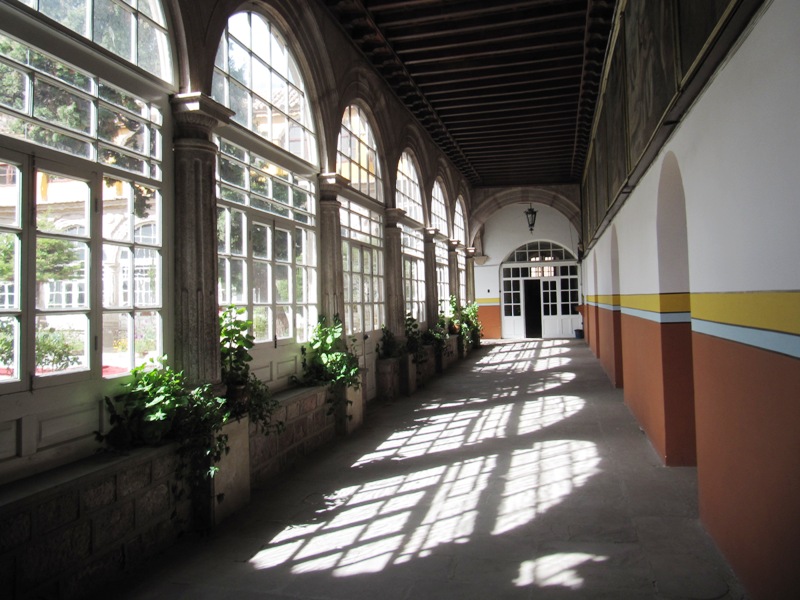
Inside the 450 year old Convento San Francisco

The dichotomy of life in Potosí extends to religion as well.  Outside in the light is a community passionate about the Catholic Church. Potosí has several beautiful colonial churches and the San Francisco was constructed in 1547 as a slightly smaller version of St. Peter’s Basilica.  In the darkness of the mines the people pray to a different god, “Tio,” the devil of the mountain.  Their daily offerings of 96% moonshine-like alcohol and coca leaves to clay statues in the caves are a way of satisfying the mountain so that they remain protected and the veins of silver remain plentiful.  The miners live these two lives: hours of darkness and heat in the mountain and a life of family and church in the city.  After four hours of clambering around in the mines the light at the end of the tunnel was thrilling. Squinting and sweating I finally straightened out and looked into the city of Potosí.
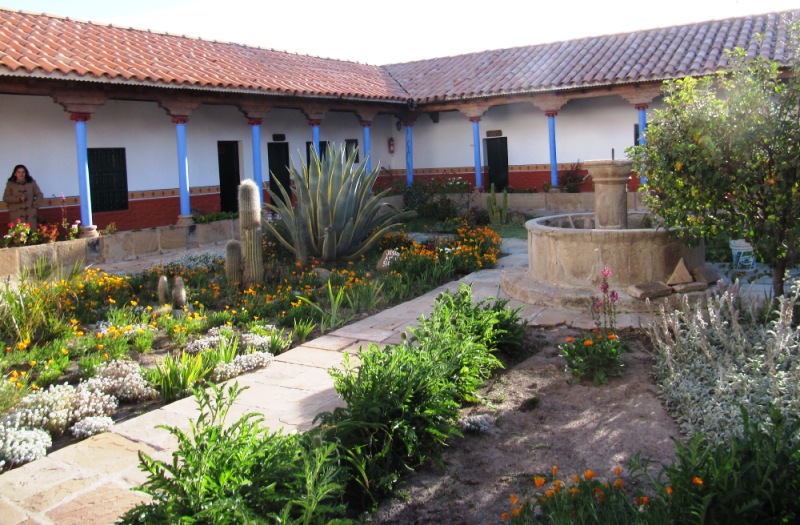
Courtyard in Convento Santa Teresa

Potosí was also home to one of the strictest nunneries.  The upper-class Spanish followed a regiment with the lives of their children.  The first born married wealthy into the colonial upper class, the third born served the military and took care of the parents in old age. The second child was dedicated to the church.  In the case of Potosí families paid an equivalent of $100,000 as a dowry for their daughter to become a Carmelite nun at St. Teresa’s.  The rules of the nunnery were so strict that the nuns could only speak one hour per day and there was no communication to the outside world.  Families could visit one hour per month and they were not allowed to see or touch their daughter.
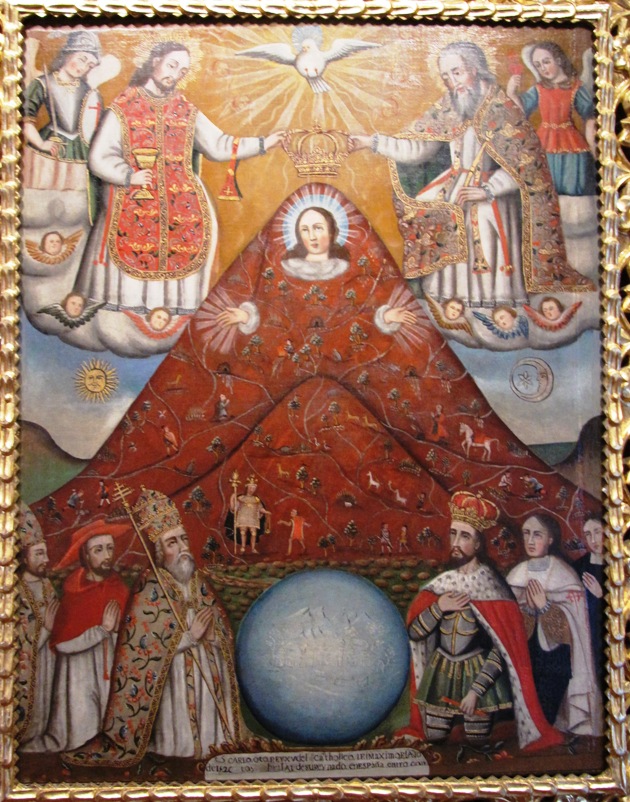
La Virgen De Cerro Rico

We observed a trend in many of the religious paintings.  The virgin Mary appears in many places as would be expected in a catholic country, but the shapeless mound that is typically meant to be non-seductive had been adapted in Potosí to be la sagrada virgin de cerro rico.  During pre-colonial times  each mountain was a god, with colonialism the traditions of the indigenous people merged with the icons of the catholic church. 

Other paintings and figures show a bloody version of Jesus on the cross.  This graphic imagery comes from the indigenous painters intertwining their own pain and suffering from the Spanish colonial rule into their faith in a new religion.

Traditional outfits on colonial streets
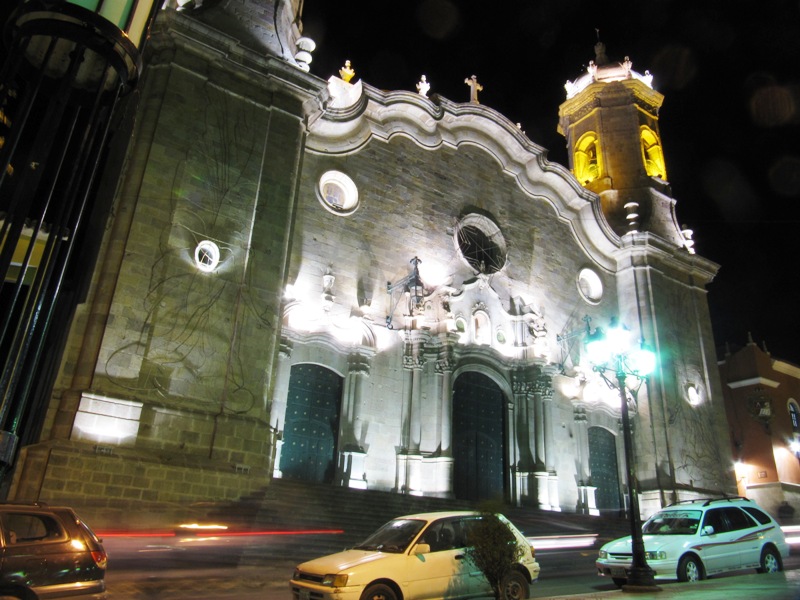
Cathedral by night

Walking the streets of Potosí we were constantly welcomed with a splash of history and tradition.  A 400 year old church and a cobble-stoned path were all common sites.  On one occasion we crossed a mother and children each wearing a traditional bowler hats.  In the evening the brightly lit cathedral was a beacon of the city.
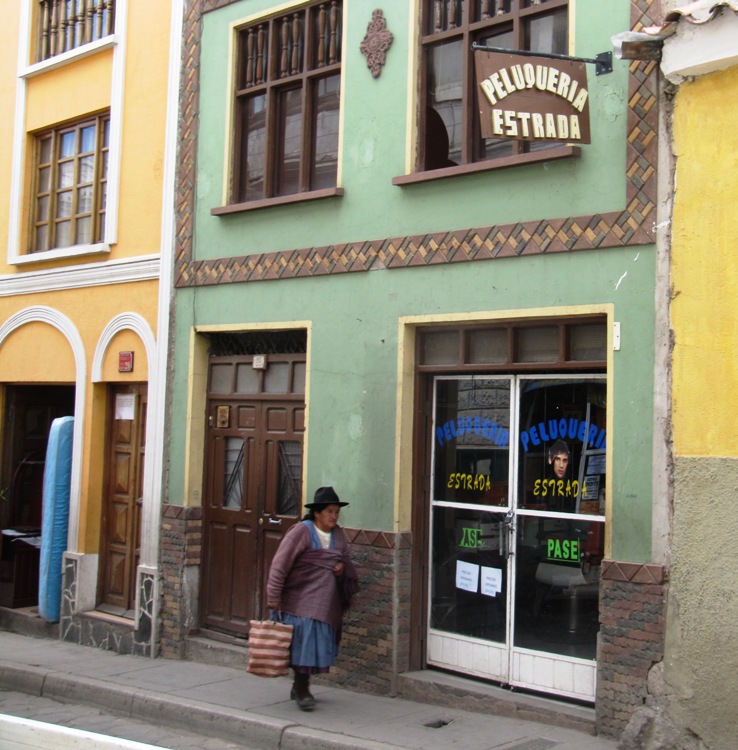
Barbershop in Potosí

I too needed enlightenment and getting a haircut seemed to be the easiest way to lighten the weight on my shoulders.  I had been scared to get a haircut for many months because Argentine men have notoriously horrible hair styles.  Throughout our travels we saw multiple rat-tails, lobster-tails and mullets and I refused to pay for something so wrong.  In Potosí I found a nice shop, but I still shook my head vehemently when the barber pointed at a poster of boys with mohawks, fauxhawks and bowl cuts.
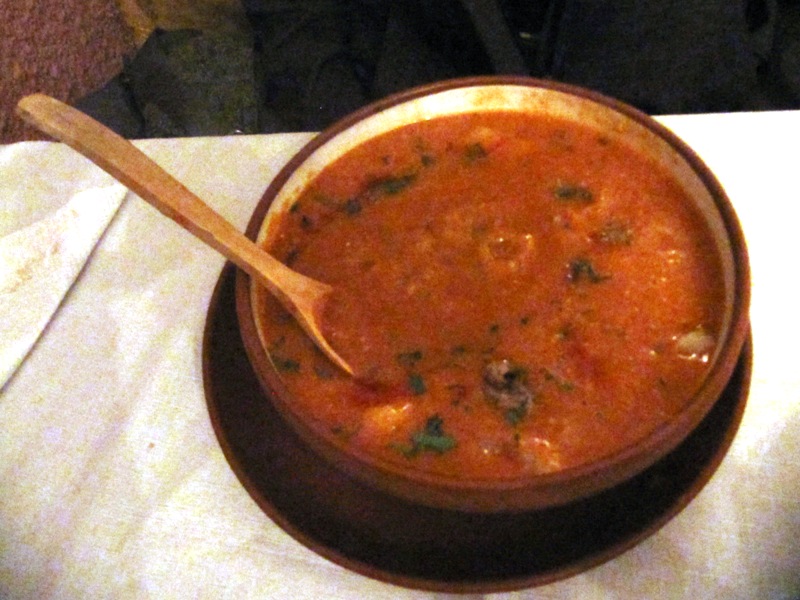
Kala purca at Puka Wasi restaurant

With my ears lowered we were in search of some food.  We found a great little restaurant with some local quechua favorites.  Kala purca is a local stew of meat and potatoes that arrives with a scalding volcanic rock bubbling and gurgling in the bowl.  Another night we found a street side snack of lomito and milanesa sandwiches cooked out of tiny stalls.  Each sandwich was doused with an array of sauces, topped with fries and spicy salsa.
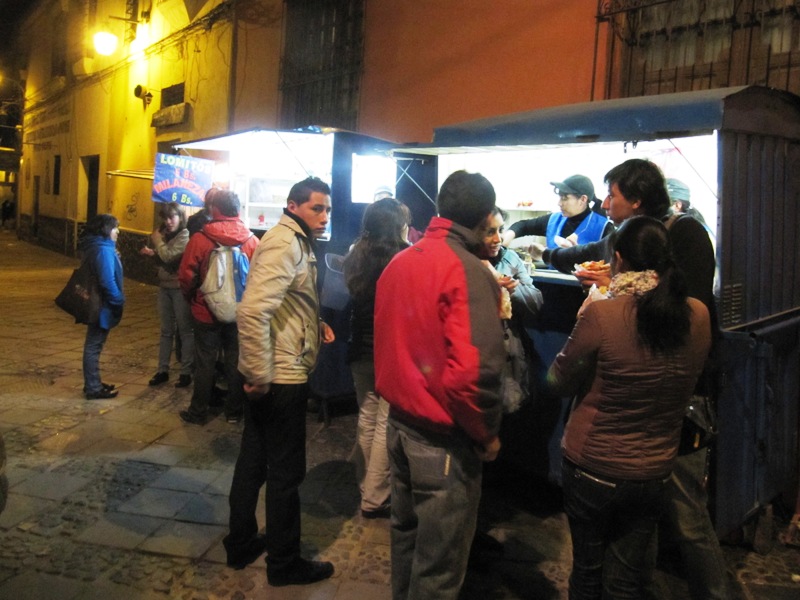
Street food in Potosí

Potosí is a charming colonial city.  Carmen and I loved the historic architecture and the rich culture throughout the city.  From this one city, we were gaining an understanding of how Bolivia’s history affects its present.
Salar + me + u = Jumping Photos – Day 4 (by Nathan)

4am – BEEP BEEP BEEP

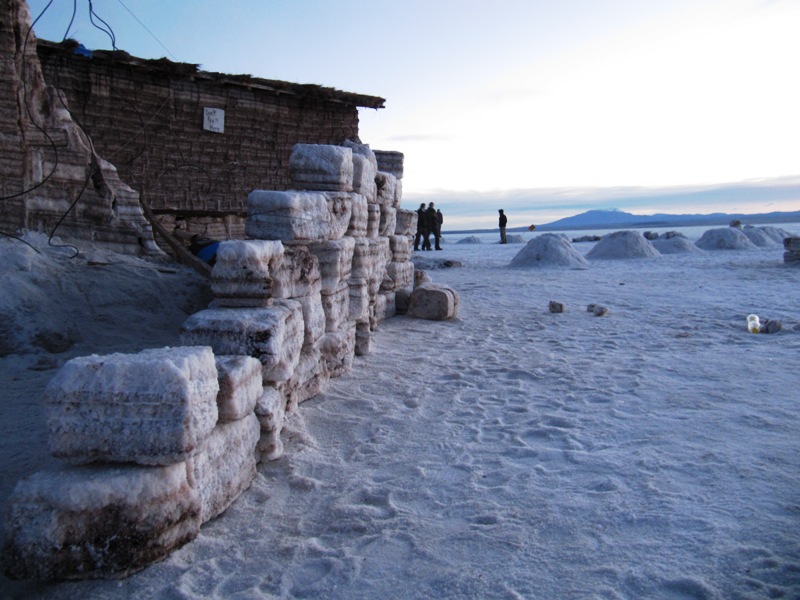
We rush to get our stuff together, we grab our jackets, the tripod and the camera...today we are going to the salt flat.  Bolivia has the biggest dried salt lake in the world – the Salar de Uyuni.  The salt lake is so big that it contains more than 60% of the worlds lithium and covers about 4100 sq.mi. (the equivalent of 10 NYC’s).  Our jeep drives right onto the salt flat and in no time we are speeding along in the darkness with a destination that none of us can see.

Salt hotel made from salt blocks

We arrive at a hotel de sal which is a salt made building in the middle of the flat.  We had breakfast of bread jam and mate de coca while sitting on salt-carved tables and stools.

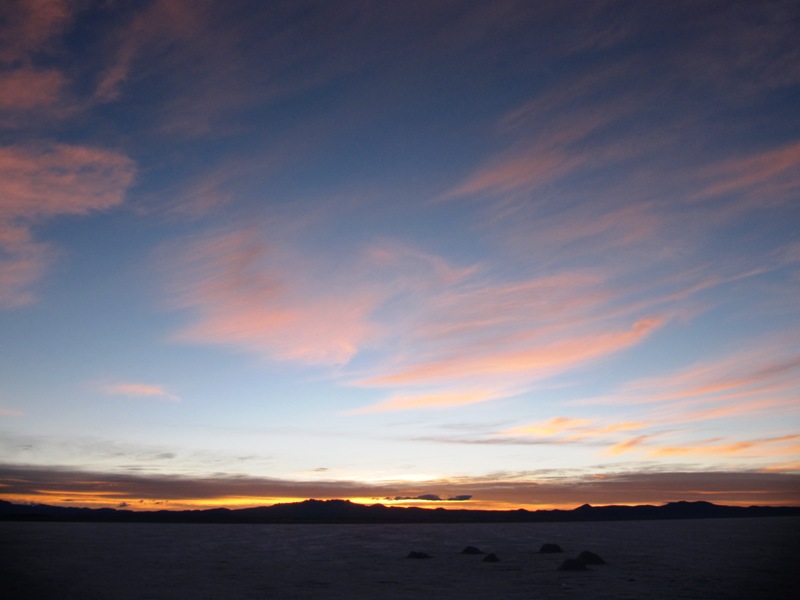
Sunrise over the salt flat

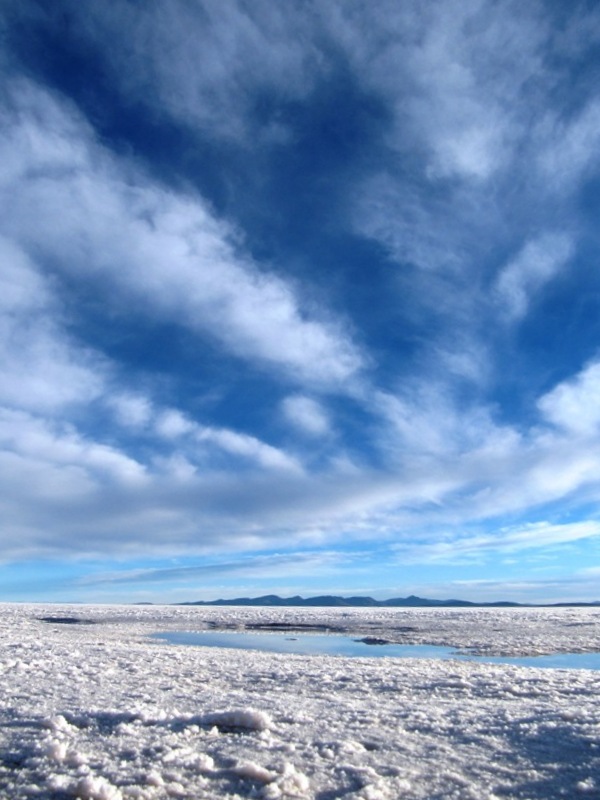
The sun slowly crept to the horizon and filled the sky with bright pinks and orange. Gradually the golden light crept to our feet revealing a flat expanse of solid white.  We had to convince our minds that it was in fact salt because the coldness and bleakness of the salar tricks the mind that it is snow.

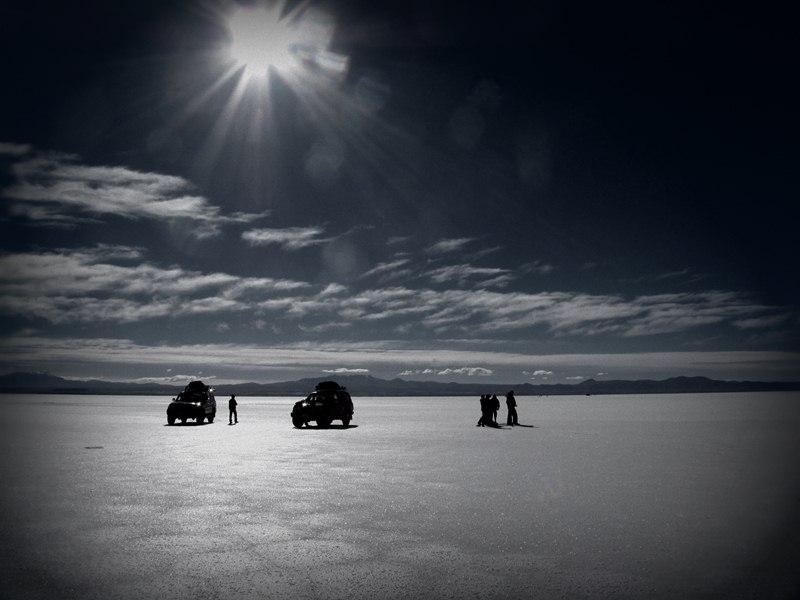
Jeep silhouettes

Carmen and I practising our jump kicks

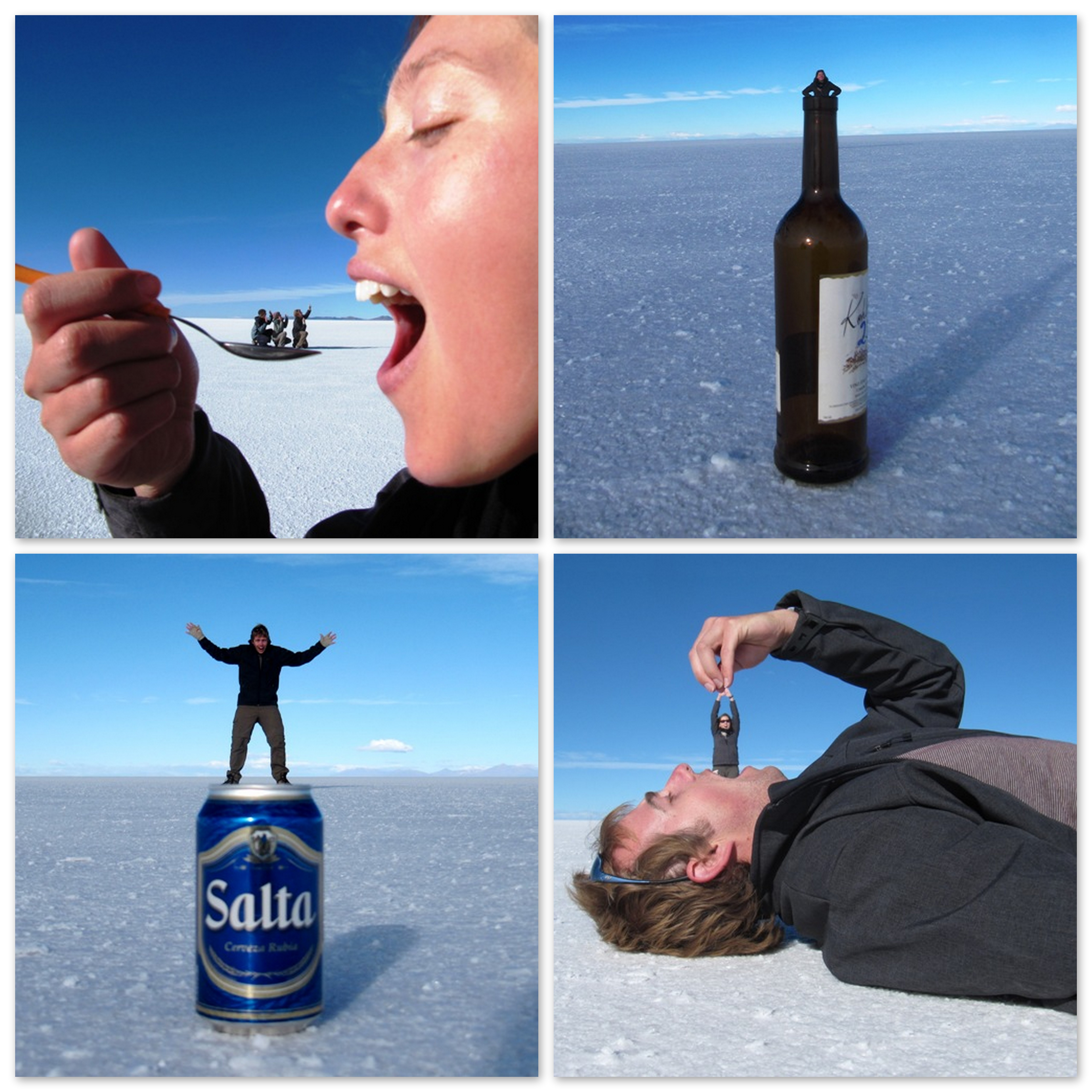
And then the jumping photos began… The reason for this?  When else will we be in an environment surrounded by flat white with the visual effects of high-flying kicks?

Fun with food

We also had quite a bit of fun playing with some beer cans and bottles.  We did our best to remember the Honey I Shrunk The Kids movie infused with a little imagination of our own.

It came down to a showdown between the couples: Carmen and I won!

One, two three! Ready, squat jump! were words repeated over and over again and with each leap a medley of laughter as each of us tried to time the best karate kick and jump into the air. Finally it came down to a competition between the couples.  Mark, Sally, Silvio and Mila had impressive jumps, Matteo and Gosia had the height, but could not synchronize after fifty or so jumps, but in the end it was Carmen and I that had the best leap (note: if any of you disagree, send me the photo and we’ll have a vote.)!

Jeep tour friends

Group jump shot

And there were group shots, many many group shots, leaving us all out of breath and our jumping legs throbbing.

Walking from a wine bottle

We attempted to walk out of wine bottles, or being blown from hair dryers, or even squished by a shoe.  All in all it was a morning filled with laughs and fun with our friends.

Salt cones in preparation for harvesting

Exhausted, we made our way from the salt flat.  On the outer edges the people harvest the salt into large cones for drying then refining.

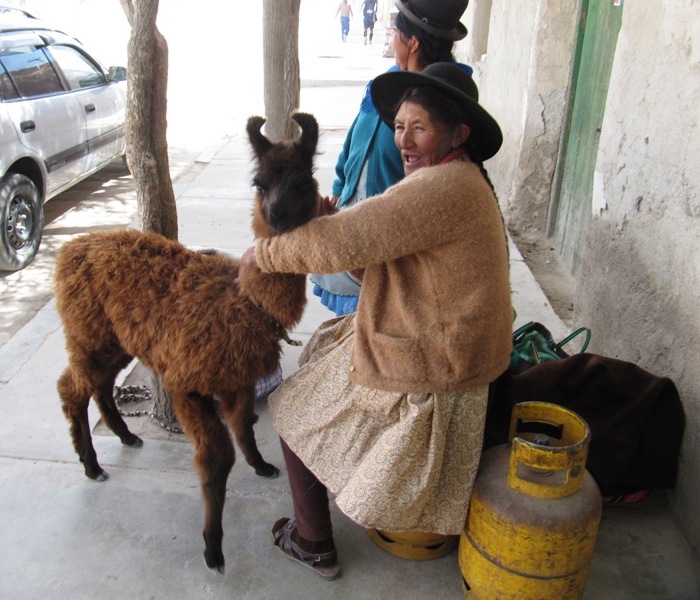
Traditional woman and baby llama in Uyuni

In Uyuni we scheduled a bus for Potosí.  We were rushing to get to the bus when we were stopped in our tracks by the cutest baby llama.  The woman attempted to hold it down for me, but it was quite restless.

We clamber onto the bus and shove our packs between our legs.  Our bodies were exhausted form the repetitive jumping, and our minds overloaded and jaded from the amazing views.  The grandeur and magic of the scenery of the last 4 days was sensational.  There were carved surreal landscapes, painted lagoons, expansive canyons and colors, vibrant colors that I did not imagine were possible at a large natural scale.  Looking back on it, I have a hard time fathoming all the wondrous beauty that we saw.  A Salar de Uyuni trek should be on everyone’s South American itinerary!

Brilliant blue skies

Our bus bounced along the roadway, jiggling and rattling its way up the mountain dirt roads.  Only the main streets are paved.  The vibrations are quite soothing, but the bus continues to acquire more and more people.  Within the first hour our the entire aisle has also filled with people scrambling to hold on as the driver twists and turns the bus at each corner.  A woman next to us held a plump baby with a shawl wrapped around her back.  On her front, several other bags hung from her shoulders; her one free hand clawed at doorjamb for stability.  After a couple hours the baby became restless.  I offered for her to lean the baby on my backpack that was on my lap, instead she passed me the chubby baby. We giggled and made faces at each other for the next hour.  I attempting to entertain it with the few items that I had accessible, but my red water bottle did not have much success for long.  She was a cute little thing and I escaped with minor droolage.

I was asleep seconds after passing the baby back, my head swayed from side to side as we climbed into even higher mountains.  When awoken at my new destination, it was me that had been drooling.

4 Wheelin’ El Parque – Day 3 (by Nathan)

Laguna Colorada

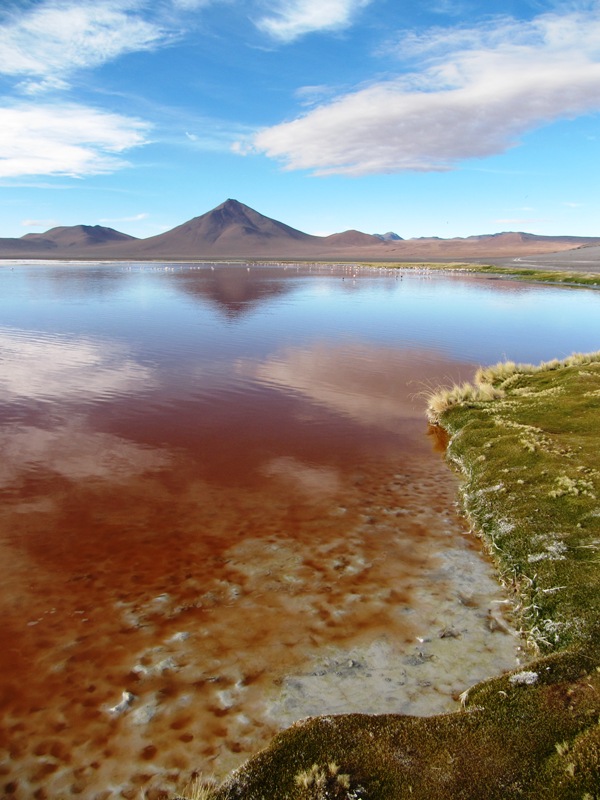
The next morning was cold…real cold, but it was expected when sleeping at 4500m (14,800ft).  We bundled into the jeep at sunrise and we were off to a whole new set of destinations and jaw-dropping sights.  The name of the park that we have been exploring for the last few days is called Eduardo Avaroa Andean Fauna National Reserve.  The park is one of the most visited sights in Bolivia and it contains some of the most beautiful, color-rich and grand natural earth formations on the planet.  The laguna colorada was one of the most impressive thus far.  This small lake contains all sorts of minerals, mostly borax, but it is the red algae that really flourishes here.  The water was still and the air cold allowing for a hazy reflection of triangular mountains beyond.

Arbol de piedra

Carmen and I climbing on the rocks

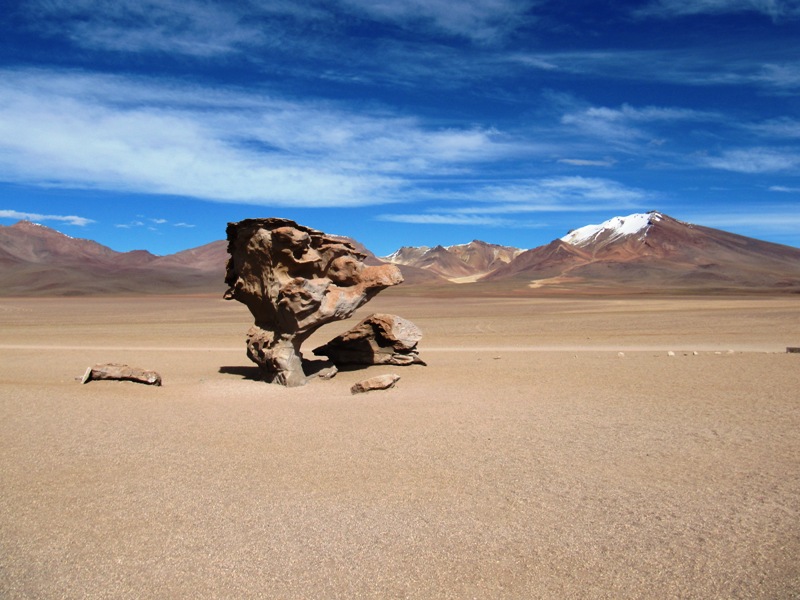
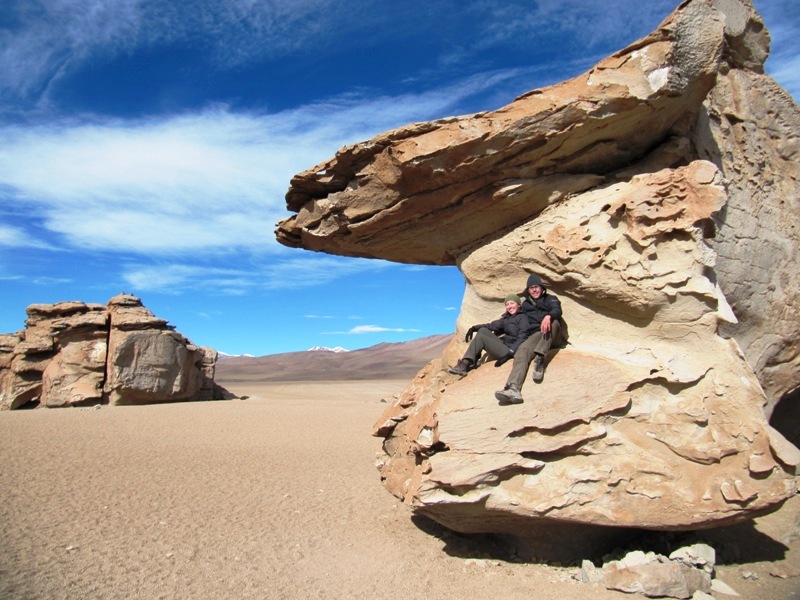
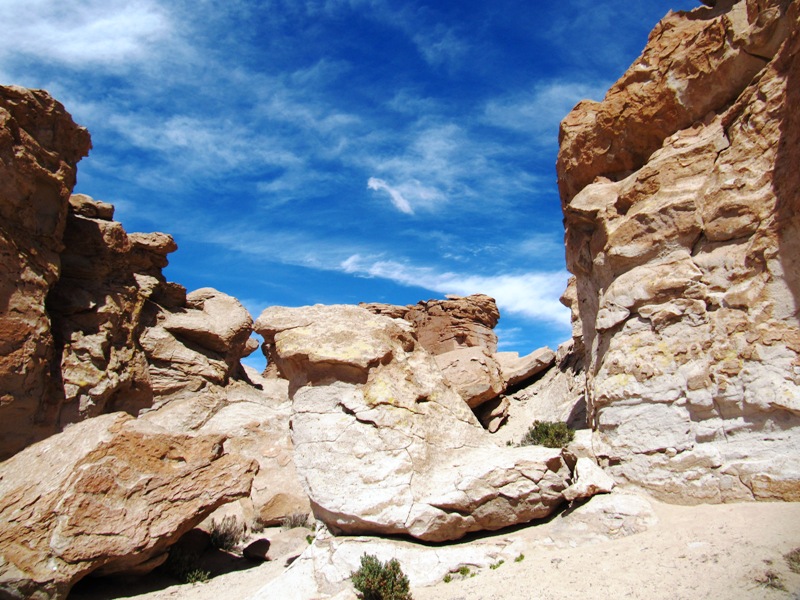
Further along the drastic landscape was a bleak desert surrounded by colorful volcanic mountains.  We stopped at a rock forest with hundreds of angular and twisted formations that are remnants from the last eruption many thousands of years ago.  The most famous is the arbol de piedra, but we had great fun just climbing around all the enormous rocks.

Laguna Honda

Flamingos at Laguna Hedionda

We romped through the mountains climbing an occasional mountain and blazing our way through the highland deserts.  The next stop was a series of five lagoons that the flamingos use a breeding sancuary.  I never realized that these birds enjoyed high altitudes.

Landcruser crossing a river

There were times that the terrain became pretty rough and it was nice to have a guide that had been driving these roads and trails for 15 years.

Montaña de siete colores

The landscape throughout the day was mesmerizing.  Everywhere we looked was an beautiful snow-capped volcano, a colorful mountain, bright blue skies, multiple lagoons and thousands of llamas.

Valle de rocas

Tailgate lunch at valle de rocas

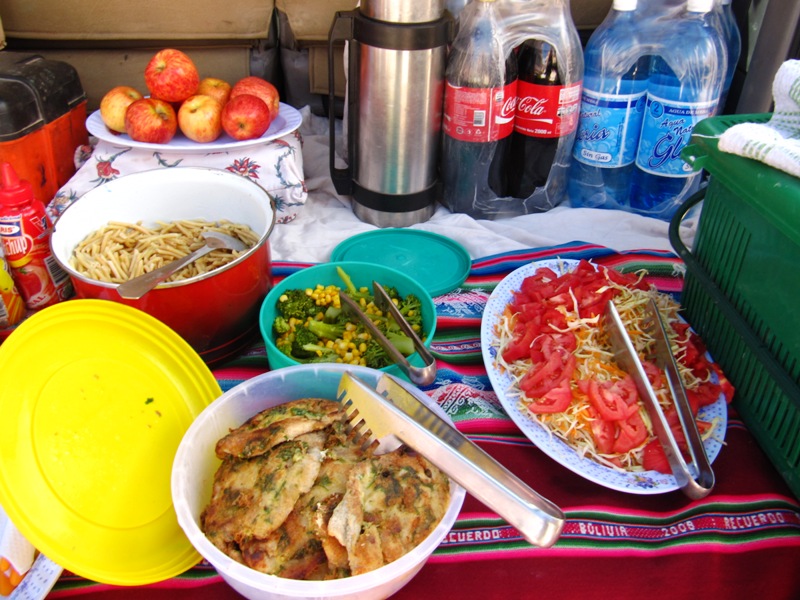
Our jeep caravan included an amazing Bolivian woman that cooked for us.  While we played around at the valle de rocas she whipped together an delicious meal of chicken milanesa, noodles and salad.  Of course it was served with the only drink that South Americans seem to know: coca cola.

Friends at the cemetario de trenes

Evening approached quickly, but we did have time to explore the cemetario de trenes just outside of Uyuni.  There used to be reliable and functional train traffic in Bolivia.  In the 1940′ hundreds of train cars and engines were abandoned due to rapidly depleting mining resources.  Now it is just a heap of rusted metal, surrounded by fields of endless trash, nevertheless it made for a good photo opportunity with friends.

That night we prepped ourselves for what was going to be the saltiest day of our lives.

Tupiza & Salar de Uyuni 4×4 Adventure – Days 1&2 (by Carmen)

I didn’t really know what the 4 day Salar de Uyuni tour really entailed but I was looking forward to it nonetheless.  I had seen a picture of one of the tour sights – the salar (salt flats) that looks like you are sourrounded by endless snow but it is actually salt.  This was enough for me to build it into our itinerary.  Fortunately, Nathan trusted my gut on this one.

Quebrada de Palala outside of Tupiza

As we got closer to Bolivia we met more and more travellers who had positive experiences.  A range of superlatives were used to describe the scenery: “beautiful”, “spectacular”, “surreal”, “the best”.  So we hopped in a jeep with Mark and Sally, the English couple we had met in Cafayate, and were on our way.  An our outside of Tupiza and we already had our first breath-taking view.

Adorable llamas were everywhere

Onwards we climbed up to the altiplano (high plateau).  Our excellent driver, Idel, was happy to inform us about the flora and the fauna. The flora mainly consists of sturdy clumps of grass which were fed on by the llamas and the vicuñas. The llamas were adorable all dressed up with colourful ribbons in their ears.  This was how the owners identified their herds.

Wild vicuñas

The vicuñas, on the other hand, are smaller and wild.  They are a protected species so they don’t have ownsers. But once a year the local community rounds them up to shear their extremely valuable wool.  The $400 a pound profits are shared collectively.

Multi-purpose clothes line with llama jerky

Tiny settlements dot the mountain landscape.  They are hard to spot as the mud brick homes blend in with the earth. We stopped in one and saw how their clotheslines were multi-purpose.

Snowy mountain in view from the first nights lodging

The next town over we spend the night, surrounded by dramatic mountain scenery.  The stars were beatuficul but it was too cold to observe for long.  Instead we retreated to our own beds which had 3 heavy blankets on them.

Ruins of San Antonio and viscacha

The next morning we travelled a short distance to a set of Spanish ruins.  The Spanish had settled there in the 16th century because of a nearby silver mine.  They essentially enslaved thousands of indigenous people to work there.  The town had a reputation for having too much money, making people greedy and wasteful.  When an epidemic decimated the population, the town never recovered.  With the silver dried up and the buildings in decay, the last residents left 20 years ago.  Now, the crumbled homes are inhabited by cute, rabbit like animals called viscasha.

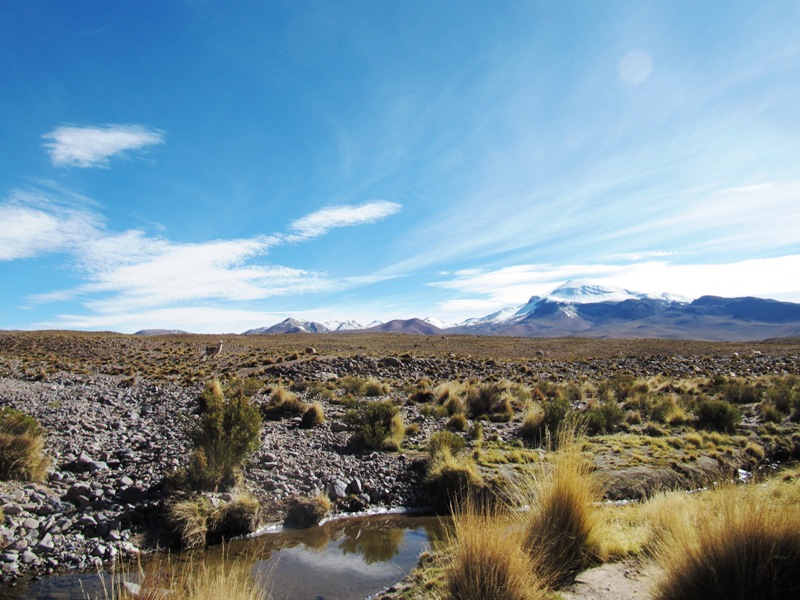
Creek with llama

The ruins were followed, of course, by more drastic scenery and more llamas!

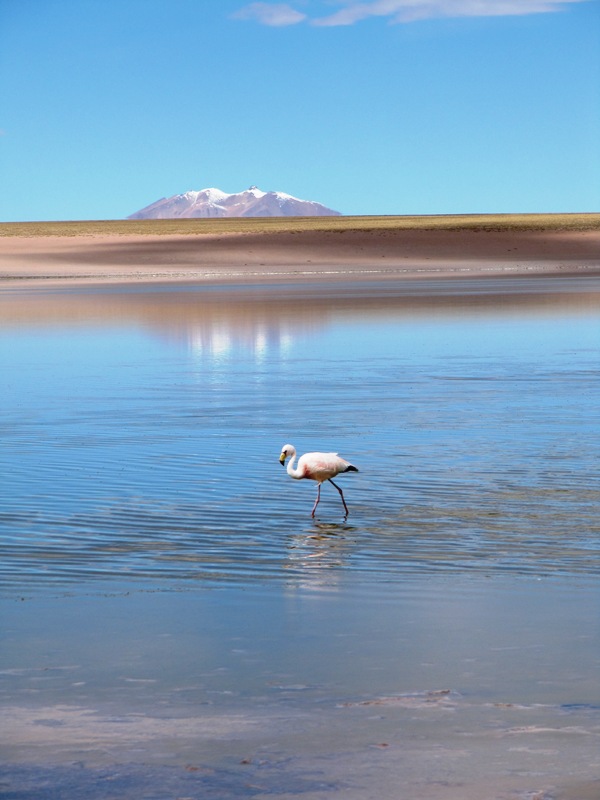
Flamingo posing for us at Laguna Morejón

And then a new animal entered the scene – flamingos.  I had always thought of these pink and black birds balanced upon spindly legs as a Caribbean creature. But these flamingos like it rough, toughing out the cold and wind of the Bolivian highlands above 12,000ft.

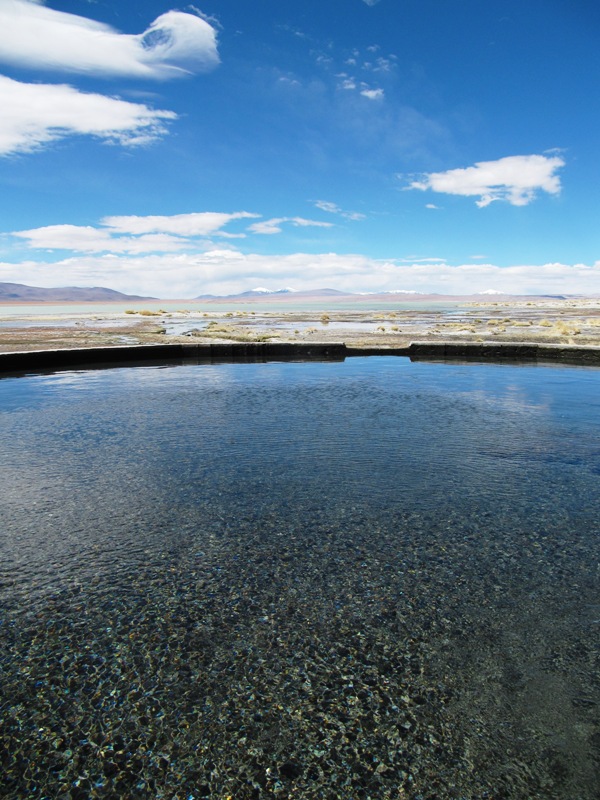
Chalviri hotsprings

I don’t like it so rough.  At the next stop Nathan and I took a dip in the soothing natural thermal pool.  It was the perfect temperature and had perfect views to boot.

Yummy lunch outside the thermal pool

All warm and toasty from our bath we headed into a dining hall for a delicious beef stew lunch.  I haven’t mentioned yet but there was another jeep in our group.  That made 8 of us total.  It was quite an international crowd: 2 Americans (us), 2 Brits (Mark and Sally), 3 Italians (Matteo, M, S) and 1 Pole (Gossia). It made all our meals very convivial.

Jeeps, hills and new friends Mark and Sally

Dalí desert

But there was yet more to see.  We drove through the Dalí Desert named for the surrealist painter.  I’d say it was an apt reference, especially with the brushstroke clouds painted in the sky.

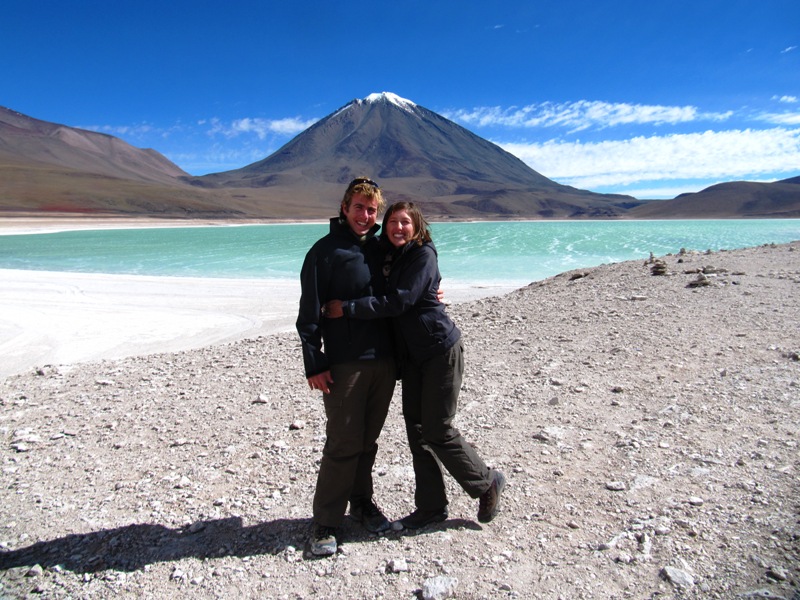
Us at the Laguna Verde

Then we hit the Laguna Verde, named for the green color produced by minerals such as arsenic.

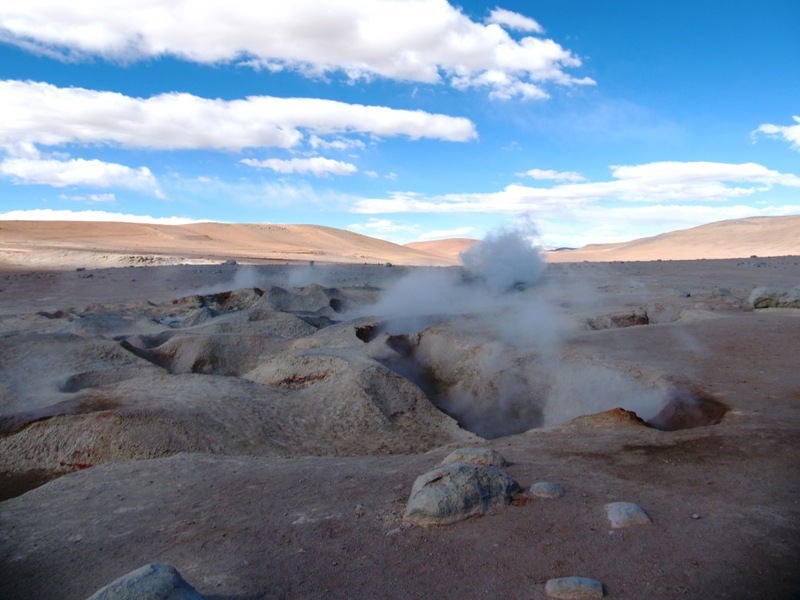
Sol de Mañana Geysers

Finally, we made it to the geothermic area called Sol de Mañana.  Here the heat of the earth escaped through bubbling mud pools and steaming geysers.  One steam spout was so powerful it almost seemed to whistle like a kettle on the stove.  It was a long and happy couple of days, and the tour was only half over!

Cowboy Up in Tupiza (by Nathan)

Entering Bolivia in many ways feels like a step back in time. Determining what decade we landed in can be a challenge. Many women dress in a traditional pleated skirt, sweater, colorful shawl and a bowler hat.  The cars spew out thick black smoke, coughing their way to each destination. The great canyons, saddled horses, and lawless feeling of it all appears like we entered some modern wild west.

Carmen & horse in Tupiza canyon

The first challenge for any American is getting across the Bolivian border. It is such a pain to travel as an American in South America because almost every country has charged us $140 each as a reciprocity fee.  I guess Bolivia was a deal because they only wanted$135 each in pristine bills.

Now here is the catch, no one has dollars.  Carmen and I searched Argentina and in Salta they wanted dollars but would not give them.  So we arrived to the border at La Quiaca with only $60 and some Argentine pesos to exchange.  The casas de cambio are a huge rip off with a 20% exchange loss.  And out of the 15 we asked only one had dollars.  To our great luck in Villazon we found a cash machine at the far end of the main plaza that gave dollars.  We pulled $200, exchanged for $10 more and we had our $270.

We returned to the Visa window and we have it all: application, new passport photos, yellow fever proof and the money.  As we discussed our application, the armed guard keeps grabbing at our money saying he needs to examine the bills.  We suspected this to be some scam where the guard slips a few twenties away telling us we miscounted or switches them out with fakes.  We do our best to ignore him and the subtly unbuttoned gun on his hip.  We tell him to go away and not to touch our money because we are dealing with the other officer behind the glass.

Somehow this works!  The officer inside counts the bills then two more military outfitted men enter and they too count the dollars.  The third man scrutinizes every bill.  He scratched at them, examined the watermarks and analyzed every edge and detail of every bill.  He rejected $60 showing us the tiny ink dot and 1mm rip are not acceptable. There is major arguing back and forth and we are able to convince them to take the rest in bolivianos with an extra 10 boliviano fee.  So much in Bolivia can be handled with an extra 10 bolivianos.

Welcome to Bolivia

Our mistake was that they then took our money and passports into a closed room we could not see.  I expected them to return and ask us to pay again. We waited for 15 minutes which felt like an eternity.  Then the three returned with our passports and a colorful new sticker. Whew…finally we can legally enter Bolivia. Still a bit cautious and shaken up we slowly walk across the border from La Quiaca to Villazon.

The next task was to find the bus terminal for tickets to Tupiza.  The bus station more or less found us.  As we approached, dozens of agents shouted at us “Tupiza! La Paz! Uyuni!” hoping to cram us into their collectivo van.  The bus vendors were no different – aggressive and pushy for a sale. We found a bus company that was leaving in ten minutes so we bought a ticket that cost $2 USD for the three hour journey.

Pollo con picante street food

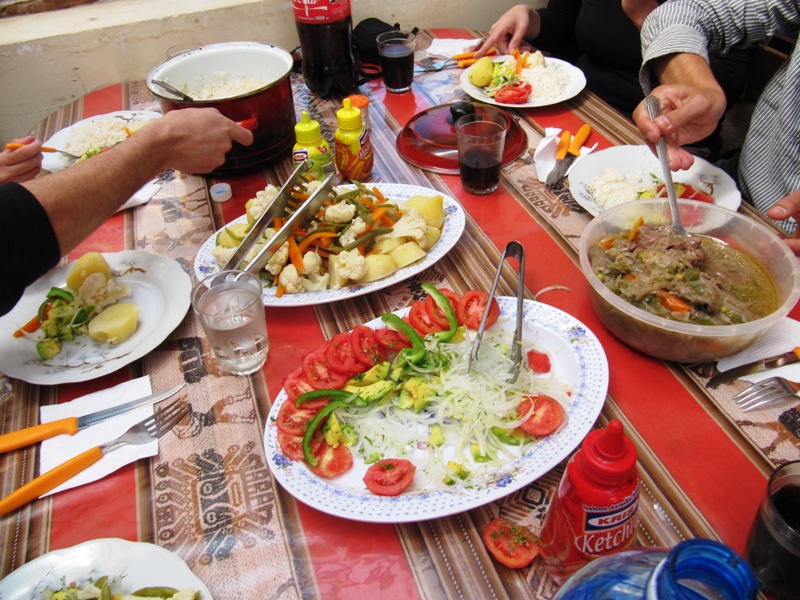
We worked up quite the appetite and our throbbing stomach acted us a compass guiding us to the stalls behind the bus station. We found a nice round lady with two shiny teeth and a big smile.  She had stewed up some chicken and potatoes over noodles and there was some purple mushy stuff which we think was some other type of potato salad. We ordered two and watched her scoop mounds of slop with her bare hands into plastic containers.  We were worried by this, but also very hungry. Our consumption of this food is more of a performance. Five or six dogs gathered around us with patient interest.  With speed and grace we shoveled the food into our mouths. A shot of whiskey each is the best anti-sick medicine we have.  Two swigs and thankfully we didn’t get sick.

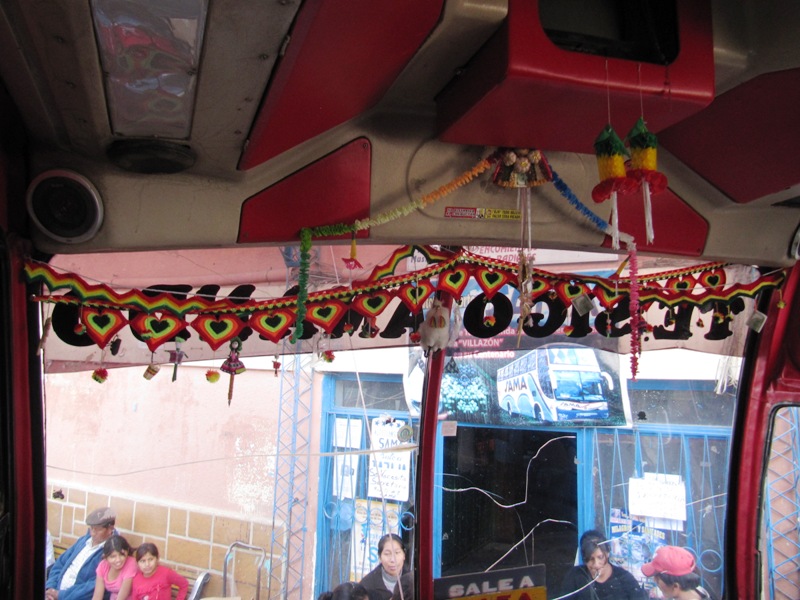
An hour of waiting and another gringa informs us that we should have adjusted our watches.  The bus is right on time.  We load into the bus, we shove our packs between our legs, and we leave. The three hours bounce by as we sped through paved and unpaved highways.  Carmen and I enjoyed the colorfully decorated windshield with swaying llamas, people ornaments and wooden flutes.

Bus decorations

Midway through our journey there is a commotion of conversation moving through the center of the bus.  The traditionally dressed women next to us are shaking their heads and repeating “shame”, “thief” and “I didn’t know”. We don’t find out the whole story until we get to Tupiza. When we are boarding the bus in Villazon an official looking man boarded and asked the other gringos to put their hand luggage in the overhead.  The man put the items above them then moved down the isle. With each placement of a new bag he pulled their stuff to the back.  Mid-bus ride they found their bags not above them but behind and open, with cameras gone.  Carmen and I escaped with luck.

Tupiza city

Tupiza is a cute city with its own set of majestic canyons.  We staged Tupiza as a transition to southern Bolivia and a point of embarkation to the four day national park and Salar de Uyuni 4×4 trek.  We took some time to enjoy the red cliffs and since we were in the wild west we needed horses.

Carmen and I as cowboys

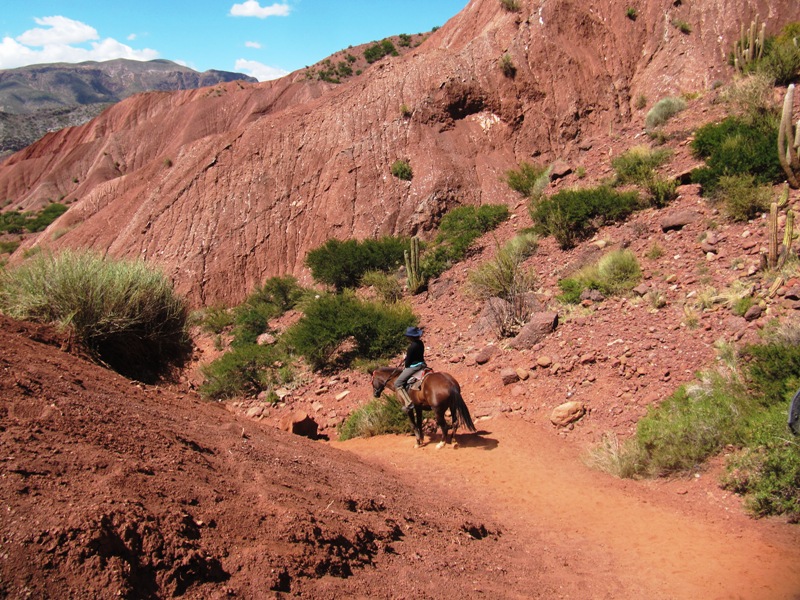
Bolivia is enjoyably inexpensive. Our horse ride for three hours cost about $15 each, lunch or dinner is about $2 to $5 and transit is a quarter of the cost of Argentina. We were outfitted with leather chaps, a cowboy hat and some mellow horses named Negra and Linda.  In single file we trotted deep into the canyon.

Red canyon

Red canyon

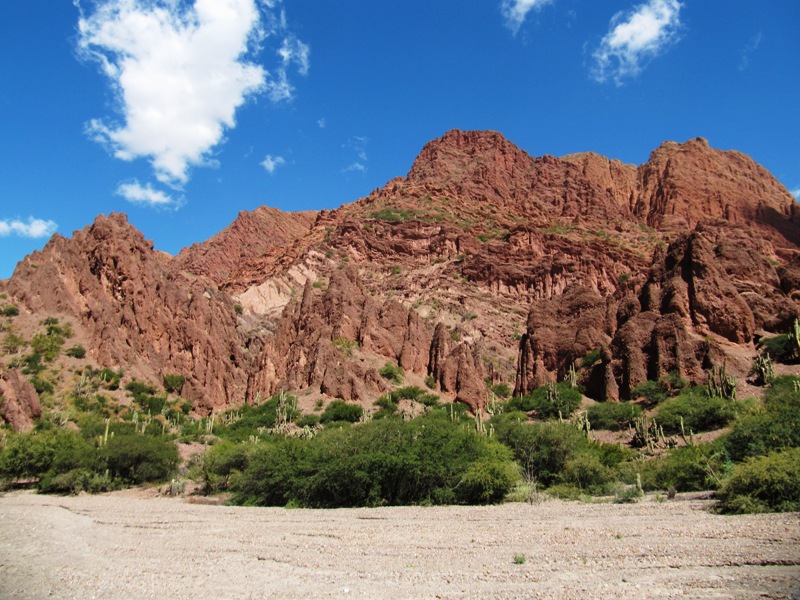
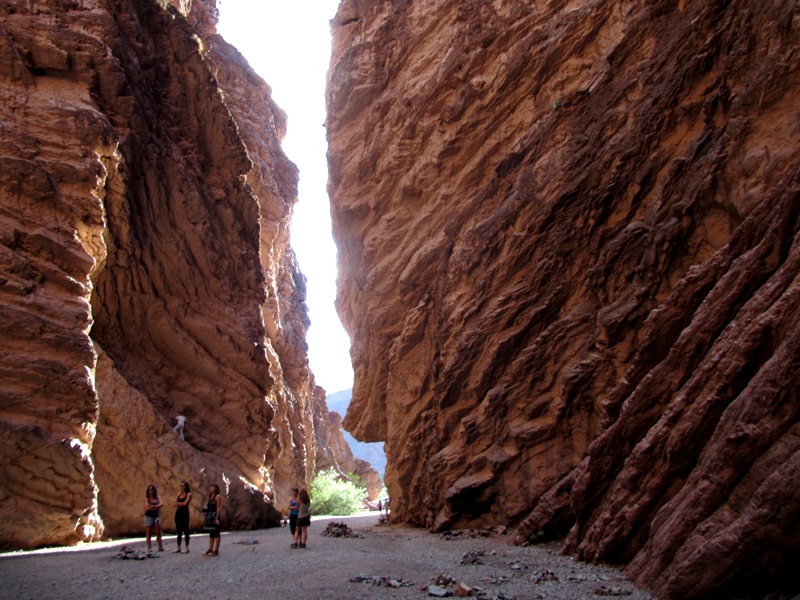
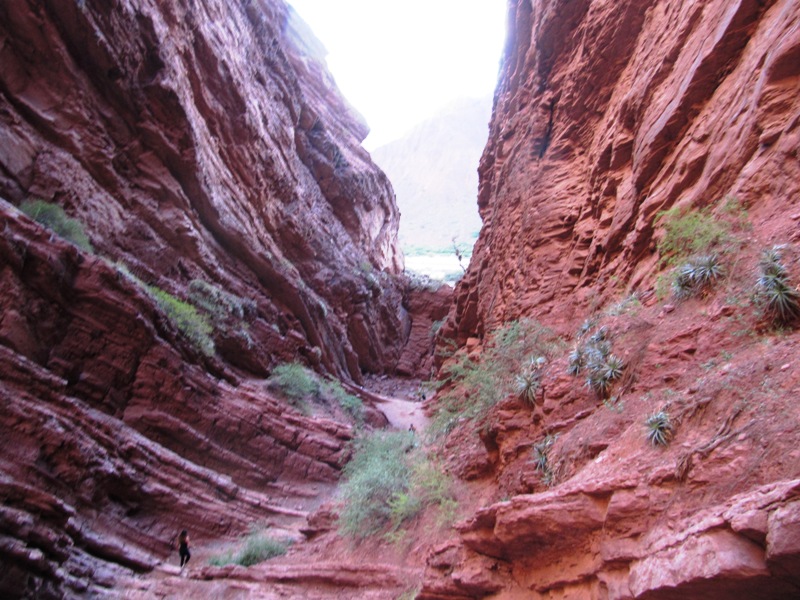
The colors and textures were new and exciting.  The reds were deeper and more pronounced than Cafayate and the formations more grand mountains than individual rocks.  The quebrada de inca starts as two wide cliffs that quickly narrow into a tight slot canyon that used to be an actual transportation path.  Our horses slowly walked along the trails they had memorized.  My horse was not particularly fond of me because I would insist we stop to take a photo then we galloped to join the group.

Tupiza food market

Arriving back at the ranch we strolled a little bow legged back into town.  On our way we found a market.  Supposedly there are thousands of varieties of potatoes across Bolivia and Peru.  Here we found at least fifty along with many other tasty looking veggies.

Tupiza allowed us to forget the hassles at the border and enjoy the mellow sense of time amid the carved landscape.  We traded in our horses, climbed aboard a jeep and began the off-road trip of a lifetime.

Hop, Skip and a Jump through Salta and Humahuaca (by Carmen)

Historic Cabildo building

We had two more towns scheduled for Argentina before arriving in Bolivia.  First we hopped to Salta. I’ll admit I had high expectations for Salta and for this I blame House Hunters International.  This is one of my favorite TV shows though I only catch it occasionally on my parents’ cable. The basic formula is this: a person/couple/family is moving abroad, they walk through 3 homes each with advantages with disadvantages, and then there is the suspense of guessing which one they choose!  I just love seeing how people live in other countries. Before the trip I caught an episode on Salta. The family moving there had been traveling for a year looking for a new place to call home and this is where they moved.

Colorful Church

I stepped off the bus expecting to be charmed.  Instead, on our walk to the hostel we encountered stagnant rain puddles and constant cars shoving their way through intersections without signals or stop signs. Overall, we were not too impressed. We eventually found the pleasant bits: a café lined central square, ornate churches, a bustling market where we drank beer while watching a futbol game.   The city started to grown on me but nothing enticed us to stay too long so we skipped on to Humahuaca.

Street in Humahuaca

Humahuaca is a tiny town in a huge canyon of the same name.  The town is cute but a little tourist ready so we spent our afternoon there exploring the surrounding nature.

Striped Humuhuaca hillside

Just 30 minutes from town and we were on a cliff overlook observing the striations of red and white.

Tortilla española de C&N

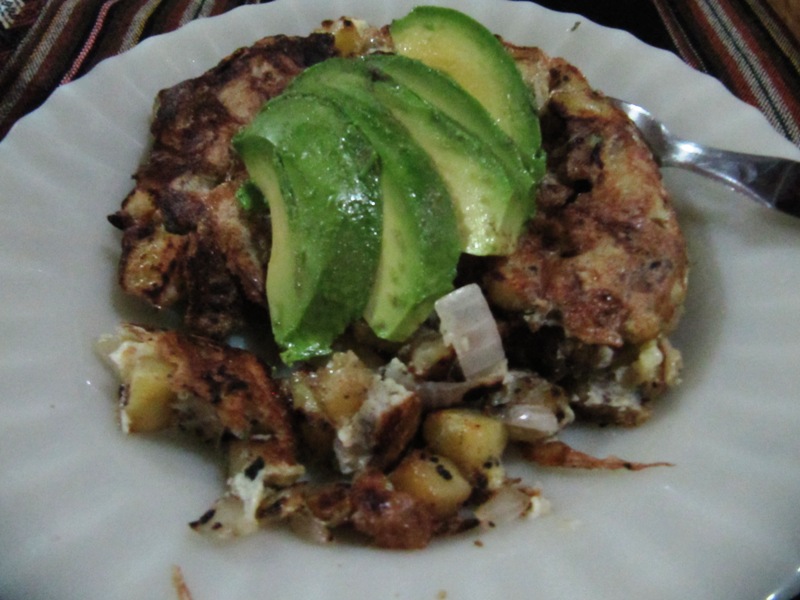
Back at the hostel we cooked up an easy traveler’s dish – tortilla española.  Basically, this is an omelet with thinly sliced fried potatoes and onions. We topped it with avocado, paired it with wine and were good to go!  While cooking our meal it was fun to rub elbows (literally) with other travelers in the tiny kitchen.  We swapped stories of where we’ve been and where we plan to go.

Landscape of Humahuaca Canyon from bus

The next morning we crawled out of our warm beds to catch an early bus to the Bolivian border.  Salta and Humahuaca proved to be enjoyable pit stops before we jumped out of Argentina.

The Colorful Quebrada de Cafayate (by Nathan)

Layered red cliffs

Entering into Cafayate we experienced a drastic change of scenery.  Grass covered hills transitioned to brilliantly red cliffs and cactus filled valleys.  I could not help but be reminded of the drive from Las Vegas to Zion National Park.  The beauty was similar, but exciting and special in its own way.

Las Ventanas

El Fraile

The quebrada (canyon) extends almost 110mi (180km) between Cafayate and Salta.  Every two to three miles and new rock formation emerges from the earth. A series of arches in one area is called las ventanas (the windows).  Another formation resembles a monk in robes and is called fraile (the friar).

Colorful Striations

Desert flowers

The colors and textures of the rock make a feast for the eyes. Striations of copper, sulfur, iron and zinc create rainbows of layered rock along the cliffs.  The desert is home to many spiny plants and animals.  The canyon has a unique microclimate where it only rains a few days a year even though it rained everyday in January and February in Cafayate.

Feeding a llama

Further on we stopped for drinks and a chance to feed llamas.

El Sapo

One of my favorite formations was el sapo (the toad).

El Locomotivo

Another formation is perched on a cliff, el locomotivo (the train).

El Amfiteatro

The grand scale of the canyon is not fully felt or realized until we enter el anfiteatro (the amphitheater). Huge rivers flowed down the mountain side and created this 400ft deep bowl at the base of the waterfall. Plate tectonics have now shifted the mountains and diverged the flow of the river so that the rock formation remains dry.  The cliffs are gorgeous, striped with colors and golden in the sun engulfing us as we stood, taking it all in. The name of this formation comes from the high quality of sound retention.

El Gargantua del Diablo

The next major attraction to the quebrada is gargantua del diablo (devil’s throat). I think it’s funny how names are reused. There has been at least five “mountain of seven colors” and Carmen described another gargantua in Iguazú. This formation is enormous!  Its natural origins are similar to the anfiteatro but contain many levels of red rock and contrasted with perfectly green little trees. We had to do quite a bit of scrambling to get to the main bowl but it was well worth it.

Layered rocks

Two weeks ago, we were entering Mendoza and the bus felt so small in its attempt to cross through the Andes.  The highway to Salta has been a different experience of vibrant colors and imaginative land formations. Goodbye to the Grand Canyon of Argentina.

Cozy Cafayate (by Carmen)

Cafayate enamored us from the beginning. Even on the bus ride into town we were admiring the neat streets and cozy feel of the place.  Like many Argentine towns Cafayate is organized in colonial Spanish grid system with a central square.

Alfajores factory by night

Just off the square was a sweet alfajores factory with traditional flavors such as coconut and chocolate dipped, as well as some unusual ones like lime.

A dozen delicious empanadas

Wood-fired empanada oven

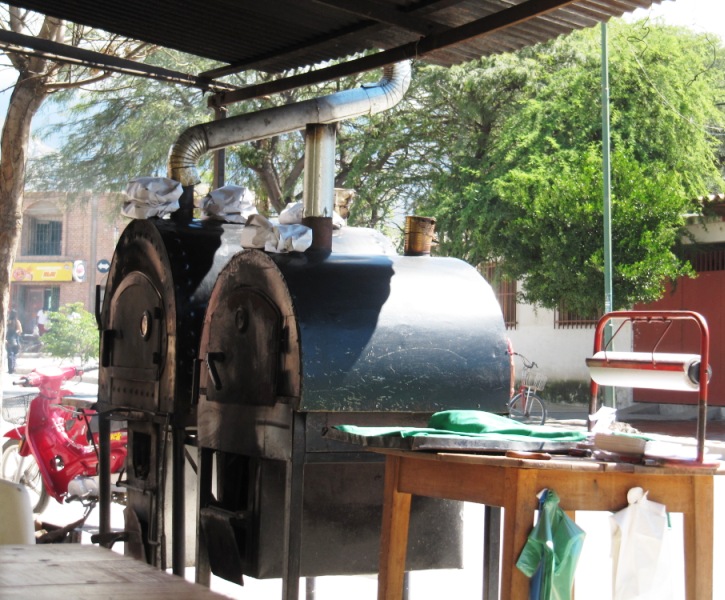
But we could not survive on sweets alone. Across the street from our hostel we were enticed by iron wood-burning ovens puffing smoke.  Inside were trays upon trays of salteñas (empanadas filled with meat, onions, olives and hard-boiled eggs).  We ordered a dozen along with wine and soda water to make a spritzer (very popular in these parts).

Red cliffs and cactus

The next day was Sunday, which in small town Argentina means everything shuts down.  So we decided to go on a hike.  Based on the guidebook and information from the hostel we chose a 4 hour trek to a waterfall deep in a canyon.  We were expecting a moderately difficult but fairly straightforward hike. Of course, it didn’t quite work out that way.

Canyon and creek

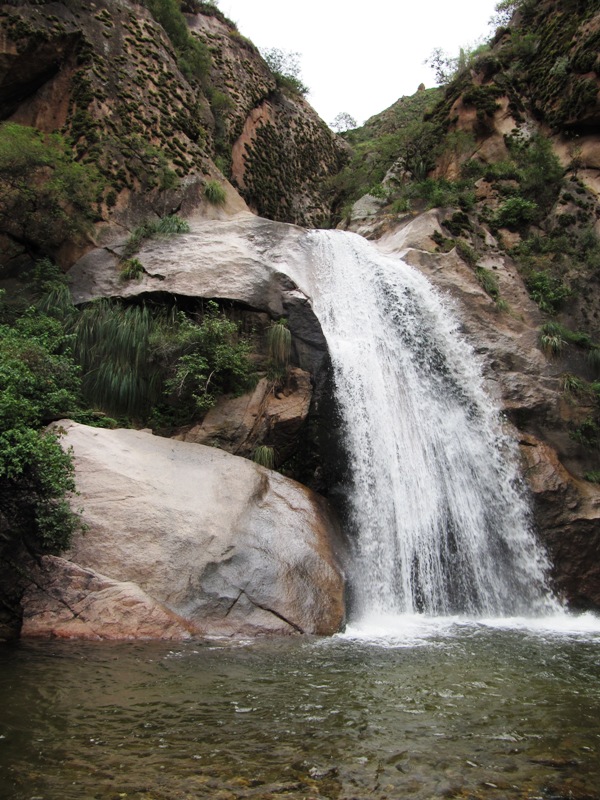
Cafayate waterfall

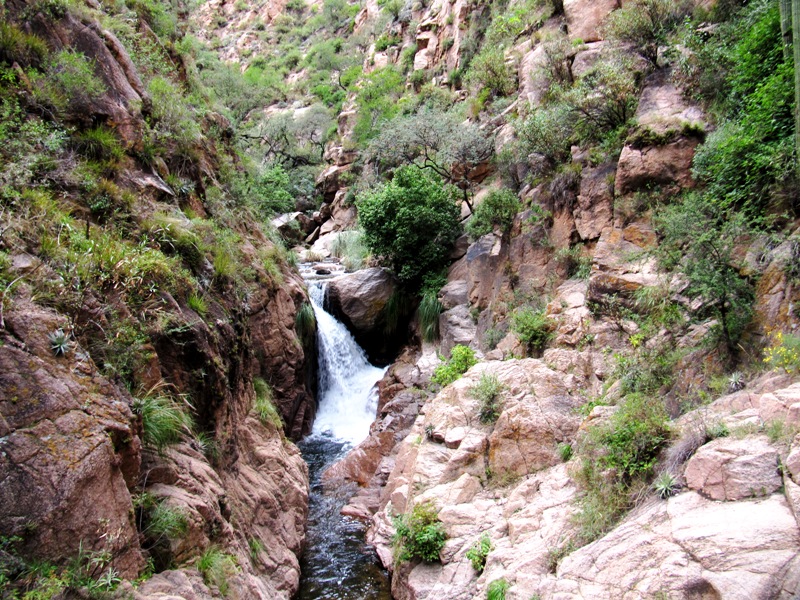
The “trail” was often difficult to find and involved a lot of scrambling up cliffs. The path kept disappearing into the river that carved the canyon.  These were no simple crossings but some of the most difficult I’ve ever encountered.  They stressed me out but Nathan happily skipped from boulder to rock like a pro. (Though he was less happy when I accidently knocked him into the water as he tried to help me cross.  Twice!)  The invisible path, the river crossings, and the lack of any other hikers started to get to me. But with tired muscles and soggy boots we survived the hike, happy to have enjoyed the spectacular scenery.  The waterfall was beautiful, gushing 10 meters into the red rocks below.

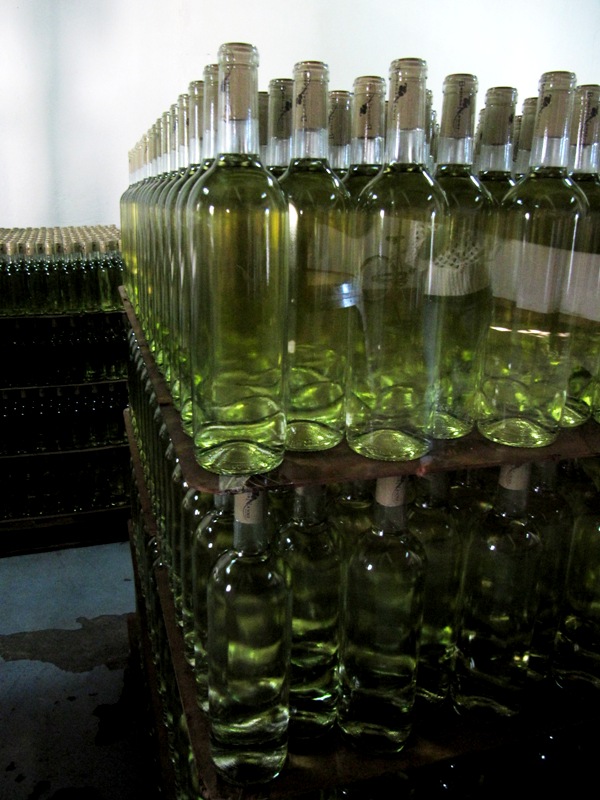
Recently bottled torrontés wine

Ok, time for the real reason we went to Cafayate – wine!  We learned in Mendoza that the white torrontés wine was from here.  But all the northern wineries also produced malbecs and cabernet sauvignons that were more tannic than those in the south. Our favorite winery of Cafayate, Nanni, is actually in the town itself.  It produced crisp torrontés that straddled the balance between sweet and dry.

Bodega de Esteco

Another great bodega was Esteco.  Beautiful setting, delicious wine, wide selection.  But they lost points for offering wines by the glass instead of a tasting.

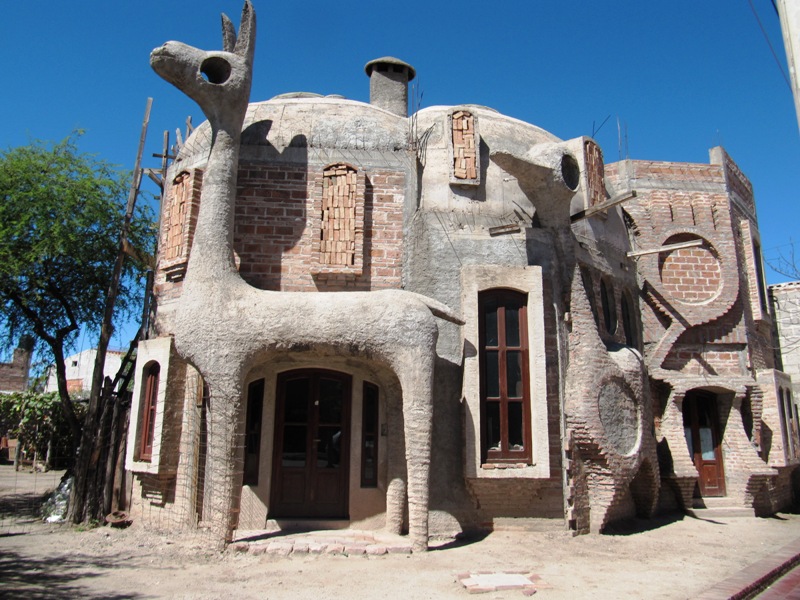
Crazy llama building

There were many more: Finca Las Nubes for its excellent torrontés, El Transito for its rich cab, Domingo Hermanos for its goat cheese.

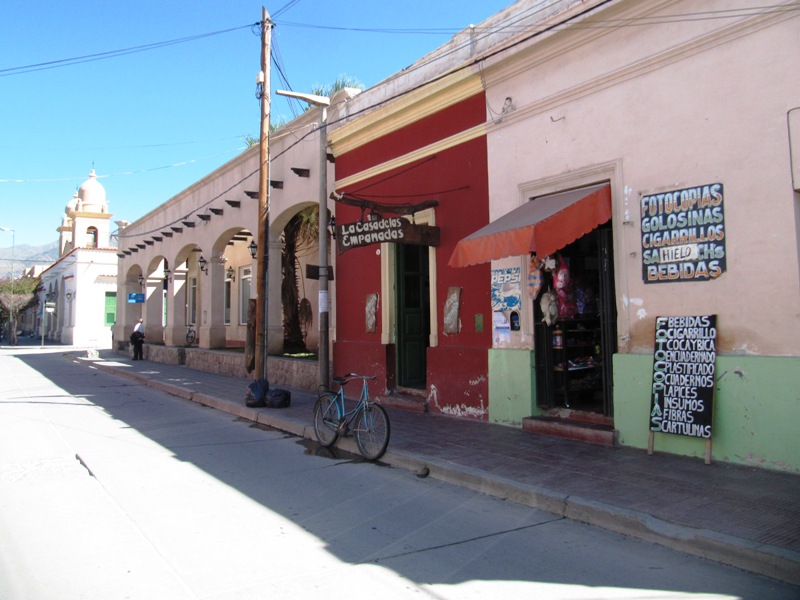
Cafayate typical street

Although we came here primarily to check out the wine scene, we ended up making many new friends.  An Aussie couple we met at a winery, a Swedish pair at an empanada lunch, and an English couple we shared wine and dinner with at the hostel.  Cafayate is just that kind of place.

4 feet 4 paws 3 mouths (by Nathan)

What is it about the companionship of a dog that is so rewarding?  There is of course the loyalty between the animal and the owner and something soft to pet whenever the need.  But there is also the unconditional love between the two.  Chile and Northern Argentina have an abundance of stray dogs.

On a daily basis all types of dogs roam the street, sleeping in plazas, playing in parks and just being happy dogs.  The amazing part is that all of these dogs seem really healthy with shiny fur, seemingly well fed and the most sweet demeanors.   Sometimes they follow you.  The join you in your walk, they frolic along side of you with an occasional nudge or lick.  Then after just minutes or hours the relationship is severed.  This is the story of some of our newest and lost friends.

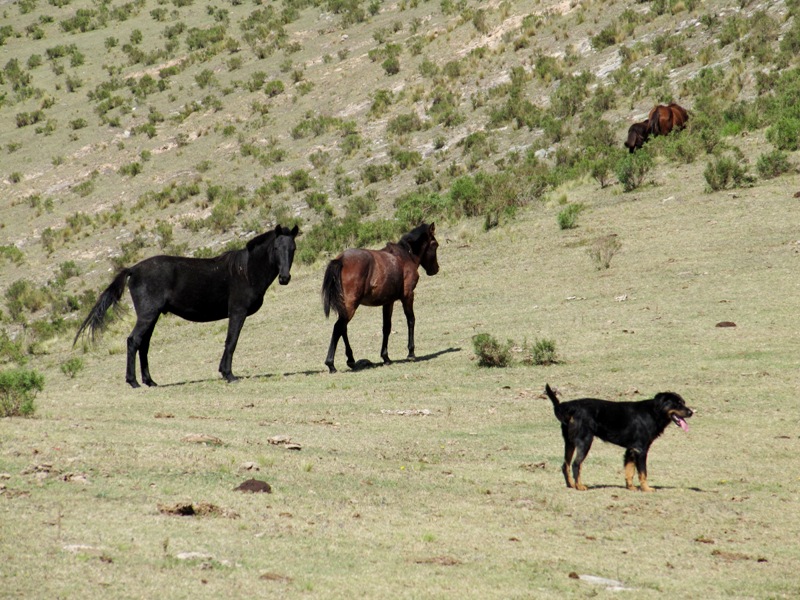
I write this sitting on a bus after leaving one of the kindest dogs we have spent time with.  Carmen and I stayed the last few nights in Tafí de Valle; it’s a tiny town, but we were able to spend a long day hiking.  An hour into our trek and we were in the wilderness with infinite lengths of rolling hills and a scattering of wild horses.

Our shaggy friend keeping us safefrom the horses

Suddenly this dog runs up from behind us barking, but not at us, instead he was herding the horses away from us.  He stayed with us the entire day nudging us with his head, rolling into us as we took a break to eat cheese.  He was so content to just have someone to walk with.  We hiked for hours, scrambling down rocky mountains then jumping rocks in the creek.  When we arrived to the town he joined some of his dog friends and although saddened, I was happy it was a clean break-up.

Enjoying a long hike

Then at the bus station the following morning this black shaggy dog with brown paws and eyebrows prances across the field.  The dog was absolutely elated to find us, thrilled to see us after probably searching the entire night.

He tried to say good morning to everyone, but instead we watched a woman push him away with her boot disgusted that this thing would try to get close to her.  He liked it, willing to accept all the petting he could get.  It must be easier for some people to act aggressive in these situations; they harden themselves against the world, locking down all emotions.

I’m different.  My new friend plopped between my legs and immediately fell asleep.  I must have been the only safe thing he has had in weeks.  Then, it was time for me to board the bus.  My friend looks longingly at me, Carmen gives him a last pat on the head and we leave, his heart broken and a little of mine too.
I also remember the tall skinny one that was white with brown patches in Santiago.  He walked with Bobby, Stephanie, Carmen and me for a half hour.  He was very skilled at crossing the street.  Can you imagine dogs walking only on sidewalks, stopping at red lights and only crossing after looking both ways and a “walk” signal?  The dogs in Santiago can do this!  This dog was particularly sweet, with so much joy just to be walking with some people.  An occasional nip of my fingers or throwing his body against my kneecaps was his way of saying that he liked my company.  Suddenly we saw our local bus, we ran for it, paid our fare and our friend pressed his face against the glass, and barked “Why can’t  I come?”  He ran alongside of us weaving around people, leaping in and out of the street, then, when almost being hit by a car, he gave up.

Mollar pre-Incan pillars and another companion

Then there was the little female that followed us into the archeological site in Mollar.  I gave her some rind from our cheese and she looked at me with the excitement of a child´s Christmas.

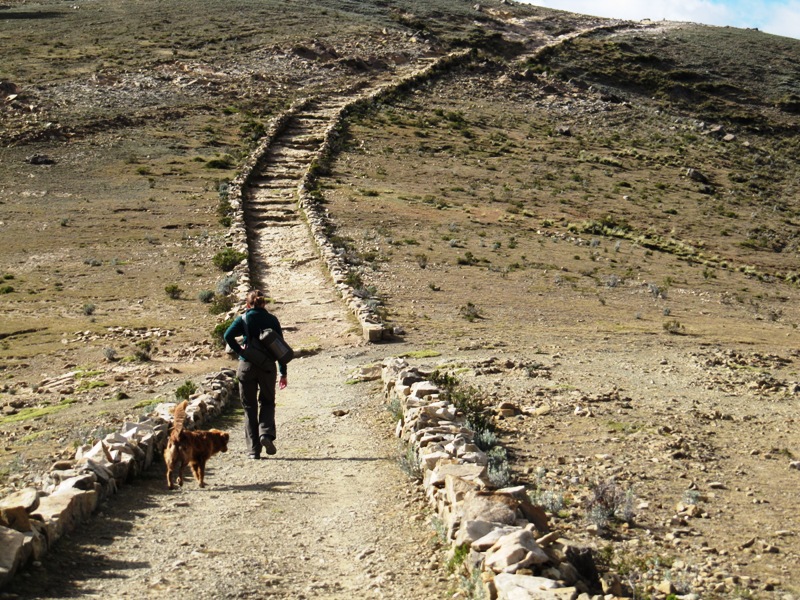
Carmen and another friend

Another dog followed for five hours on the sacred Incan ridgeline of Isla del Sol in Bolivia.

I do not want to forget the famous Pancho of Lujan de Cuyo, the half dachshund, half pug and a half something else.  He waddled his way through the winery of Pulmony with us. And there was the skittish black shepherd in Mendoza that found us three days in a row.  He had some sort of death wish because he liked to bite front bumpers.  I doubt he is still alive.  There was also the mother and pup that fought for our affection.  The most adorable puppy trotted around with us at the hot springs, so clumsy that I thought he was going to fall into the hot water.

Numerous friends, numerous relationships have ended, but are not forgotten.  Although it is sad that there are so many strays it has been nice to make these new friends.  Throughout South America we have had an obvious language barrier, but for some reason a scratch behind the ear does not work for most Brazilians.  To a dog I give a little recognition and they give loyal unconditional love.  They are indiscriminate with their friendship and similarly I can only hope to be that type of friend.  To be a companion that is compassionate, without judgment and loyal to the end.

**Two weeks after writing this, Carmen and I were stopped in our tracks by a not so friendly enormous rottweiler.  We had to load our fists full of rocks and a very spiny bush.  Luckily we were able to sidestep him on another road.  On another occasion a pack of three dogs went for me in Bolivia and I was able to stave them off with a few rocks.  There is a distict difference between the homeless loving strays and the fiercesome dogs left to roam away from their homes.

Tafí del Valle (by Carmen)

Mountains with clouds and shadows

Lonely Planet is both a blessing and a burden.  Their South America on a Shoestring guide is basically the travel bible for the continent.  It is packed with information you need from bus times and costs to great places to pick up empanadas.  Some people don’t “do” Lonely Planet to make themselves feel like more original travelers.  Nathan and I still find it valuable to check out their recommendations but keep our eyes open for serendipitous discoveries as well. At the same time, depending on a single text means that you end up where all the other gringos go.
Estancia Los Cuartos

But just when you think you are going to chuck the heavy book from your backpack, along comes an “our pick.”  These are supposed to signify an extra special find. Not all cities have such an accolade; they are actually few and far between.  So I took note when the small mountain town of Tafí del Valle had an “our pick” hotel called Estancia Los Cuartos.

Our historic suite

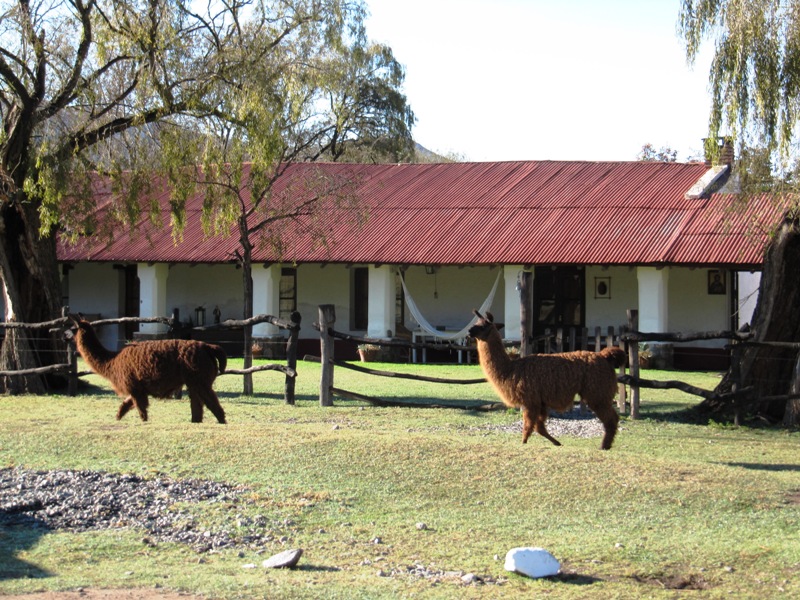
It was wonderful. The estancia was an old ranch house from the 1700’s.  Our room came with thick walls, a stone floor, dark wood book cases, a thatched roof and warm blankets.  I love history and it felt like I had stepped back in time a bit.  There were a few key modern amenities, such as a heater.  A nice touch since it rained heavily for part of our stay.

Breakfast with Tafí cheese

Another highlight of the estancia was breakfast.  The dining room overlooked the beautiful mountain scenery.  We enjoyed the typical courses of coffee, bread and jam but the best part was the homemade cheeses.  Tafí is known for its cheeses, which are modeled after a Spanish-style manchego (one of my favorites!).  Each year, the town hosts the national cheese festival.  We missed the festival but did indulge in a large block of cheese, which we enjoyed with a rosé we brought from Mendoza.

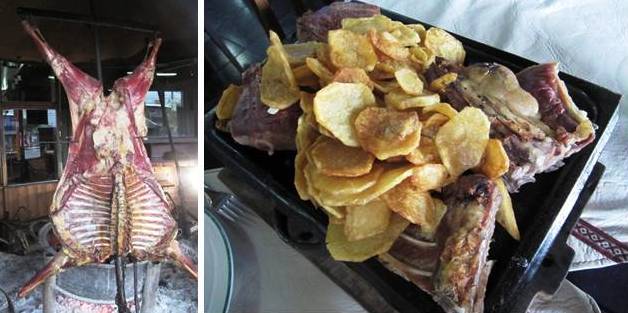
Barbecued goat and potatoes

In addition to good cheese, the main strip of Tafí has a few good parrillas.  We stopped into one that had a nice fire built in the front with meat roasting above it.  Their specialty was chivito (goat).   We ordered a grill plate for two which came heaped with chunks of juicy meat and delicious, crispy slices of potato.  Truly some of the best potatoes I’ve ever had.

Wild horses on mountain

We needed to work off all these heavy meals so we did a nice hike to the cerro de la cruz (peak of the cross).  From here we could look over the town and the nearby lake.  Herds of free roaming horses grazed nearby.  Seriously, how much more idyllic can you get? At least for me, it was a blissful weekend.

On the overlook

Post Navigation