4 feet 2 mouths

walking and eating our way around the world

Archive for the tag “Big Cities”

Remembering NYC 2011 (by Carmen)

Chrysler Building

I had to go back to New York City.  After having visited many of the major cities of Europe and Asia, it was a shame to have missed out on New York.  So last August, Nathan and I made time to visit friends and family there. And it was awesome.  This post is about remembering the good times we had last year and naming the reasons why we simply had to return during our year off.

Grand Central Station

Beautiful Brooklyn Bridge by night

First of all, there’s the transportation.  Most of the United States is fully reliant on their cars to get anywhere.  But NYC is one of the few places where transit takes over.  It’s wonderful to see the diversity of people on the subway and buses. Another great thing is that all of these people are unafraid to walk.  In the US people generally don’t like walking more than 5-8 minutes to get anywhere.  New Yorkers walk for miles, and quickly too. Nathan was loving the famously fast pace of New York sidewalks – which is really what he considers to be his relaxed stroll.  Together we joined the walking masses, from Lower Manhattan to Midtown, from Chelsea to Lower East Side.  One of our favorite walks, though, is across the Brooklyn Bridge.

A classic lox bagel
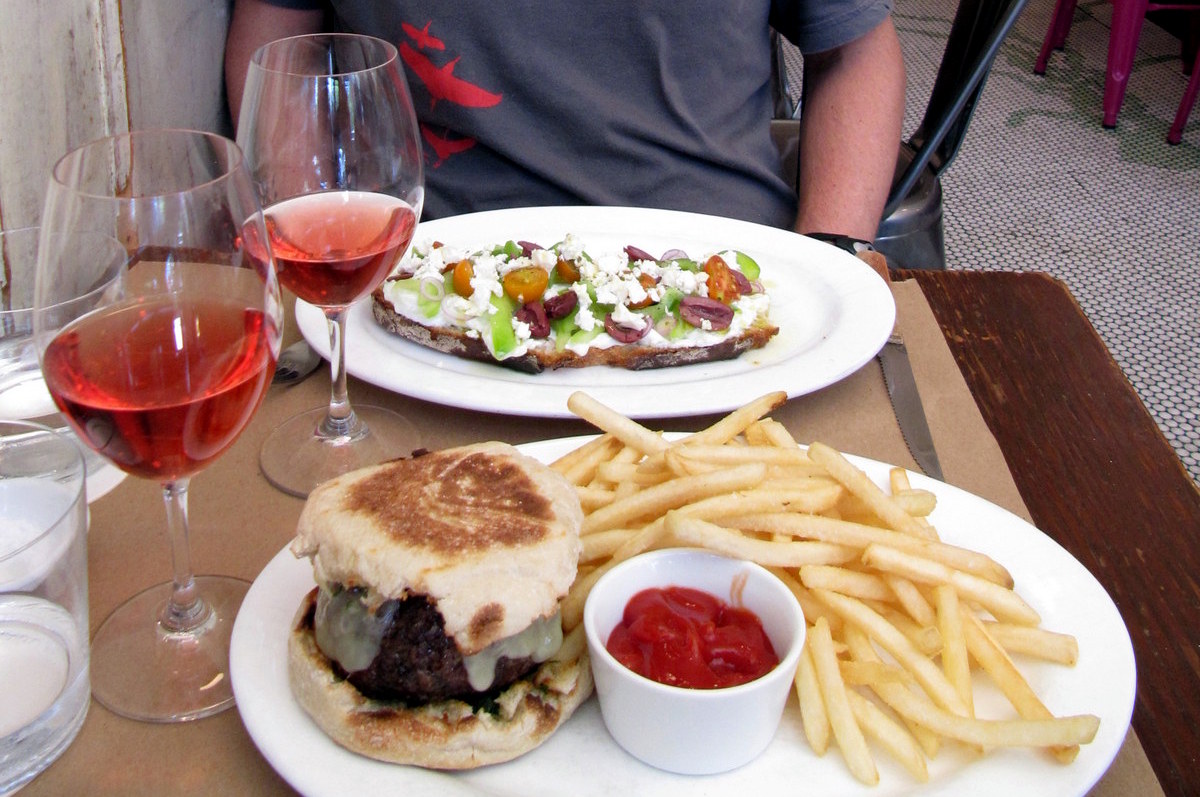
Awesome burger at Prune
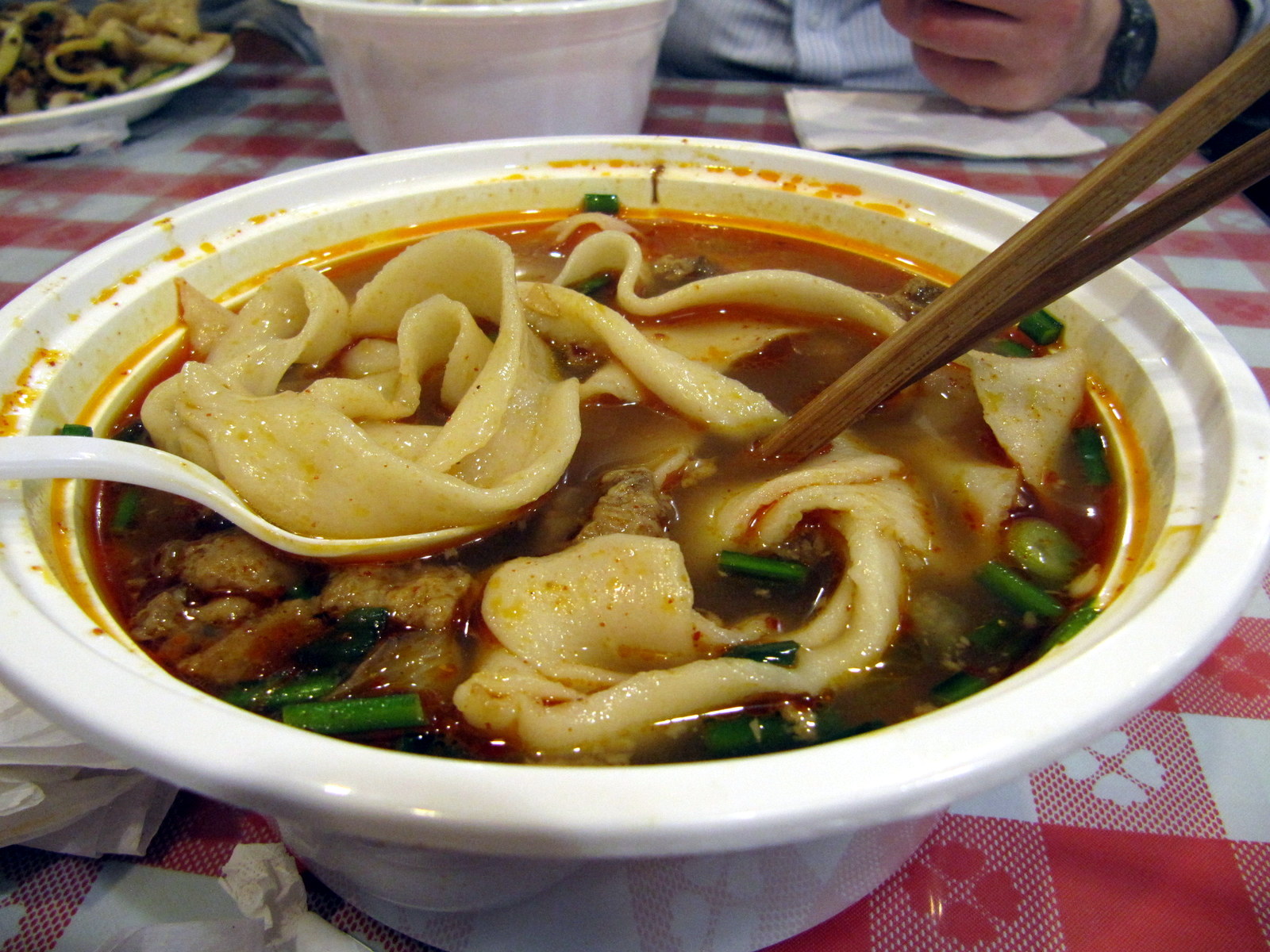
Handmade noodles at Xi’an Famous Foods
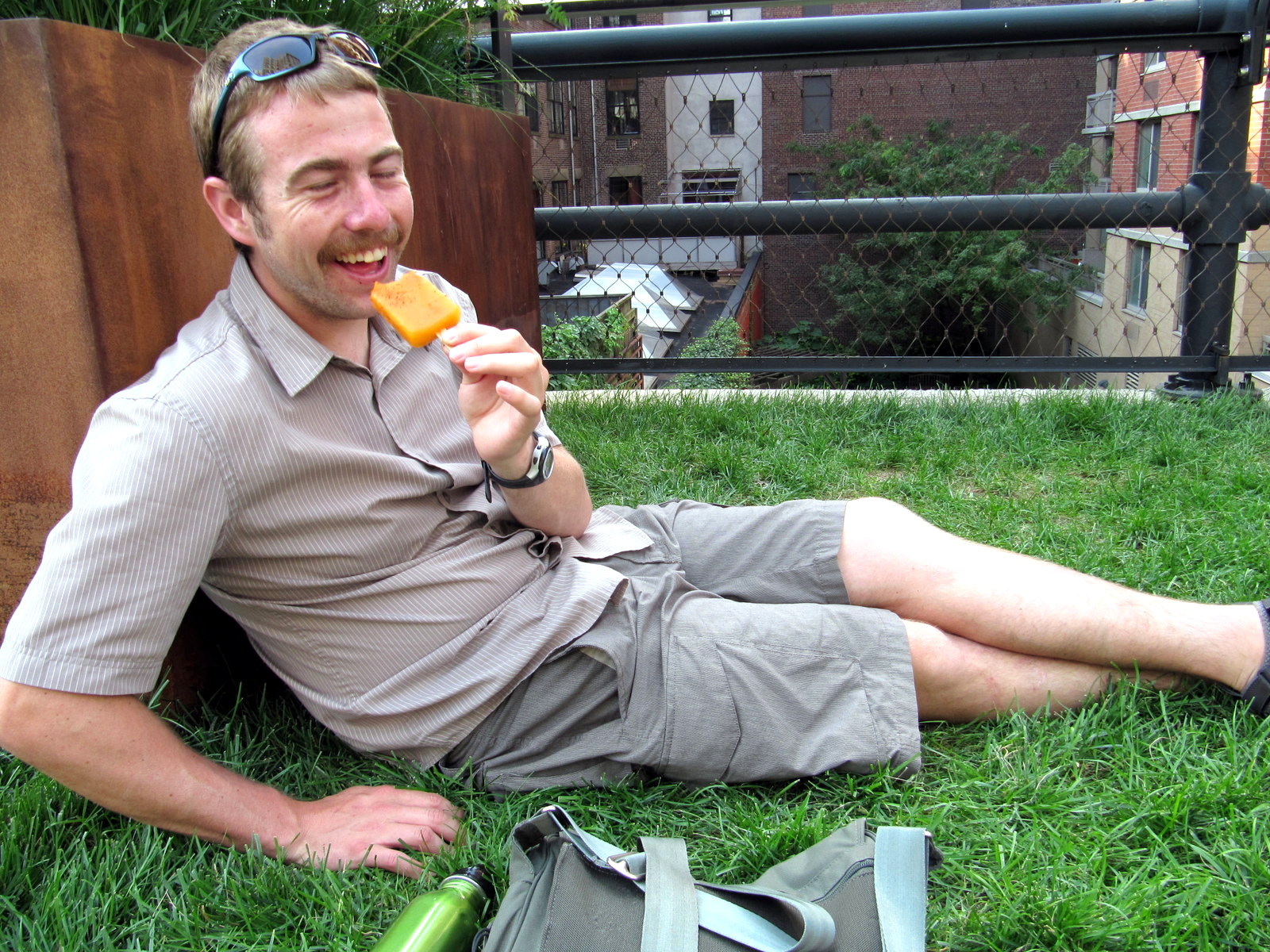
Nathan enjoying his paleta at High Line Park

Then there’s the delicious food.  New York is known for having any cuisine you can imagine being served within its limits.  We hit just a small sampling of its restaurants and street snacks.  Some of the best eats are highlighted in these pictures: 1) a lox bagel at Russ and Daughters, which Anthony Bourdain recommended as an absolute must try in New York (we agree); 2) a perfectly cooked burger and sandwich at Prune, owned by the author of the great memoir Blood, Bones and Butter; 3) eastern Chinese style handmade noodles in a spicy beef broth at Xi’an Famous Foods; 4) Nathan relaxing with his mango and chile paleta (popsicle)  served by the La Newyorkina in High Line Park.  There were many more great things we ate but we knew we were only scratching the surface.
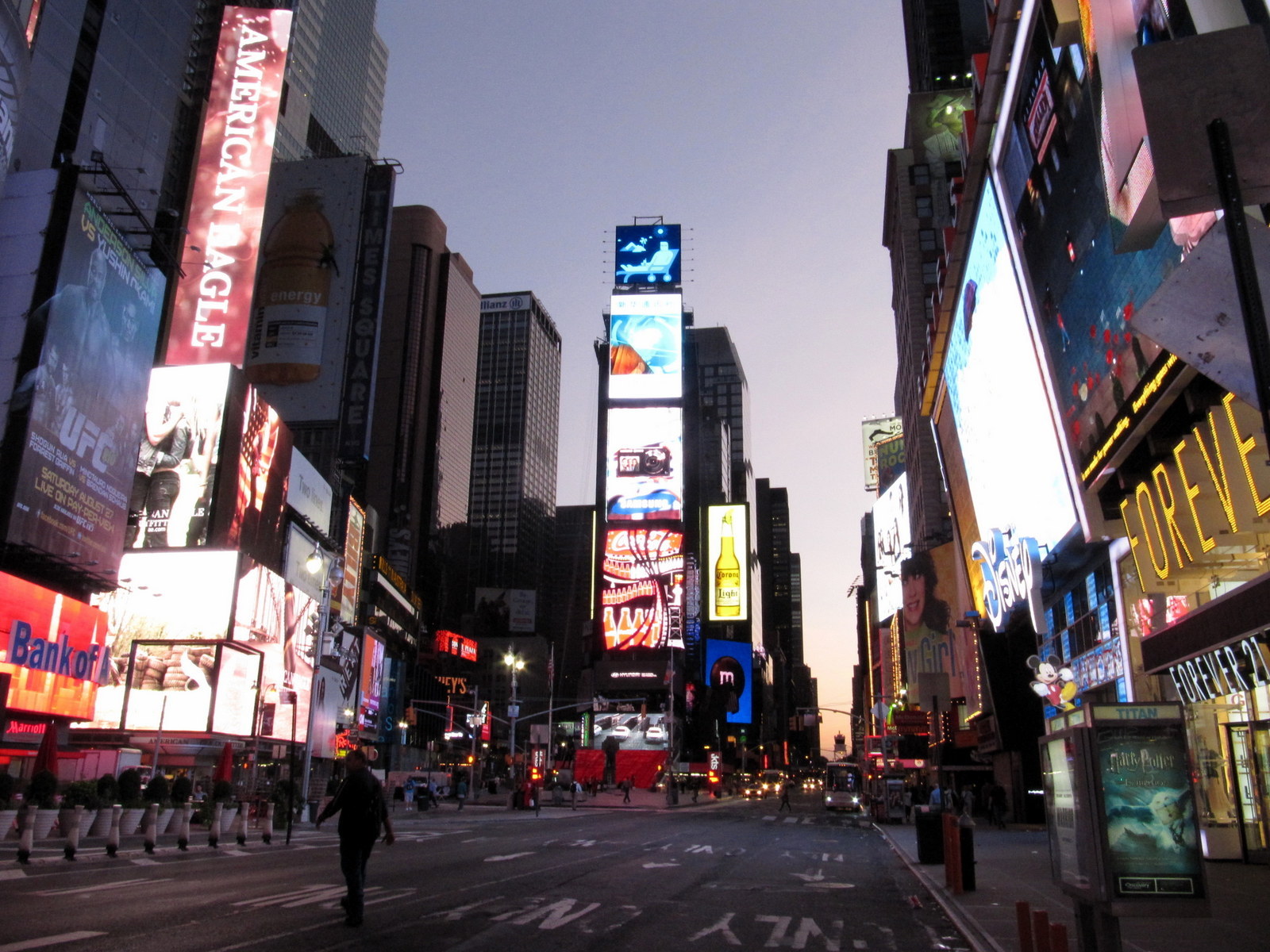
Times Square at dawn
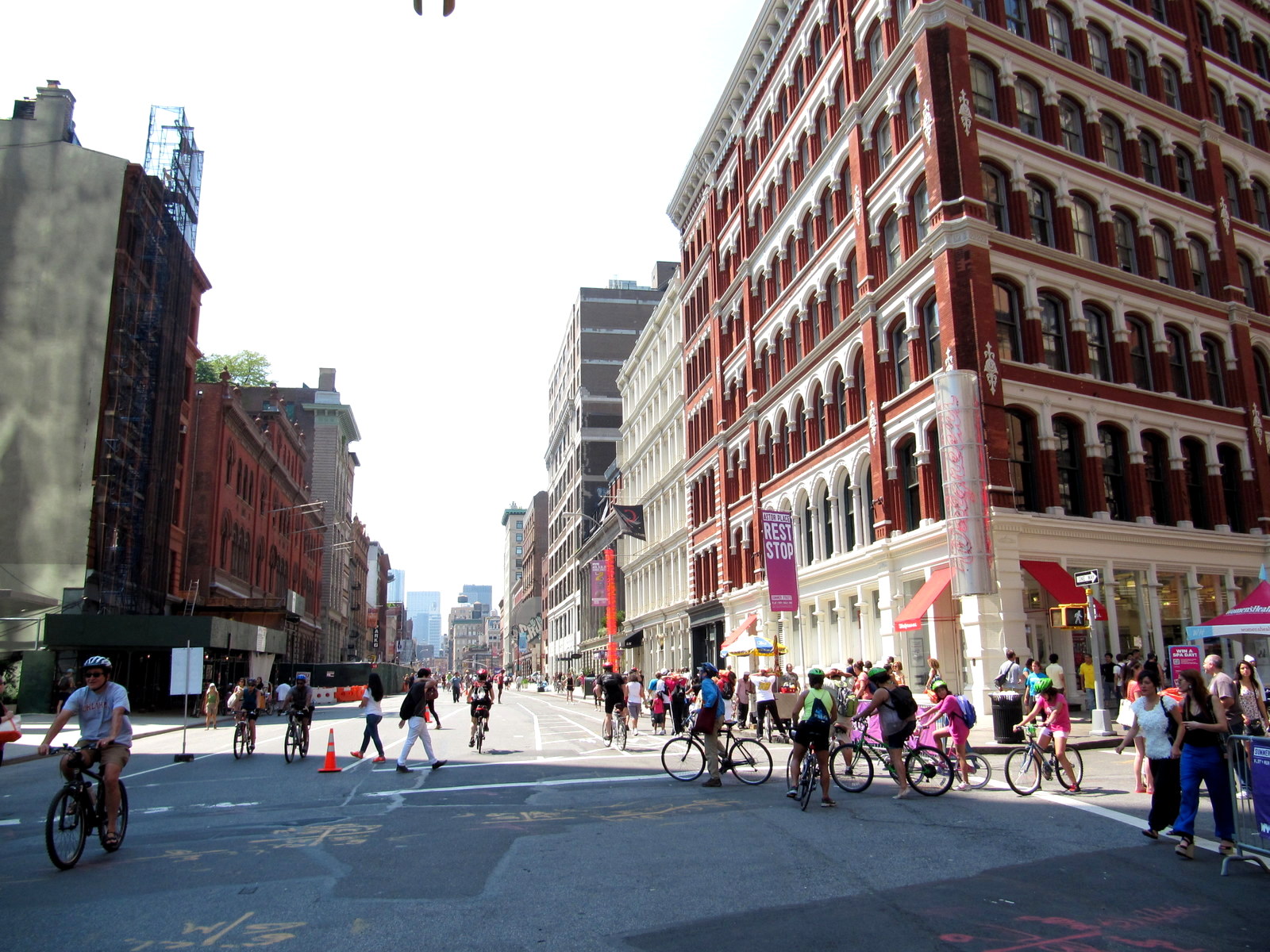
Car free Park Avenue on a Summer Streets day
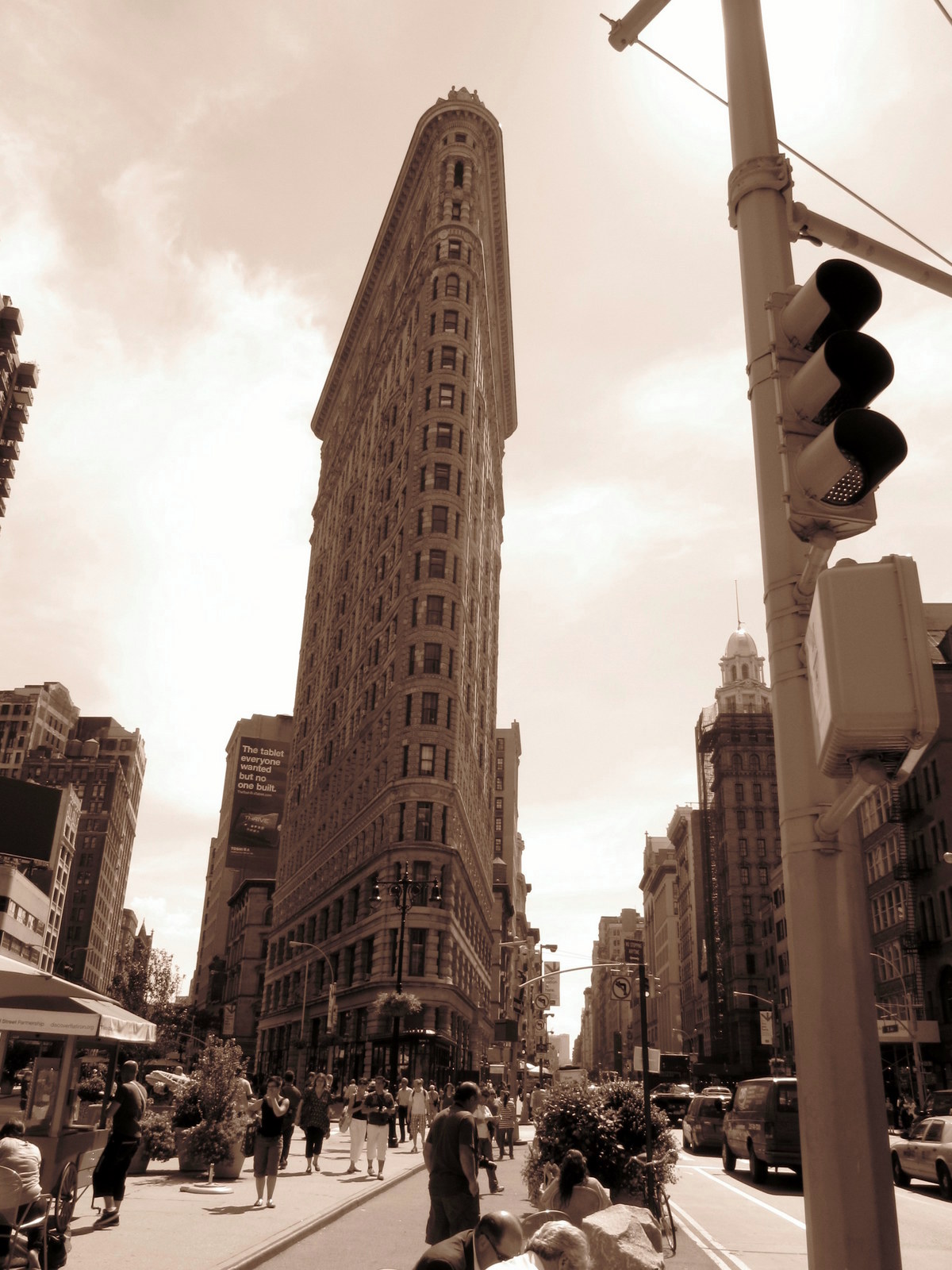
Flatiron Building – one of Nathan’s favorites

And, of course, the architecture was everything we hoped for.  The famous high rises stacked against one another.  This density of brick, iron and cement opens up into little breathing pockets in the vibrant plazas and parks dotted around the city.  Every other block had some interesting building to look at.

The new $10 bill

On top of all that, New York offers a ton of cultural experiences – music, theater, galleries, museums. On this trip, Nathan and I took advantage of the museums with visits to the Guggenheim, Museum of Modern Art, Museum of the American Indian, and even small exhibits such as that of Trinity Church on Wall Street.  At the last one, they had this ten dollar bill cut out that Nathan proudly took his portrait with.  This picture just hit my funny bone.  I could not stop laughing!  So much so that the security guard came over to check things out.  It still makes me giggle – I think it’s the ‘stache : )
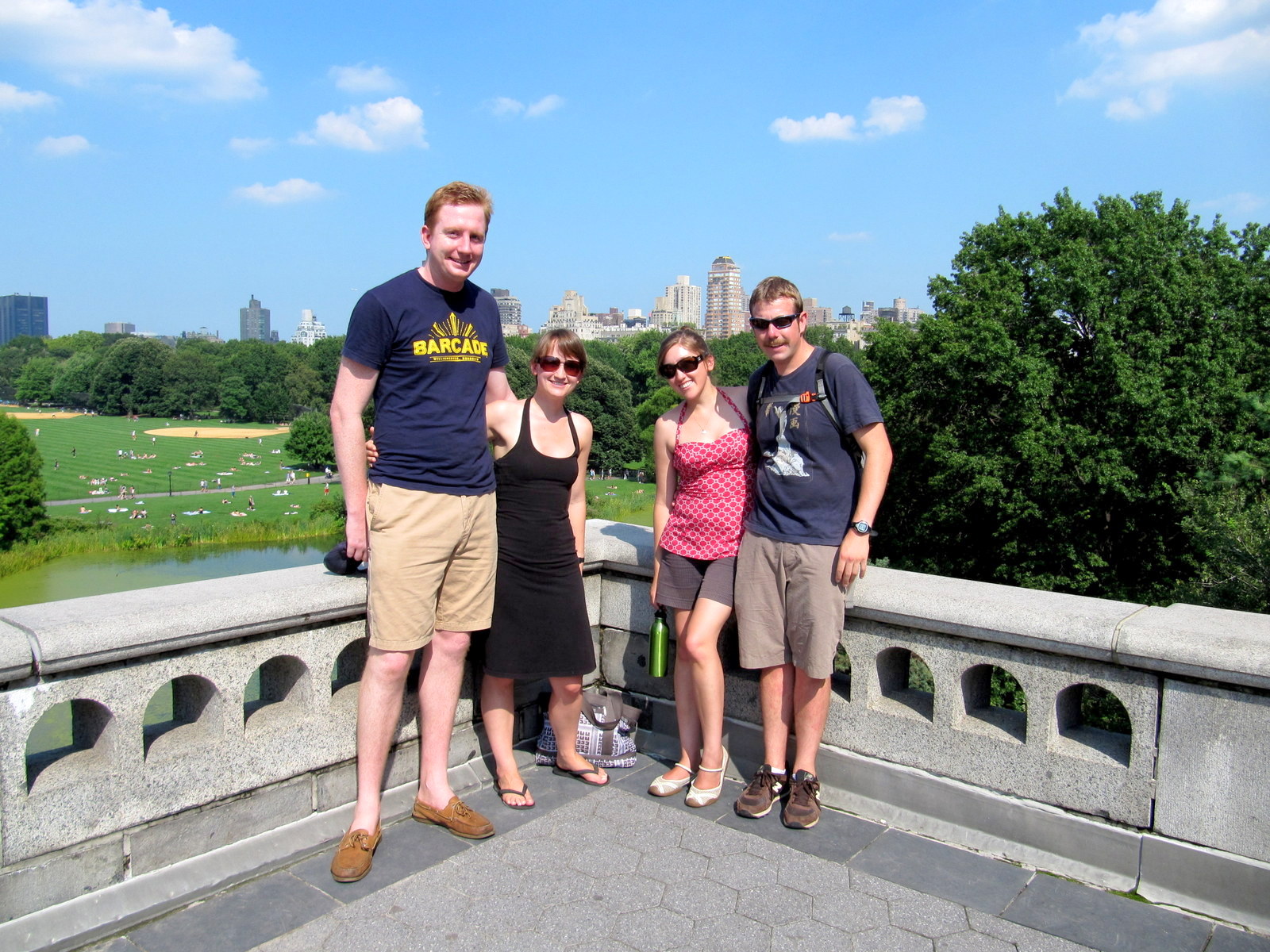
Andrew and Taylor showing us Central Park
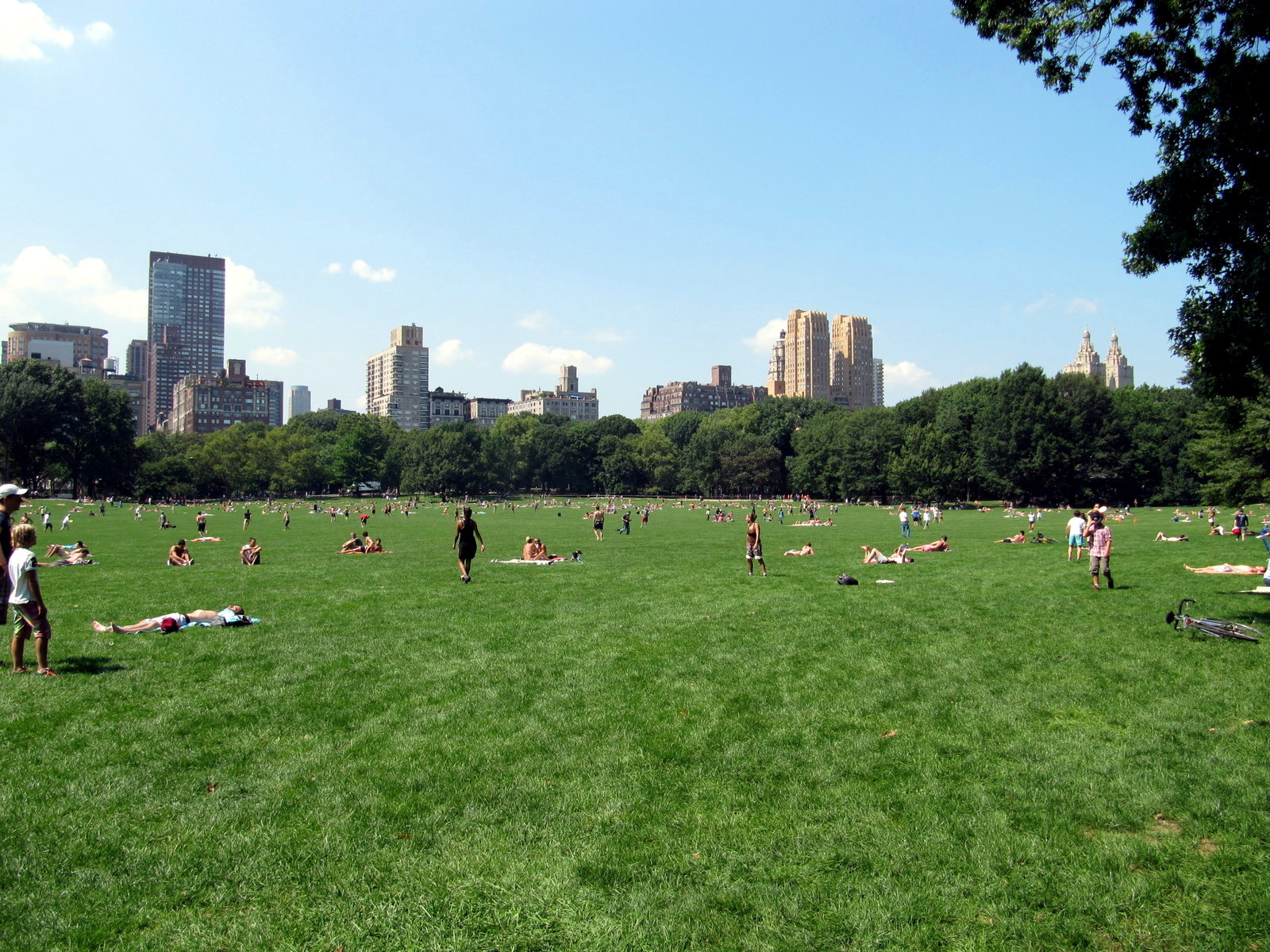
Sheep Meadow in Central Park
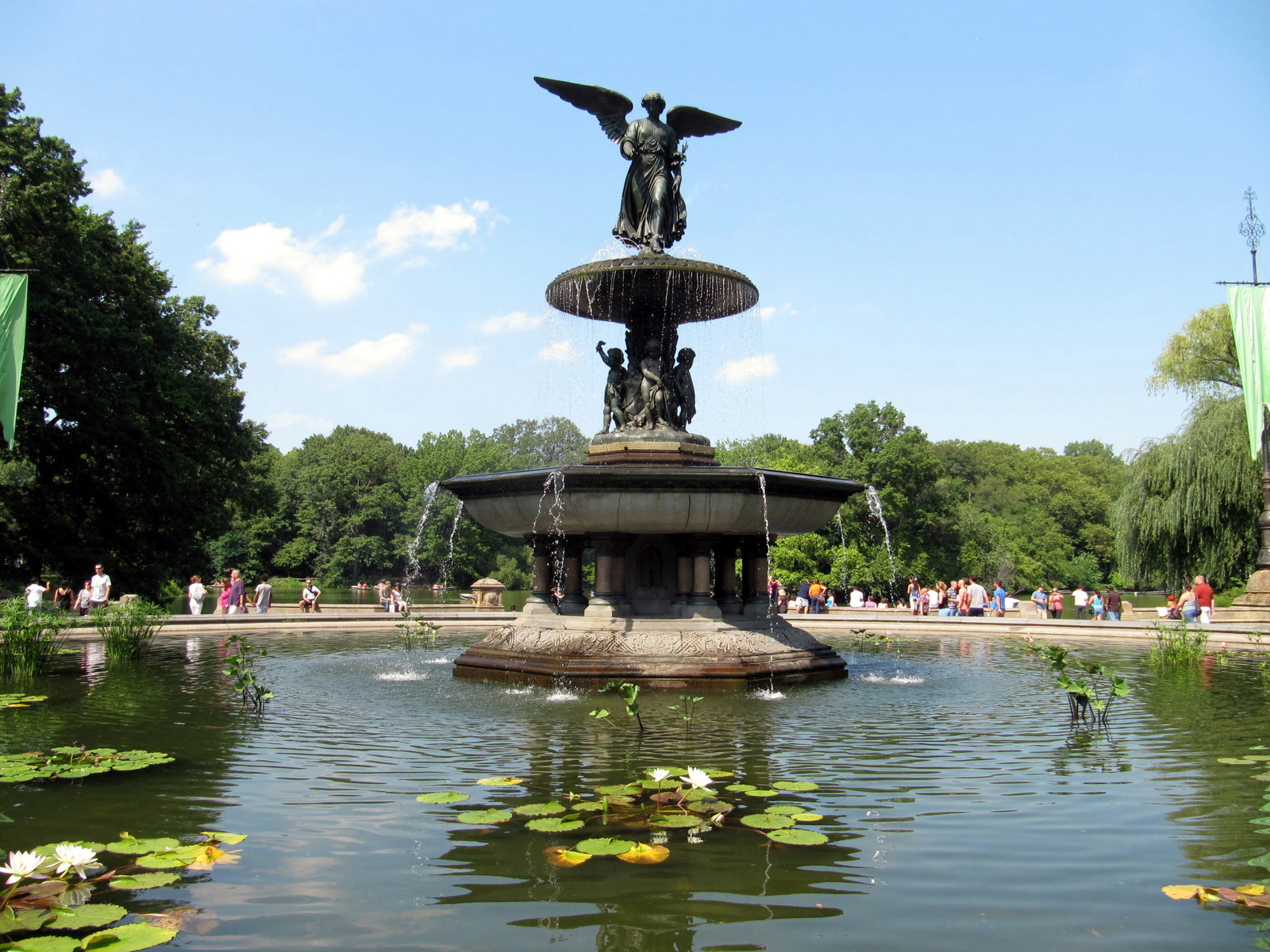
Bethesda Fountain in Central Park
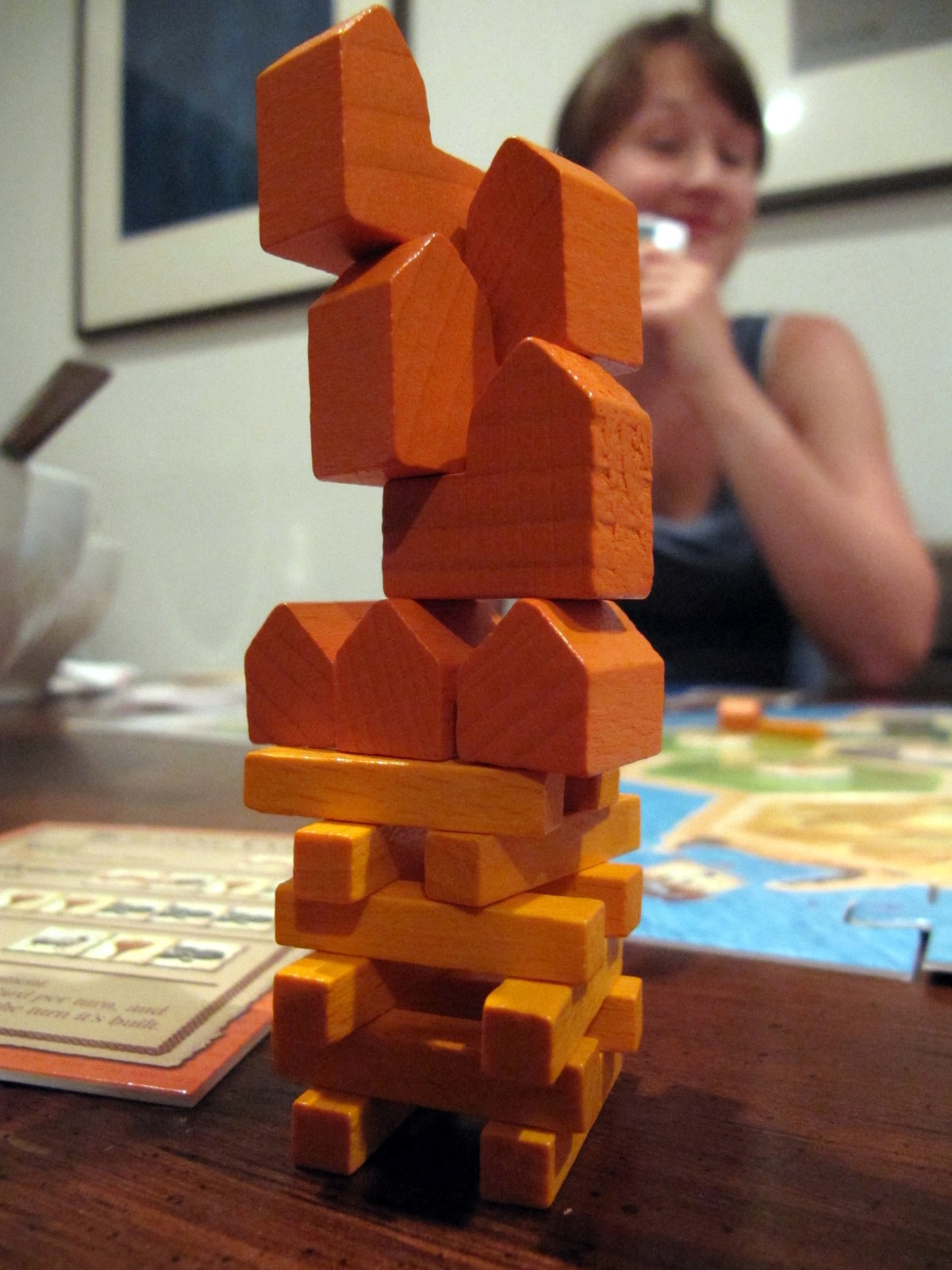
Biding time during a tough game of Settlers of Catan

But the best part about New York is the friends and family who live there and welcome us with open arms.  Andrew and Taylor showed us such a great time with a walk though Central Park, drinks at cool bars and chill nights in playing boardgames.  The trip would not have been the same without them!

Coney Island

Me and Adri on High Line Park

And my dear cousin Adri, who is teaching while getting her master’s degree (wow!) was game enough to travel all the way to Coney Island to dip our toes in the water and eat Russian dumplings.  She even shared her mango flower she bought on the boardwalk.  That’s love.

the bottom line

So what I’m really trying to say here is that last summer Nathan and I joined the millions in saying, “I ♥ NY.”  We couldn’t resist a second trip, which Nathan will cover in the next post.

36 Hours in Lima (by Carmen)

The buck stopped here.  Our last stop in South America was Lima.  We had intended to spend more time in Peru’s capitol city, but the way things worked out we got about a day and a half.  So we tried to make the most of it.  It was kind of fun to finish off our trip with final rush of food and fun.

Ceviche at Pontal Azul

Arroz con mariscos at Pontal Azul

Our first stop after dropping off our packs at the hostel was more ceviche!  We went to a convivial restaurant called Pontal Azul in the Miraflores neighborhood.  Lima is right on the ocean and this, combined with the modern amenities of the neighborhood, made us feel like we were in California again.  Its coastal location also makes for supremely fresh seafood, and this ceviche didn’t disappoint.

Huaca Pucllana ruins

Next we visited a small set of ruins nearby.  The Inca get most of the attention from the west since they were the ones in power when the Spanish came.  But in fact that empire was only a few hundred years old and many civilizations existed before them.  A series of these previous groups were responsible for this slightly strange set of ruins, which is essentially a large hill built of stacked bricks.  It took several hundred years to build with each society adding layers upon layers.

Downtown plaza

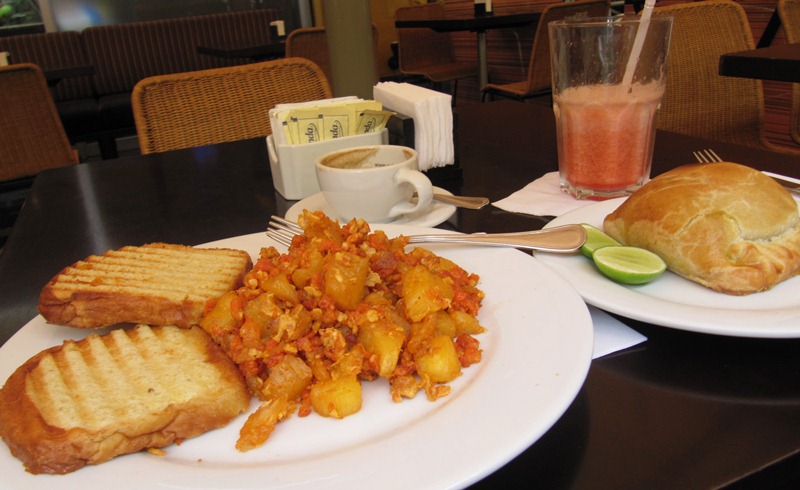
Breakfast at Tanta

The next day we went straight to downtown.  Our first stop was Tanta, a restaurant owned by Peru’s star chef, Gastón Acurio.  We weren’t planning to go here but we accidently missed the breakfast at our hostel.  This turned out to be a very good mistake.  I ordered eggs scrambled with fried yucca and chorizo along with some coffee mixed with honey.  It was to die for.  My mouth is watering just thinking about it.  I love fried yucca.  Its starchiness was perfectly balanced by the spicy oil in the chorizo.  Nathan, meanwhile, had an an empanada stuffed with aji de gallina, a kind of chicken stew made creamy nut-based sauce. He accompanied this with an excellent strawberry and passionfruit smoothie.  I would definitely go back.

Dinner at Astrid and Gaston

We spent the next couple hours exploring the old center.  We visited a monestary with a crypt full to the brim of old bones.  They estimated the remains of 50,000 people were kept there.  Afterwards we snuck in some more ceviche at La Choza Nautica, which was good but not as good as Pontal Azul. We then hurried back to Miraflores for a sunset beach stroll before meeting our friends Brenda and Drew for dinner.  Based on the excellent experience at Tanta, we decided to eat at Gaston’s other restaurant, Astrid y Gaston.  It was a fight to get a seat, but we finally managed to eat at the bar around 10pm. The verdict – it was ok.  The food was well executed but, as Nathan put it, it lacked love.  Too bad.

Cevicheria la Choza Nautica

Our final morning in Lima we enjoyed a leisurely breakfast at the hostel and then piled in a micro (one of the minivan buses) on our way to the airport.  It was time to go back to California. I had mixed emotions about leaving South America but that will be the topic of another post…

The Return of Street Food in the City of La Paz (by Nathan)

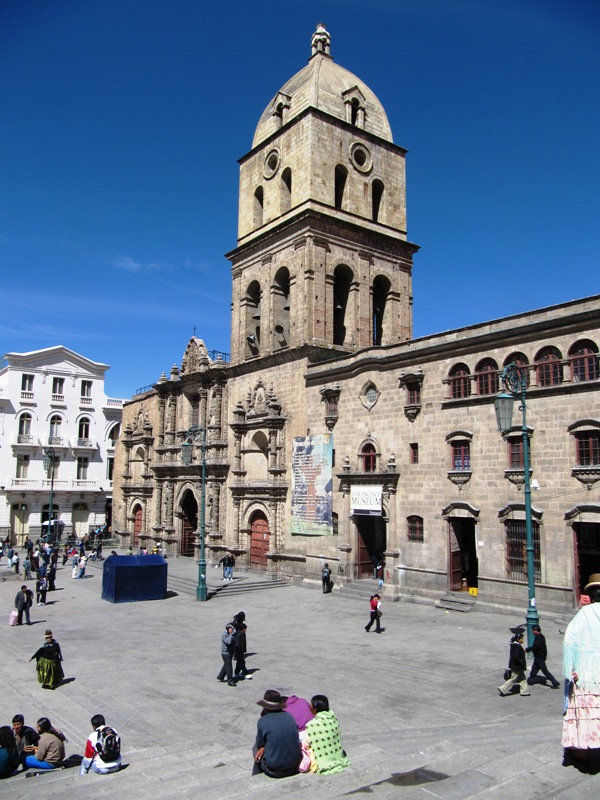
Streetside commotion and Iglesia San Francisco

One thing that is common among all my favorite cities is good street food.  I love experiencing a city that is vibrant with life on the streets.  I love the excitement of the people and the craziness of community that buys and sells everything on the roadside.  In some special places in the world some of the best meals were served from a vendor on a flimsy plastic plate or napkin wrapped delight. 

Street markets in La Paz

In La Paz we experienced a return of street markets.  The street vendors were endless; little stalls stuffed with produce, meat, blankets and DVD’s filling up the hillside with everything imaginable to buy.  Thousands of people scrambled from vendor to vendor weaving in and out of the sidewalk and street and carrying bags filled with the day’s purchases.

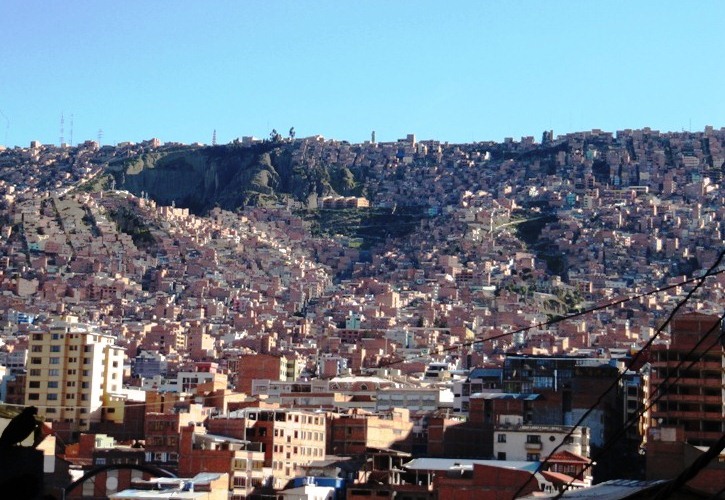
La Paz hillside homes

I could spend days and days wondering markets like these.  I do not even buy anything.  I enjoy meandering from stall to stall listening to one vendor describe the perfect mango, or another flaunt a superior winter coat and the buyers negotiating for a better price.  There is so much culture fit into these streets and I like to roam and soak it in deep into my lungs.  And my stomach too!

Sidewalk bowl of lentils

Quite often in these markets we find men and women selling local street side fresh food.  There are doughnut-like things with a molasses syrup, roasted turkeys or pork loins to be made into sandwiches and an abundant array of herbal and thick drinks served out of buckets.  Occasionally we are stopped by an intense aroma that causes us to swirl our head around looking for the source and occasionally this smell is linked to a vendor with a hoard of people huddled around grabbing for some of the delicious eats.  This is how we found lunch one day.  Two women had joined forces to cook up several pots of food and carry them to their sidewalk restaurant.  We had a heaping bowl of soup, pasta with lentils, potatoes and a salsa that made our mouths tingle.  And it cost $1.15 for the two of us!  We sat on a step and slurped down our lunch watching the people flock to this sidewalk deliciousness.

Iglesia San Francisco & plaza

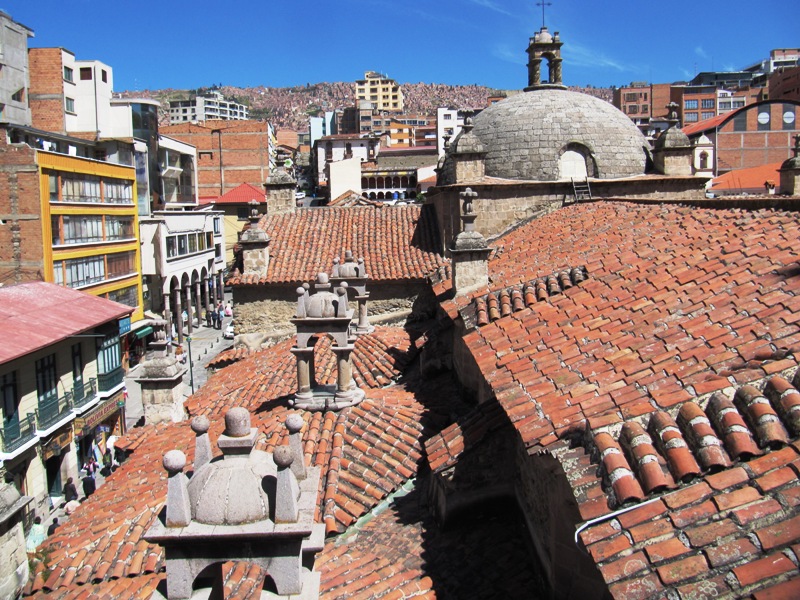
Rooftop of Iglesia San Francisco

Further on we explored the Iglesia San Francisco that was originally built in 1548.  There was a beautiful gold altar and a rooftop terrace that offered views of the city.  The plaza below the church is a central meeting point with a constant stream of people enjoying the sun and people watching.

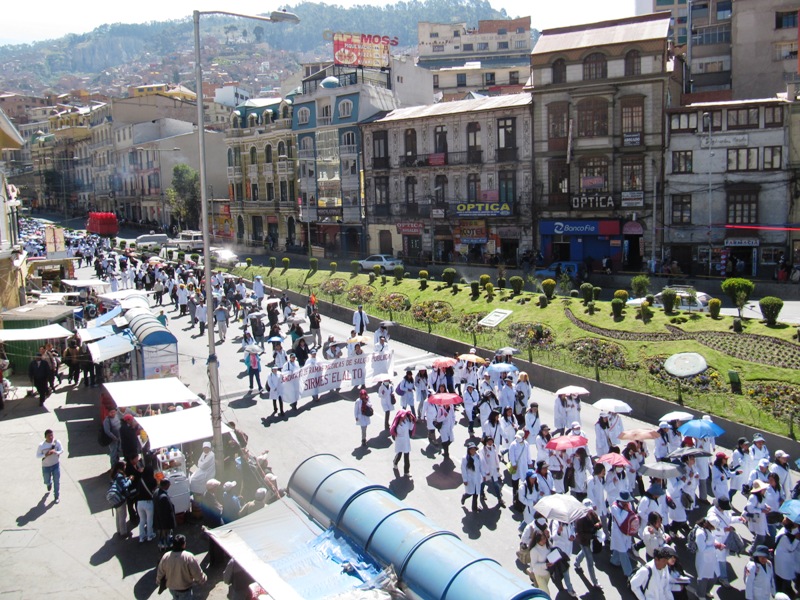
La Paz protest

Anyone who has been in Bolivia probably has been affected by or in some way has a story about a protest.  The Bolivians seemingly protest constantly.  Carmen and I were very fortunate to not have any of our regional bus trips impeded, but we did meet countless travelers that were delayed.  The protests involve road blocks and fireworks.  We watched from a nearby bridge in La Paz as hundreds of students marched along the main corridor.  There was a steady booming of explosions as the students stuffed rockets into makeshift bamboo tubes held high in the air.

Presidential palace and Wihala flag

Protests are common to all social groups.  Bolivia has one of the most complex populations in South America with the heritage and culture of the people originating from hundreds of different indigenous tribes.  There is even a flag composed of a quilt pattern of vibrant colors to demonstrate the multitude and coming together of these people to create a nation.

Collectivo micro vans

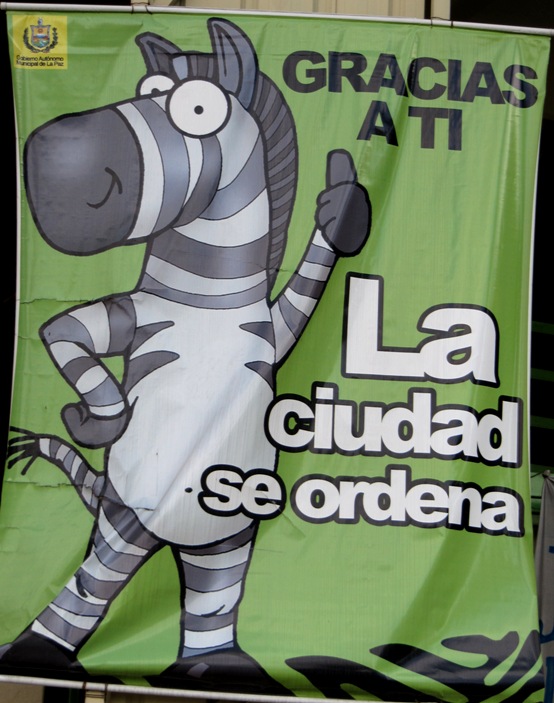
City planning zebra

Just as there is a patchwork of cultural traditions in Bolivia, there is also a patchwork of informal transit.  No formal bus line exists.  Instead private collective vans, called micros, roam the streets calling out their destinations from the window.  Carmen and I crammed into several of these vans to maneuver our way around the city.  The competition for passengers makes for some aggressive driving.  Therefore there is a planning mascot (a happy little zebra) that attempts to restore order to the streets by designating specific passenger drop-off locations.

San Pedro prison entrance

We could not visit La Paz without seeing San Pedro prison for ourselves.  We read a great book called Marching Powder that described the life and experiences of one inmate named Thomas McFadden.  Thomas lived in the prison following an arrest for drug trafficking.  The prison is unique because it is in the center of La Paz and nothing is provided to the inmates by the government, not even a cell.  Inmates rely on their families, friends and personal bank accounts to buy a cell and buy food in the prison.  There are restaurants, stores and mini apartments all housed within the prison walls.  Every prisoner gets a job in the prison, cooking, passing messages or even giving tours.  Thomas started the tours of the prison, but they have since increased dramatically in price.  The most amazing thing is that prisoners are allowed to bring their families into the prison.  The wives and children are allowed to come and go freely throughout the day.  Carmen and I showed up at the prison to watch the door and see the families and people living inside.  Most of what we could see was this enormous trash truck parked tight against the doorway and prisoners carrying suspicious heavy sacks “trash” then covering them with loose debris.  I would not doubt that they still make cocaine there.

Colorful hanging textiles

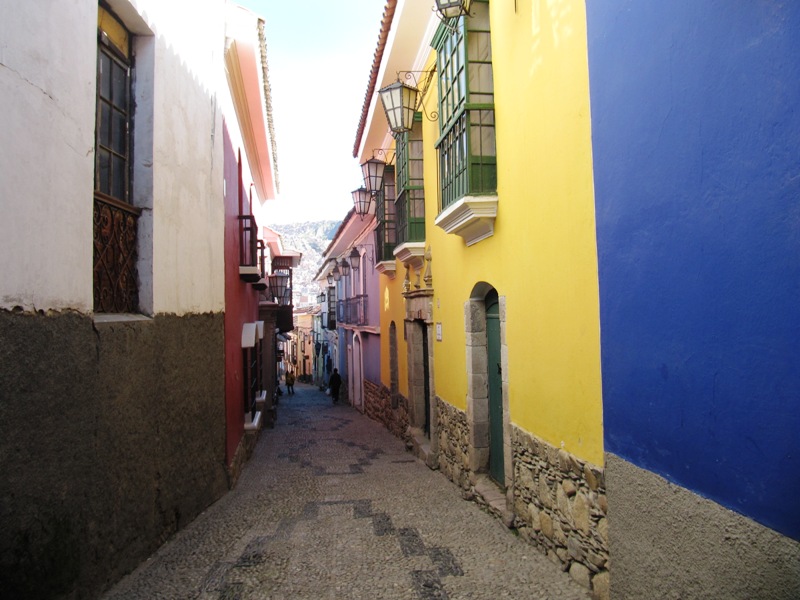
Colorful street

La Paz streets are intense with colors.  Brightly colored llama and alpaca wool fabrics hang from shop windows in the area that has been nicknamed gringo ghetto.  I bought myself a soft alpaca sweater knowing how warm and life-saving they can be in the cold.  Other streets contained buildings boldly painted in with blues, yellows and reds.

La Paz dowtown

La Paz is unlike any city that we have visited.   The biggest city in Bolivia is unlike lacks modern western influence; there is a rustic and rawness to the streets that is captivated and a history that is exciting.  Thousands of white-washed buildings with clay roves sit perched on the mountains that overlook the city.  The city is, in a way, shaped like a huge bowl and the culture and delights inside are just ready to be gobbled up.

Terremotos in Santiago (by Nathan)

View from Santa Lucía

View from Santa Lucía

Sometimes the best way to see a city is with friends by your side.  When those friends live in foreign countries, even better!  Santiago is a flourishing city wrapped with steep mountains and bustling with 50% of Chile’s population.  Many of the best sights and food are only known to locals, so we were excited to temporarily move in with our friends Bobby and Stephanie.

Vinyards and Chilean flag

Vineyards and Chilean flag

Lunch at Bodega Isidrio

Lunch at Bodega Isidrio

The last time we were together we had a great time exploring the wineries of Napa Valley.  For our first day in Santiago, we decided to repeat the experience with a day trip to visit the Casablanca wine region as well as the coast.  There are few better Saturdays than sipping on wine and going to the beach, so we had a perfect day planned.  On a beautiful morning we rented a car and ascended from Santiago to find a valley lush with grape vines.  Our first stop was Emiliana Organic Vineyards.  The excellent tasting took place in a beautiful glass, wood and stone building.  We bought two deliciously inexpensive bottles and we were on to the second winery.  Cerro San Isidro is a modern, bleach white villa perched on the hillside.  Overlooking the valley we enjoyed a delicious lunch.

Viña Beach

Viña Beach

Back in the car and we were on our way through the mountains and then dropping in the colorful beachside communites of Viña del Mar and Valparaíso.  We enjoyed a walk along the beach boardwalk of Viña.  We sipped pineapple juice, ate churros and admired the local crafts.

Valparaíso Streets

Valparaíso Streets

Valparaíso overlook

Valparaíso overlook

A short subway ride away (yes, they have a subway) and we were in Valparaíso.  This small town has a colorful charm, steep hillsides with boxy buildings clinging to the slope.  The streets are cobblestone and every visible wall and surface is artfully painted with murals.  The art was political, scenic, cultural and sometimes just tagging.  But the graphic images gave the city an intriguing sense of place that was fun to explore.

Backyard Asado

Backyard Asado

A late night drive brought us back to Santiago.  We were able to experience an excellent day trip only possible with local friends.  The next day we tagged along to a backyard asado (BBQ) and birthday party that rocked our world with a wonderful home-cooked meal.  First there was pisco sour made awesomely pink and delicious with imported Arizona tuna (cactus apple).  The main course was a fall off the bone lamb cooked in an stone oven then finished over coals and a brine bath.  Sebastian and Laura were excellent hosts.  Great food and a chance to speak Spanish with some interesting Chileans made for a special afternoon.

Parque Forestal

Parque Forestal

Ice cream from Emporio La Rosa

Ice cream from Emporio La Rosa

There are more than enough activities to keep busy for a few days here.  We were staying in the Las Condes area that had a beautiful rose-lined park. Close to the center the slender Parque Forestal offered Parisian-like strolls and locally crafted ice cream.  We enjoyed frutas del bosque (forest fruits) and thai ginger. 

Santiago and its smog

Santiago and its smog

There are a few vistas in the city, but be warned that the air quality is pretty bad.  Santiago is surrounded by mountains that offer crisp snowcapped views in the winter, but in the summer the smog and dust becomes trapped, entombed by the mountains waiting for a storm to clear it out.  Unfortunately our timing in Santiago was one of those bad air times.  With our throats raspy and our skin scaly we climbed the Cerro de Cristóbal.  We were surprised to find that we could only see a third of the city.   In the center of the city we walked to Cerro Santa Lucía and we found an urban look at Santiago under the smog.

Kai hidden Thai restaurant

Kai hidden Thai restaurant

There were many great places that we found only because of our friends Bobby and Stephanie.  Kai is this vibrantly colorful and ornate Thai restaurant   There was no sign, no entrance, but we walked through an unmarked doorway and found some deliciously spicy food.  It’s funny how I miss certain flavors, and finally after weeks of travel Bobby and Stephanie showed me a place to excite my spicy taste buds.

First round of terremotos

First round of terremotos

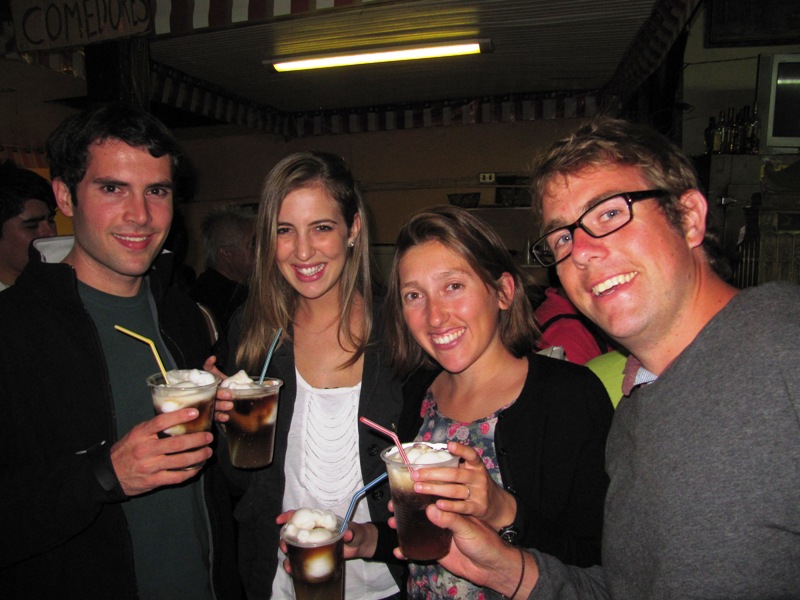
From one hidden door restaurant to the Chilean drinking hall of La Piojera we were welcomed into a new community of expat and Chilean friends.  It was an initiation into the Chilean culture with cheek kisses and a round of terremotos (earthquakes).  La Piojera definitely makes the ground feel like it’s moving as they scoop an iceberg of pineapple sorbet into a goblet of white wine and top it with a downpour of syrupy mead-like liqueur.  The end result: an off-the-richter drink!

The name terremoto is very apt and almost taunting because, like California, Chile has its share of ground shaking.  To our benefit they have a good grasp on their earthquake engineering.  One shaker caught us on the 25th floor of Bobby and Stephanie’s apartment.  We stood there frozen and watching the building sway against the horizon.

The politically exciting Bar Clinic

The politically exciting Bar Clinic

But the earthquake didn’t stop us from enjoying a few more drinks.  Bar Clinic delivered an excitingly political atmosphere and a few local draft beers for us to enjoy the afternoon sun in downtown.  The walls were decorated with odd parodies and humor reminiscent of “The Onion.”  Close by there were a few nice museums and plazas that dotted the city.  Unfortunately the pre-Columbian museum that we were excited about was closed for renovations.  We settled on the eye opening Botero exhibit on Abu Ghraib which coincidently enough was on loan from the Berkeley Art Museum.

Sizzling shrimp and garlic

Sizzling shrimp and garlic

Santiago has a culinary dish that we frequently spied on other tables.  They grill up tiny shrimp in butter, garlic and optional chili peppers in a small cast-iron pan.  It is delivered sizzling on the table.  Each shrimp turns bright red, perfectly cooked and succulent.  We liked it so much that we ate it twice, once at the excellent restaurant Galindo and then again at the seafood market.

Fresh seafood market

Fresh seafood market

The fresh food market in downtown Santiago is enormous.  Carmen and I spent hours roaming the aisles of meats and produce and we did not nearly see all of it.  The first of the markets is the fresh seafood.  Fifty or so vendors and another fifty or so restaurants called out to us as we walked by.  They held up huge pieces of salmon and others showed off their practically alive mackerel.  We settled for the tiny, perfect little shrimp.

Vega herbs

Vega herbs

Vega vegetables

Vega vegetables

Across the street is where the craziness of fresh food begins.  The first building is relatively empty and almost fooled us, except that this is where we found all the locals eating their farm to table fill of local meats and vegetables.  Further on there are a series of buildings and warehouses each with dense stalls of vendors.  This area is called La Vega (the field).  We found a vendor selling thirty types of peppers, another tomatoes, and another showed a seemingly life-cycle display of the onion.  He had mounds of chives, perfect green onions and even bright purple and plump onions, to complete the family huge leeks overflowed their crate.  We were most excited for the paltas (avocados) which were tender and ready to eat for only $1/lb.  There were dried fruit vendors, grains in bulk and, of course, meat.  Huge sections were devoted to poultry or beef and occasionally we’d see a rack of lamb.  All cuts were displayed their glass cases and ready to take home to cook.

Back in the kitchen

Back in the kitchen

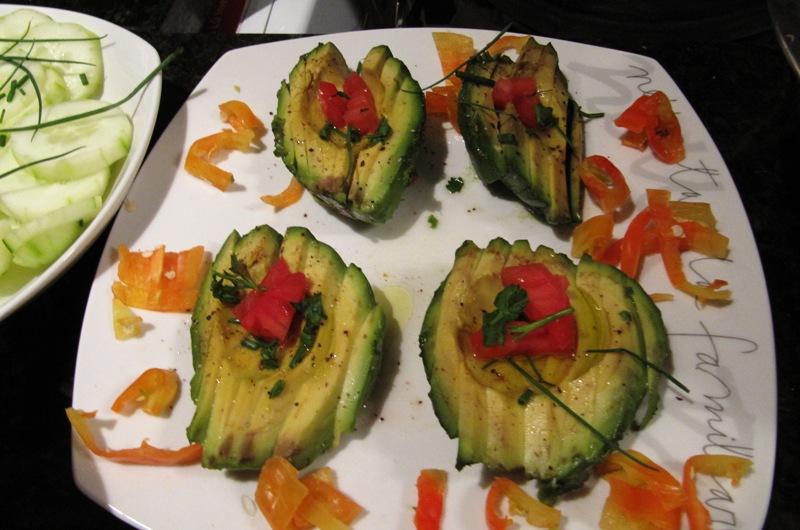
Chilean avocados

Chilean avocados

We wandered through the fresh food market gaining inspiration for a delicious meal.  We picked the spiciest peppers, colorful quinoa, and a mix of plump veggies.  Back at the apartment, we cooked a feast and shared some wine.  A home cooked meal that was perfectly fitting end to our days in Santiago.  Thank you to our wonderful hosts, Bobby and Stephanie!

Shrimp over quinoa and fruit salad

Shrimp over quinoa and fruit salad

City, Beaches, and Cristo Oh My (by Nathan)

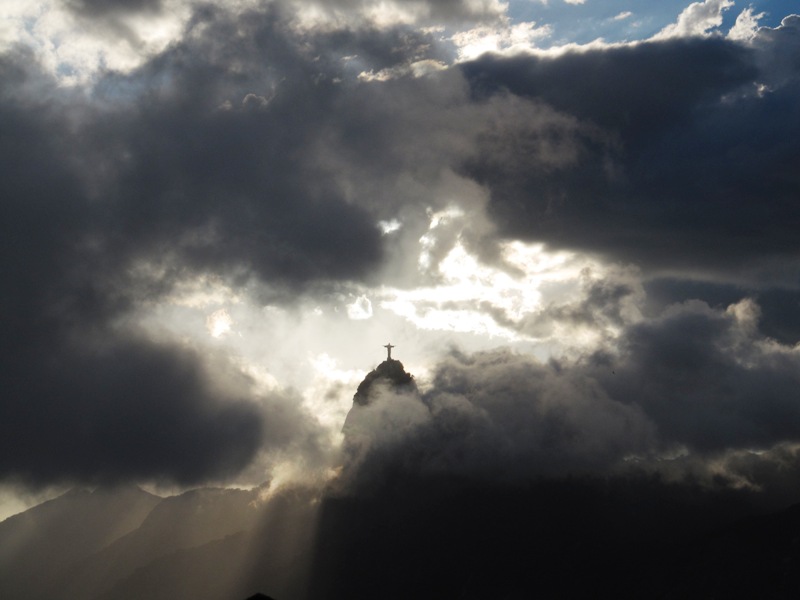
Rio de Janiero is engulfed by skyward reaching tropical mountains.  At the top of biggest and most prominent peak stands Cristo Redentor (Christ the Redeemer), the famed symbol of the city.  No matter where you are the Cristo is always overhead, always watching.  We wanted to see what he saw.  But we made our way slowly.

First we explored the lowlands, we baked in the sun at Ipanema, we drank coffee at Colombo, hiked the steps at Lapa and always just behind a cloud or shining brightly in the sun, the Cristo Redentor was there.

Parting of the clouds at Corcovado

Parting of the clouds at Corcovado

Our first vista of the city from any elevation was from the Morro da Urca.  This smaller mountain was a great little climb leaving us both out of breath and satisfied that this was at least a little training for our eleven days of hiking planned for the Peruvian Andes in May.

Marmoset at Morro da Urca

Marmoset at Morro da Urca

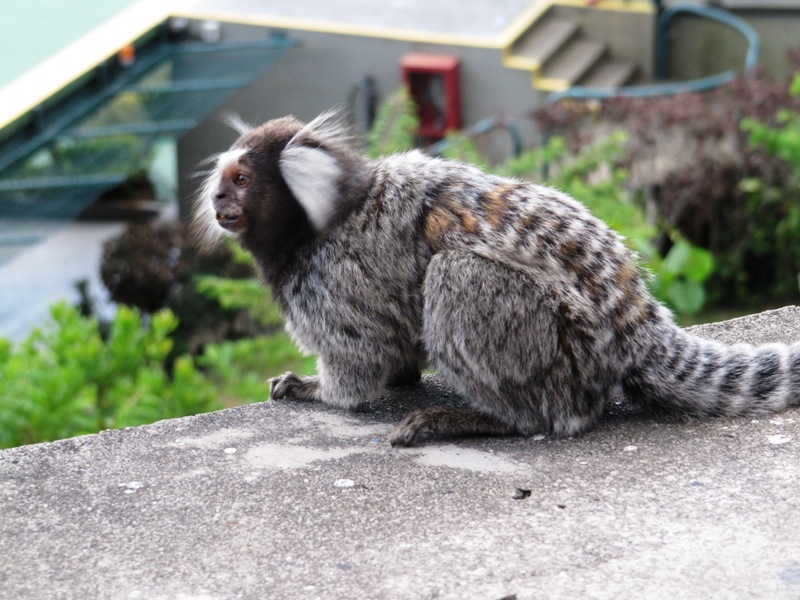
Upon reaching the summit we found another creature with an omnipresent watchful eye.  This common marmoset and his gang of friends looked like they would jump us and steal our granola bars if we approached too close.

Pão de Açucar from Morro da Urca

Pão de Açucar from Morro da Urca

The Morro da Urca can also be reached by cable-car for those not wanting a hike. From Morro we then took a cable-car to the main attraction, the Pão de Açucar (Sugar Loaf Mountain).  The hill is named after its familiar shape to the loaf of sugar made during pre-industrial refining.  It is a tall (400m) hill with shear and jagged cliffs all-around and of course has some of the best views of the city.

Sunset from Pão de Açucar

Sunset from Pão de Açucar

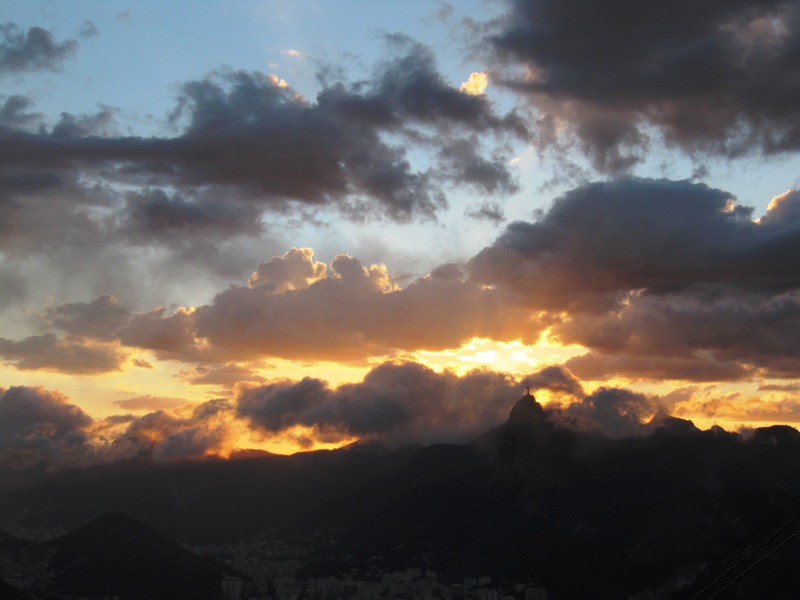
We arrived at sunset and we gazed out into the golden city.  The Cristo, high up on the Corcovado peak was shrouded by his apostle clouds.  The colors transitioned from a warm tangerine orange, then cadillac pink, then in flowed the deep purples, that, with the darkness brought the cool night.

Cristo Redentor

Cristo Redentor

The day finally came for us to visit the Cristo Redentor statue.  Up close we were able to view the intricate details  cast into the concrete: the seemingly flowing fabric, the tranquil facial expression, and the arms spread wide welcoming everyone to him and to Rio.  The statue is an elegant piece of art deco, angular, flowing and full of emotions.

Rio from Corcovado

Rio from Corcovado

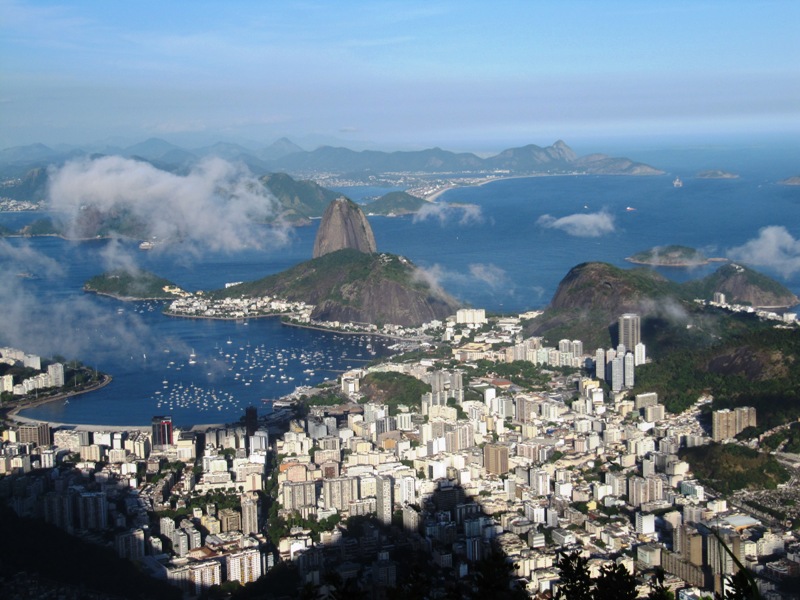
Turning around from the Cristo we saw the city of Rio from his perspective.  The botanical gardens, Copacabana, Pão de Açucar were all there, tiny specks in this beautiful city.  The buildings kissed the sand and the ocean appeared endless as it wrapped around the urban landscape.  Rio de Janiero has it all: food, music, dance, beaches, city and transit.  Could we move here and learn Portuguese?

Rio Historic (by Carmen)

Central Rio's narrow streets

Central Rio's narrow streets

I often think of Rio de Janeiro as a modern city complete with problems caused by rapid, unplanned urbanization.   I hadn’t much thought of historic Rio but it was a pleasant surprise to find it.  I know not all of you are not history buffs.  I am no expert either, but I love my hostoric trivia.  For example,  the city was founded in 1565 and has functioned as an important port for centuries.  It was also the seat of Latin America’s only monarchy.  Don Pedro I and Don Pedro II reigned from 1822 to 1889, when Brazil was declared a republic.  Ok… I´ll tone down the trivia for the rest of the post.   :)

Cafe Columbo

Cafe Columbo

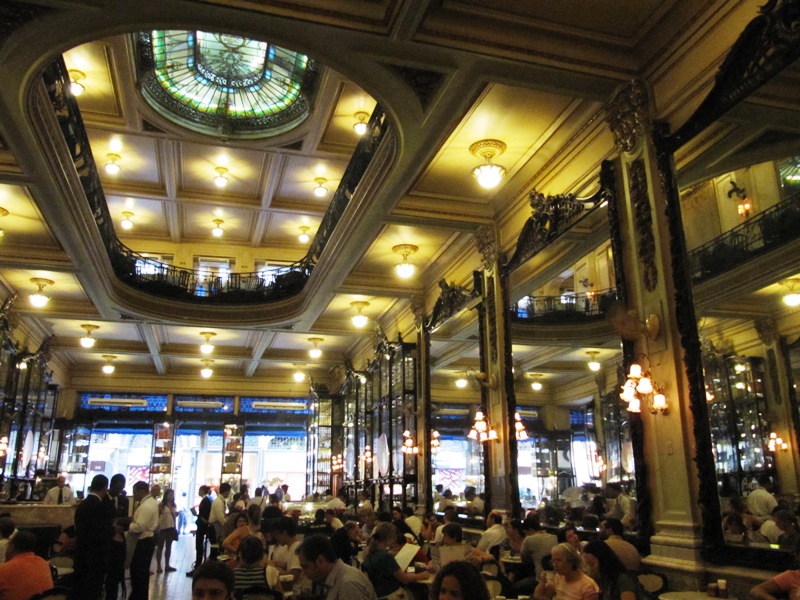
A mix of colonial and modern buildings fill in the narrow streets of Rio’s center. It’s on one of these streets that Cafe Columbo can be found.  After all the historic cafes of Buenos Aires I wasn’t expecting much from this one.  But I was wrong. It was beautiful, bright, elegant and airy.  Huge mirrors lined the walls so that soft light bounced throughout the cafe.  The sweets they offered weren’t as spectacular as the surroundings but they were still good.  Drinking coffee and eating a fruit tart at Cafe Columbo is a lovely way to spend an hour or two.

Sad transit breaks my heart

Sad transit breaks my heart

Just uphill from the center area is the Santa Teresa neighborhood.  We tried to take the historic streetcar that rides along the city’s old aqueduct (history AND transit, woot!) but it wasn’t running.  The strange thing is no one would tell us why.  Finally, a friendly shop owner told us that a few years ago the streetcar had flipped over killing 6 people!  It was a tragic accident that the government says they are fixing.  But they are taking too long and the residents are upset.  Hence the crying tram.  I hope the city gets their act together by 2014 because the tram is an important lifeline for the residents of Santa Teresa.

Funky Brazilian flower

Fountain at Jardim Botanico

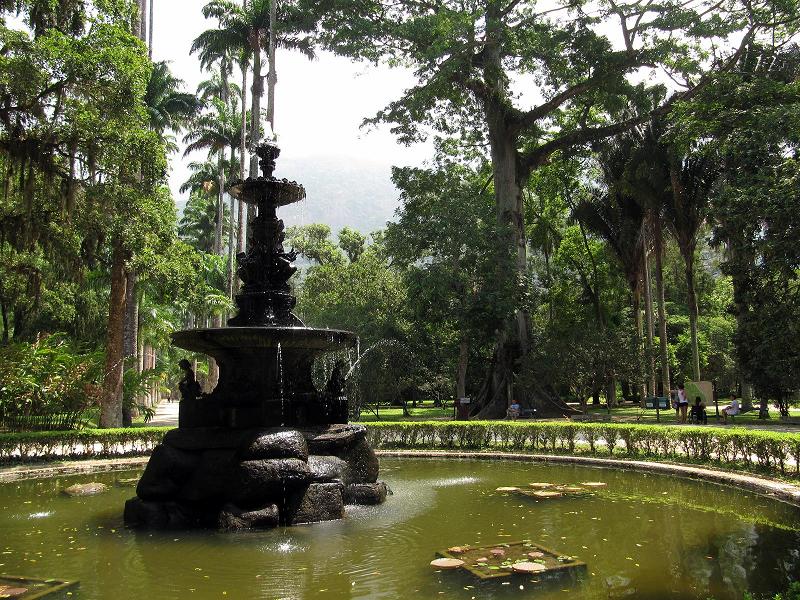
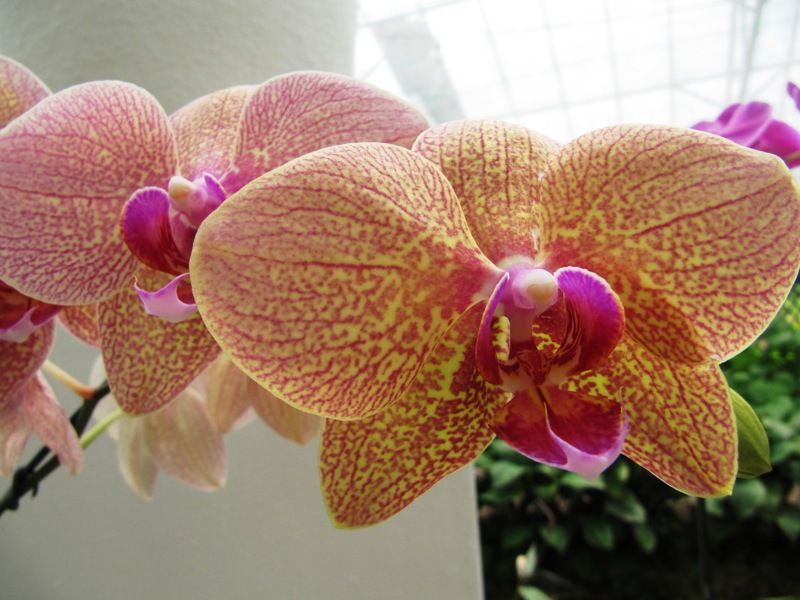
One more history lesson was at the Jardim Botanico, founded in 1808.  Since Rio was our most tropical destination, I was pretty excited about this one. It had some pretty extraordinary flowers, like the one with thick red petals and a prickly yellow center.  And of course, they had plenty of orchids.  But my favorite part turned out to be the historic central fountain.  Palm lined paths led up to it and it was backdropped by the Corcovado (the mountain with the famous Cristo statue on top of it).

Orchid at the Jardim Botanico

Orchid at the Jardim Botanico

Rio’s history added another layer to this beautiful city.

Finding Heart and Soul in the Favela (by Nathan)

Reading a guidebook about Rio can make you think that you need an armored tank to move around the city.  “Do not go to the beaches at night”,  “take taxis at night” and “watch your belongings” were statements that echoed in our ears over and over.

What we found was quite different- a city that was full of community and great people wherever we met.  That does not mean that we ignored these suggestions, but we recognized that, like any city in the world, tourists are easy targets for theft.  With our heads down and hands tight on our bags 8 feet 4 mouths (ie. us & Carmen´s parents) had a memorable trip to this great city.

Rocinha favela from above

Rocinha favela from above

Part of the reason Rio is recognized for its crime is because multiple favelas are perched next to the main sights and the city.  A favela is basically a squatter community that houses thousands of people that need to work in the city, but cannot afford the city.  So in Rio when rural populations rushed the city for jobs, they built their homes on the cliffs surrounding the city.  Now, the squatter communities have expanded and grown to form huge networks of buildings and businesses.

I was so intrigued about this intertwined network of buildings, people and  resources.  I wanted to see it for myself.  I wanted to walk through the randomness of it, I wanted to get lost in the alleys and experience the favelas in some way more than just squinting from afar.  But wondering through a favela is pretty unsafe.  And on a tour I did not want to be the spectator that exploited the poverty of the people.  It was a torn decision, but I ended up walking with a small group and guide through one of the favelas.  The end experience was rewarding in ways that I could never have anticipated.

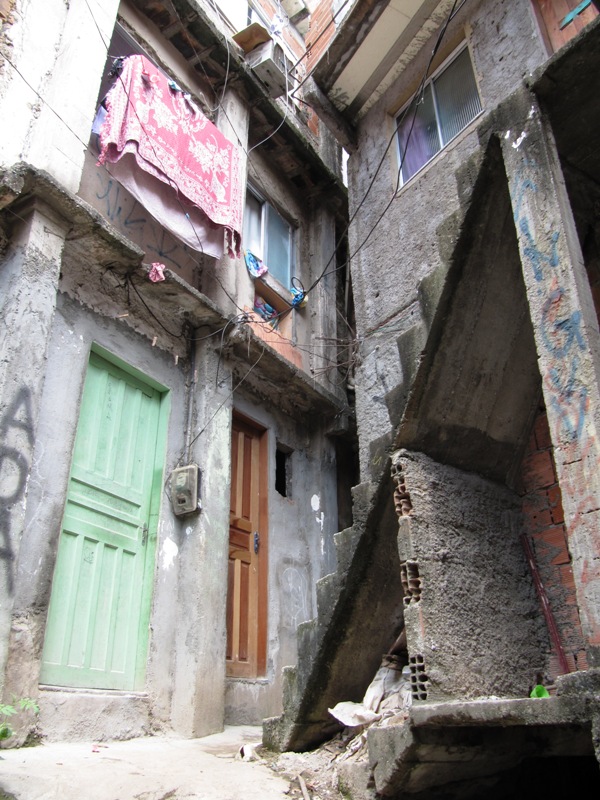
Favela doorway

Favela doorway

My day started with a minivan picking me at the hostel and taking me to the base of the biggest favela in Brazil, Rocinha.  There are only 4 roads in this favela and only one gets to the top.  All the buildings are connected with tight paths and staircases.  Although busses attempt to navigate these roads, I hopped on the back of a scooter, the favela taxi.  Imagine Lombard St. in San Francisco, a little wider, a little straighter and just as steep.  Now add a bus coming downhill, road construction taking up a third of the road and fifty or so motorcyclists with passengers racing eachother to be the first to the top.  The German tourist I made friends with in the minivan wore a pink helmet and I could not help but laugh and give him a thumbs up as my driver revved and pried his way between the front of the bus and his scooter.

We made it to the top without incident.  The main street in the favela was nothing that you would expect.  This was not some lean-to hodge-podge of a settlement, this was a mini city.  And the four main roads were the downtown of this mini city.  There was everything here: markets, appliance stores, restaurants and even pet stores all lined up on this winding street that snaked up the mountain through the favela.

Favela Walkway

Favela Walkway

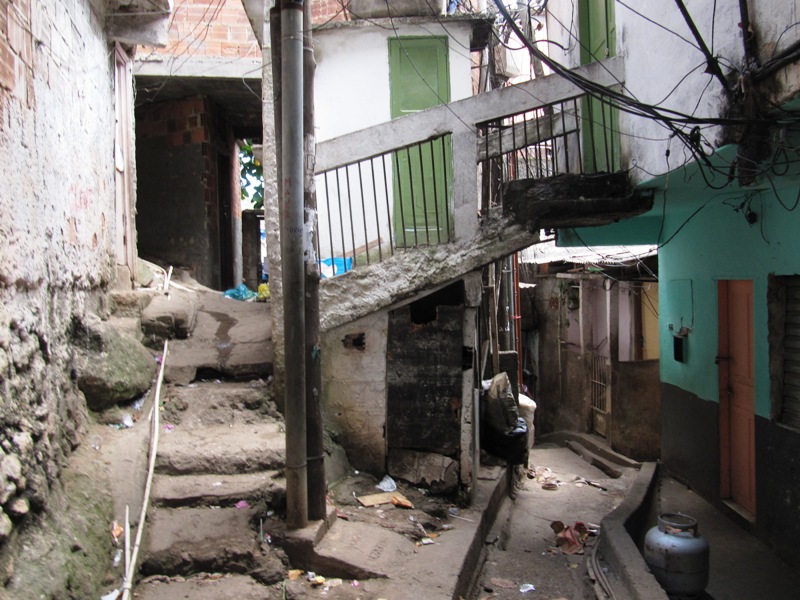
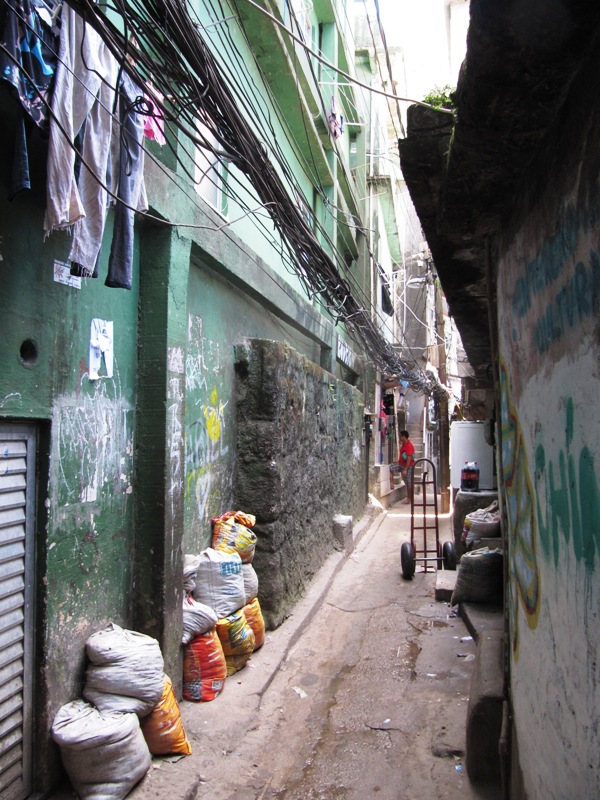
Stepping off of the paved road was an immediate change of climate to a network of tight alleyways and staircases that weaved there way through the community.  And again buildings were not what I had anticipated, this was not a shanty town, not a slum, but a streetless city of real buildings, a favela.

There is major construction happening here, two and three story masonry buildings with concrete columns.  And what an effort because everything has to be carried or wheel-barrowed through the winding paths.  Every building appeared to be part of some bigger plan, with a little more money another room could be added, or maybe next month the plaster could be complete.  The people and community worked day-to-day and month-to-month to build shelter for their families.   The construction was not the greatest but in most cases it looked straight and they even had some rebar in it.

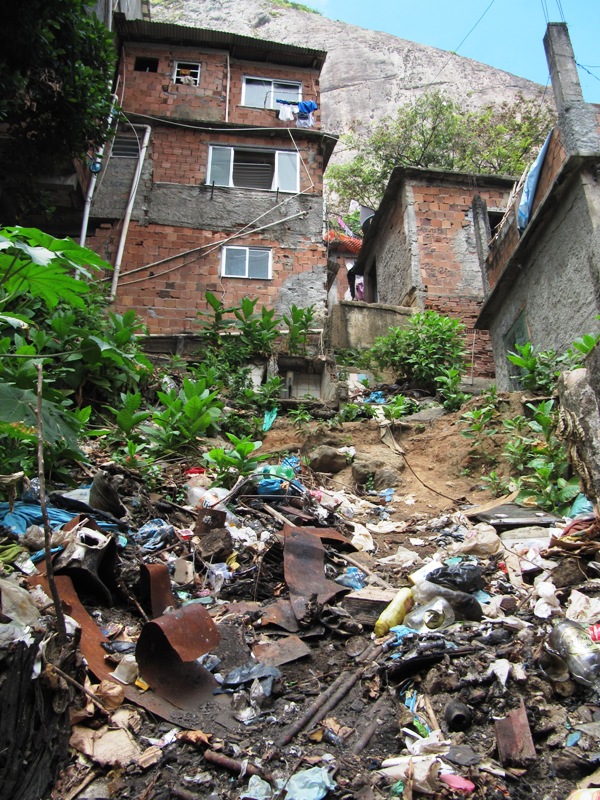
Trash and rubble from mudslide

Trash and rubble from mudslide

The positioning of buildings is chaotic with very little order.  The pathways follow the way of least resistance zig-zagging through the hillside.  As we approached the steepest parts of the hillside we started seeing the effects of the storms of the previous rainy season.  Whole homes crumbled from mudslides and toppled over one another until eventually it was contained.  The pathways were cleared and the rubble remained.  I guess it stays until the next family forgets about the incident and decides to build their home there.

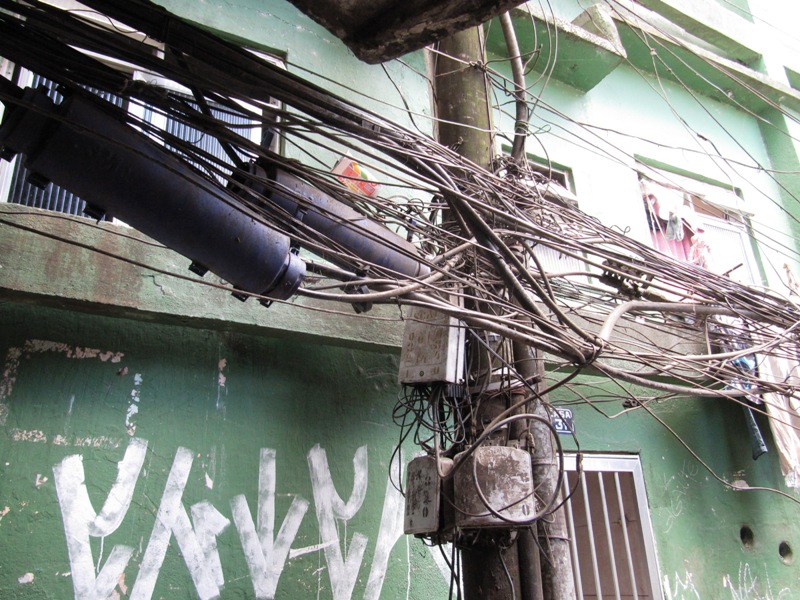
Electricity Nest

Electricity Nest

The squatter aspects of the favela are most apparent when looking up along the sides of the buildings.  Electricity connections merge into nests of spliced and re-spliced wires and cables.  Water is supplied by the city, but the pipes run along the alleyways and are similarly spliced and split.  Sewage was not so “organized,”  sometimes it ran in pipes, othertimes in trenches and well othertimes, the greywater just overflowed onto the tight alleyway.  The biggest issue was for the downhill residents when it rained, because everything flowed towards them.

We continued our walk through the favela, meandering down through the alley ways, slipping around corners and discovering more of the labyrinth of buildings.  Amazingly, there is an estimated 200,000 people that live in this one favela that is one square kilometer in area.

Favela colors

Favela colors

We stopped at multiple locations in the city for the guide to talk about the favela, teach us about the schools inside the community as well as welcome us into the local businesses.  It was here that I realized that we were not just spectators of the impoverished favelas, but as tourists we were part of something bigger that supported and contributed to the community.  We bought art, crafts, drinks and food which brought money into their economy.  We listened the drum style and dance that originated from the favelas.  And we  oohed and awed at all the little children napping in the preschool.

Our walk through the favela was completely safe.  Residents said “hello” to us to practice their english and we replied with our few known words of portuguese.  I enjoyed seeing how happy people were.  All the residents appeared to know my guide and they gave him high-fives and compliments wherever went.

Favela stairs

Favela stairs

The scramble to the bottom took a couple hours.  It is extremely impressive to imagine climbing these walkways on a daily basis.  Thousands of people do it, in fact there are over a million people living in favelas in Brazil.  We walked along and stepped to the side from time to time as a group of men carried a refrigerator up the steep steps or a group of school girls passed talking on their mobile phones.  Yes, many of these residences had all sorts of appliances.  An hour walk from the main road and we could peek into a home and see a family cooking a delicious feast, and others watching TV from their sattelite dish and more just enjoying the sun on the patio.  How is this different from anywhere else?

I think what I like most about the Rocinha was the whole collaborative community aspect of living in the favela.  Despite that everyone was thrown into this random maze of buildings, the people found the time to help each other, to laugh and to work together for their community.  The colors of the buildings and the bright smiles of the people are to be remembered forever.

Eating too much and staying up late in Rio (by Carmen)

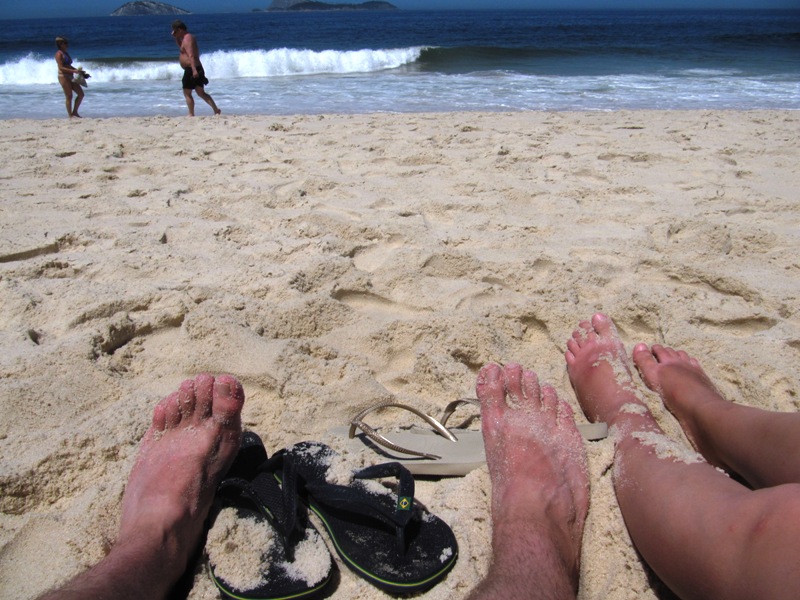
4 feet in the sand

4 feet in the sand

So we didn’t spend all day at the beach!  Although it was tempting.  We mixed it up with some good sights, food and nightlife too.  Our entire time in Rio was spent with my parents.  Four mouths to feed usually means that we got to try even more dishes when eating out.  But on our first night in Rio, all four wanted the same thing: feijoada.

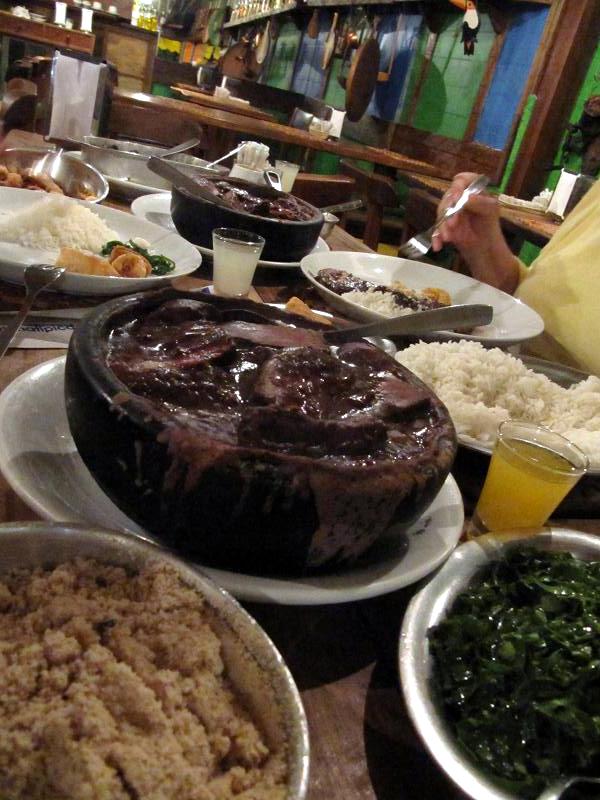
Feijoada

Feijoada

Feijoada is the national dish of Brazil.  It consists of black beans stewed with meat, served over rice and other side fixings.  We chose a place that specializes in feijoada and were pretty excited to fill up on some homey comfort food.  All four of us ordered the feijoada but the waiter kept shaking his head and saying that was too much food.  He kept suggesting that we mix it up with something, such as la truta (trout).  It didn’t seem like he was getting money out of us – it was more of a cultural misunderstanding. Nonetheless, we insisted on getting feijoada and 4 huge bowls of it landed on our table.  We could’t even make a dent as it was a feast for ten people.  But it was good. And now, whenever a misunderstanding occurs (which is often) Nathan and I shrug our shoulders and say ¨la truta!¨(you have to say it very emphatically with a long drawn out “ah” : )

Bossa nova nightlife

After the feijoada we were in food coma mode.  But we charged on to the bossa nova club.  It was awesome!  The singer performed a mix of old standards and a few less familiar songs too.  My dad would play bossa nova while I was growing up and I’ve loved the genre ever since.  This was a special treat.

Shrimp wrapped with fried noodles at Manekineko

Shrimp wrapped with fried noodles at Manekineko

Brazil has a lot of Japanese immigrants so we were excited to find Manekineko, a japanese brazilian fusion place.  Fusion in this case means mostly japanese food with the chefs adding cheese and frying things when they found the opportunity.  Nothing amazing but it was fun.

Fresh juices and smoothies at Market

Fresh juices and smoothies at Market

I think the best thing about the Rio food scene (and Brazil for that matter) is the wonderful array of juices.  Everything from pineapple to kiwi to avocado to pears.  Mixed the way you want.  I want a juicer now!

Palm hearts and sashimi at Market

Palm hearts and sashimi at Market

One of our best lunches was in the palm shaded patio at Market.  The organic certification reminded me of California.  As did the quinoa salads and salmon sandwiches.  But after so many heavy dishes, I liked being reminded of home.

Samba club in Lapa

Samba club in Lapa

Our meals fueled us up for a big night out in the Lapa district, which is a hub of Rio nightlife.  We went to the club with the biggest crowd and loudest samba band.  I loved how people of all ages were dancing between the tables.  It was great to put my year of samba lessons to use!  This inspired me to come back for Carnivale…maybe next year…

Copa and Ipanema, the Beaches of Heaven… (by Nathan)

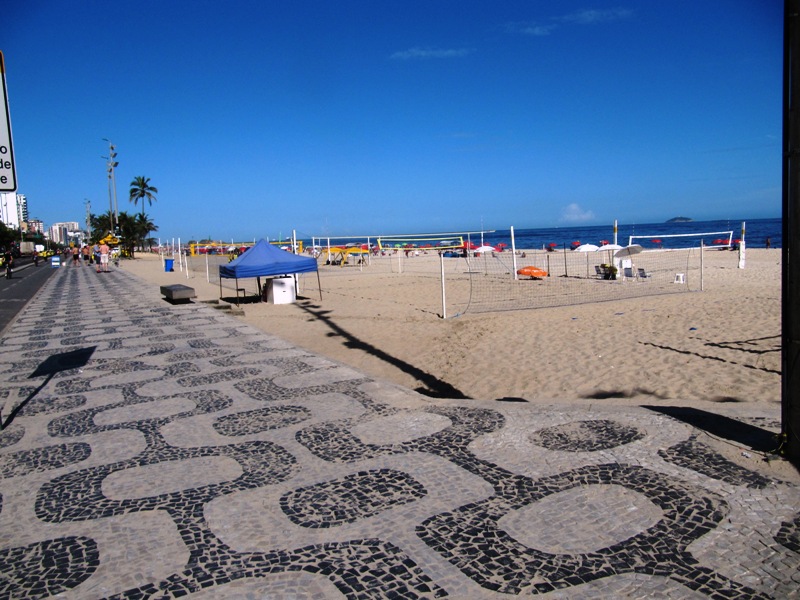
Sidewalk along Ipanema

Sidewalk along Ipanema

Rio is by far one of the most beautiful and exciting cities.  Imagine walking along a beach with incredibly soft sand.  The waves are crashing in front of you.  Behind you there are majestically steep mountains surrounding a city of highrises that come right to the water.  These are the beaches of Rio.  And they are blissful.  The beaches and laid back atmosphere sometimes reminded us of California.   But the setting was much more urban.  Los Angeles can learn a lesson from Rio on how to build a proper beach side city.  LA, you planned it all wrong!

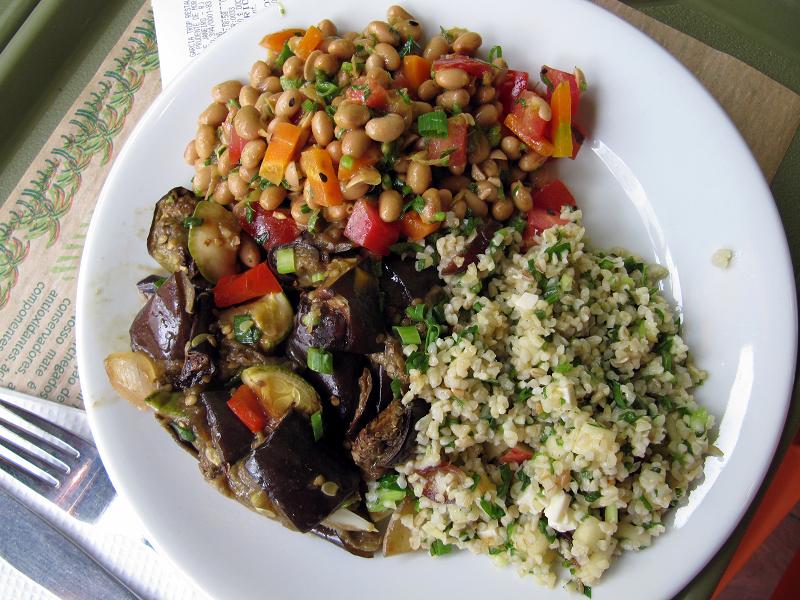
Delirio Salads

Delirio Salads

Even the food has a California type feel with an abundance of fresh local salads.  At one of our first restaurants we were hit with the flavors of Brazil and the realization that finally we were in a country that loved their veggies.  The variety of salads is something to awe  at.  Vegetables cooked and raw and delecately infused with new and known spices.  And Brazil cares about variety so we lucked out.  2 blocks from our beashside umbrella on Ipanema was Delirio Salads which was had some 20 options that were all fenomenal.

Girl from Ipanema (i.e. Carmen)

Girl from Ipanema (i.e. Carmen)

First let´s describe the sand.  The magic I think must be in the sand.  The beaches are not exactly white sand, but the texture is soft, real soft.  Slipping your feet into this sand is like having your feet wrapped in warm velvet.  The sand is like like brown sugar and just as sweet for your toes.

Copacabana Beach

Rio’s beaches are enormous.  The two popular ones, Ipanema and Copacabana make up about 5 miles of bliss.  The waves were big and there was a hefty riptide.  There is also a beautiful sidewalk along the full length of the beach, tiled with Poruguese black and white patterns.

Sunset on Ipanema over ¨Two Brothers¨

Sunset on Ipanema over ¨Two Brothers¨

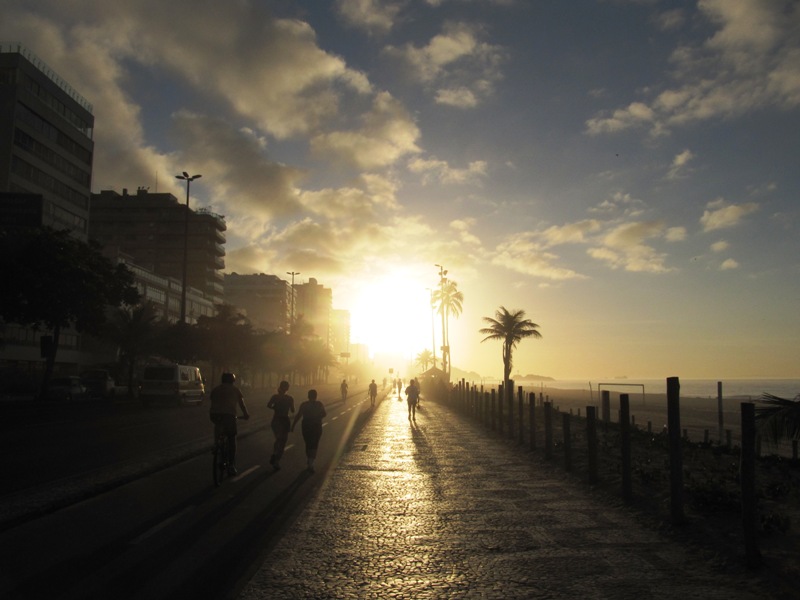
The beaches can be enjoyed at almost all times of the day.  The sunsets there are breathtaking and the sunrises are passionate with color.  The beauty is omnipresent.

Ipanema sunrise

Ipanema sunrise

These beaches are destination worthy sights on their own.  Thrown in the amazing food, the history, the samba nightlife, the mountain-top vistas and crazy high-speed bus rides and Rio has become one of my favorite cities.

Moving to Buenos Aires? (By Carmen)

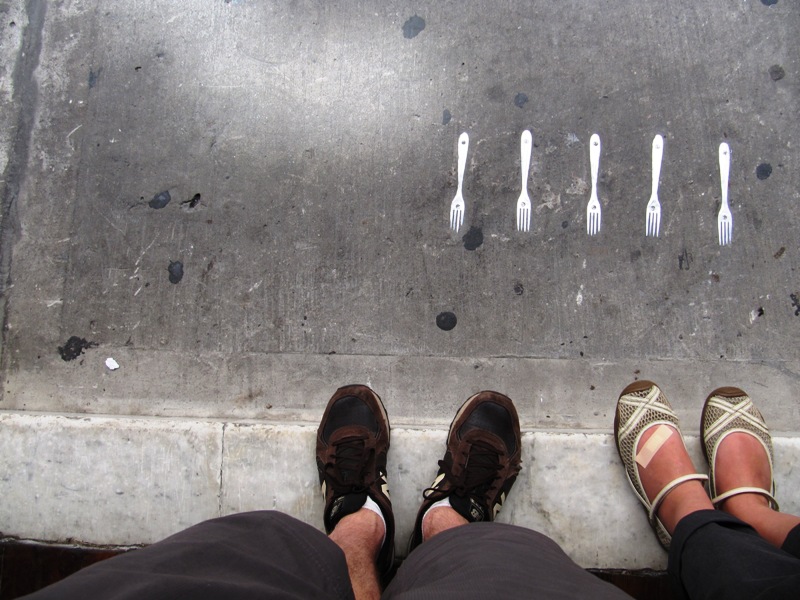
4 feet 5 forks - we found these embedded in the sidewalk. Seemed appropriate :)

The question Nathan and I ask ourselves about every city is, “Could we live here?” BsAs has its pros and cons.  We´ve written about the highlights such as great markets, fanatic fútbol culture, tango, inexpensive transit and good food and wine (particularly pizza).  There are a couple other items we didn´t have time to cover:

Nightlife – A good night out isn´t hard to find in BsAs.  That is, as long as you can stay up late enough.  Things don´t really get started until 2am or so.

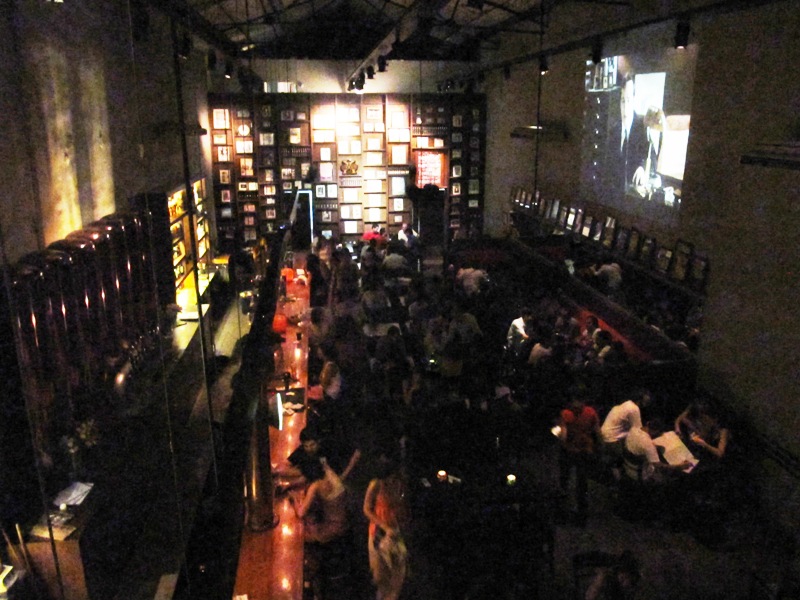
Antares Bar on a Friday night

One of our first outings was at Antares, a local microbrewery.  Because we were still jet lagged, the late night was easy! It wasn´t the best beer we´d ever had but the bar was hopping  and had a great atmosphere.

The marble bar at Million

Another night we went to Millon, an upscale bar in a beautiful setting and prices to match the name.  Friendly bar tenders, good cocktails, 2 for 1 happy hour.

La Bomba de Tiempo at the Konex Center

Every Monday there is an awesome drum show called La Bomba de Tiempo at the Konex Center.  This is one of the rare early nights in BsAs since the show is from 8-10pm.  It attracts a young crowd that jumps in rhythm to the 12 or so drums on stage.  You can´t help but want to dance.

La Peña de Colorado

On our final night we checked out the Peña de Colorado.  There we heard more traditional music with guitars, harmoicas and vocals.

Menu from the closed door restaurant

Blurry picture of me on the stage with my raffle winnings

Closed Door Restaurants – One of our favorite nights was at a closed door restaurant in the Almagro neighborhood. A classmate from the spanish school invited us to join in.  She actually lived in the house where the restaurant took place every Friday.  Her roomates were the chefs and the entertainment since their band also performed.  The food was great, the crowd was lively, the tunes were awesome.  I won the raffle too so I got a CD of their music!  After this night, I really started to feel comfortable in BsAs.

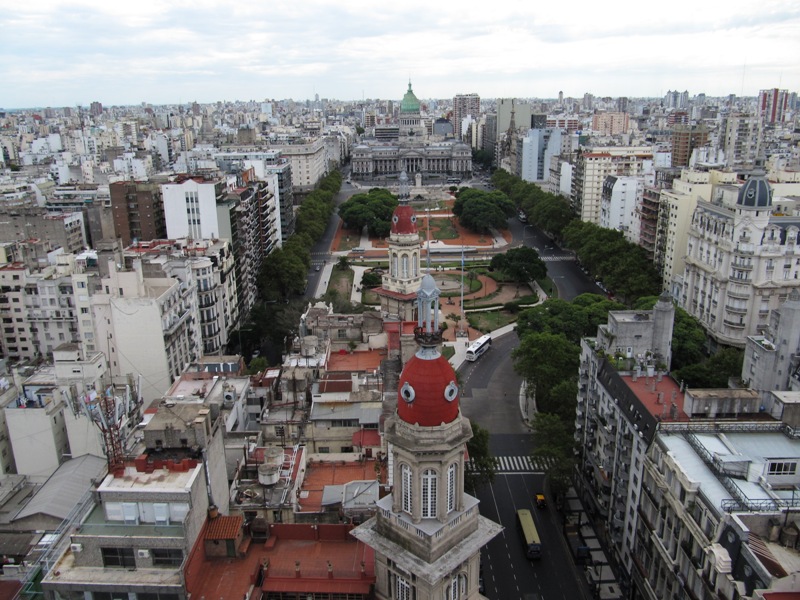
View of Plaza Congreso in Buenos Aires

Calle Florida

Architecture – Another great characteristic of BsAs is its elegant architecture.  This is probably what makes it feel most like Paris, the city it’s always compared to.  Beautiful buildings can be found on almost any street.

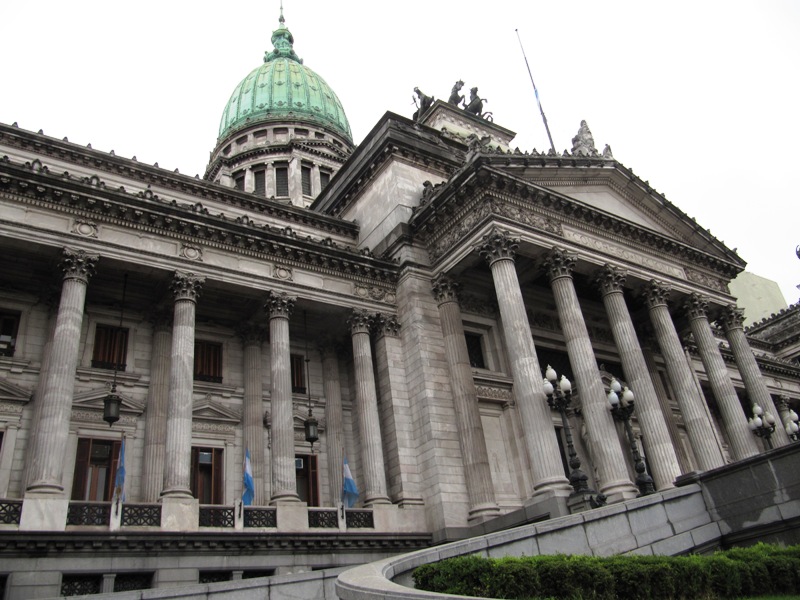
El Congreso

One of the landmark ones is the Congreso, where their national government meetings are held.  I highly recommend the tour of the inside.

Palacio de Aguas Corrientes

Another beauty was the Palacio de Aguas Corrientes (Palace of Running Water).  It was constructed to hold the city´s first water pumps.  Today it still has the pumps as well as a museum about plumbing.  Complete with old toilets.  Awesome.

So the question is, could we live here?  For me the answer is yes.  The city has totally charmed me.  There are definitely drawbacks.  For example, you can´t hurry an Argentinian.  You sit at restaurants for 20 minutes waiting for the bill you already asked for.  But at the same time, this pace of life forces you to relax.  And looking out the window of a cozy cafe in BsAs is a pretty great place to relax.  I’ll miss you BsAs!

Finally, just for the fun of it, here are a few more pics we couldn’t fit in elsewhere:

View from the river in Tigre, a cute town on the edge of BsAs

The Recoleta Cemetary was one of our favorite sights in the city and has one of the best weekend markets outside its gate

The seal of Argentina can be found everywhere

Pierinos again! Delicious ravioli

Post Navigation