4 feet 2 mouths

walking and eating our way around the world

Archive for the category “Latin America”

Iguazú, Argentina Style (by Carmen)

Nathan beautifully described the experience of Iguazú from the Brazil side.  With its stunning vistas and platform right near the Garganta del Diablo, it may seem like you have seen it all. But Nathan and I found that the Argentina side had a lot to offer as well.  Contrasted with Brazil, it gives a more up close and personal view of the falls.

Garganta del Diablo

Garganta del Diablo

The first thing we did on the Argentina side was to see the Garganta de Diablo from the top.  This is the largest of the falls and one of the most impressive.  There is something strangely mesmerizing about so much water free falling hundreds of feet.

Trees and cascadas

Trees and cascadas

Next we hit the upper trail that looks at a series of waterfalls from the top.  Even though there is a banister, the act of looking down a straight drop into the turbulent water at the bottom made me a bit dizzy.

San Martin waterfall

San Martin waterfall

Finally, we weaved our on the lower trail.  Parts of this almost go under some of the “smaller” waterfalls.  There is even a small ferry that takes you to an island in the middle of it all.   The island has a short walk to one of our favorite vistas.  From here you can feel the power of one of Iguazú´s major cascades, San Martin.

Cascadas, San Martin on left

San Martin is loud.  You can hear the water screaming its way down.  One of the signs nearby had a picture of San Martin during a major drought in the 1970s.  This all mighty waterfall was literally reduced to a trickle.  It is hard to imaging compared to the heavy flow present today.  But it is a reminder of how fragile a seemingly invisible force of nature can be.

Foz do Iguaçu – Brazil (by Nathan)

For being one of the most spectacular natural wonders of the world, I am amazed that more Americans do not know about the Foz do Iguaçu.  It was unknown to us too, but with more trip planning it became an essential site and it fit seamlessly with our gringo trail through South America.

Foz do Iguaçu from Brazil

Foz do Iguaçu from Brazil

The waterfalls are at the border of Brazil, Argentina and Paraguay.  Paraguay used to have waterfalls, Guaíra Falls, they were so big that they had the highest volume of water flow in the world.  Now the Itaipu dam and reservoir sits in its place.  Nevertheless, Iguaçu still exists and it is thrilling.  The main viewing of the waterfalls is from a series of over-looking platforms from the Brazil side and weaving pathways through the waterfalls on the Argentinean side.

Toucan

Toucan

For anyone coming here, see the Brazil side first to get the big picture views, then go to the Argentinean side the next day to get up close, wet and personal.  Spend at least three nights, but these tiny cities have many other great activities and ecological reserves, Carmen and I left thinking we would have liked two more days.  The region is a jungle with lots of great wildlife.  We saw wild monkeys, toucans and coati.

Bahian Moqueca

Bahian Moqueca

When in Brazil, eat moqueca.  This stew of seafood, manioc and vegetables is hearty and perfect for a long day of hot humid hiking.  No car necessary, we grabbed a local bus for about $2 and it took us right to the park entrance.  We started along the south end of the park moving from vista to vista and worked our way to the biggest of the falls.

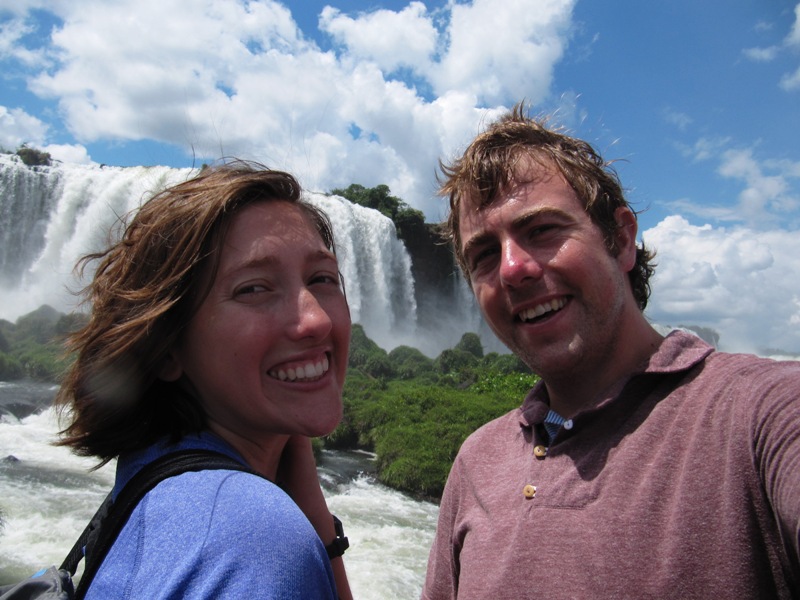
Us at the falls

Us at the falls

The awe-struck feeling that hit me when looking out into the valley was intense. My heart started throbbing rapidly, my ears became deaf by the thunder of the falling water and all that I could do was stare out, mouth open and probably a little drool hanging off my lip.  I was dumbfounded by the beauty of it all.

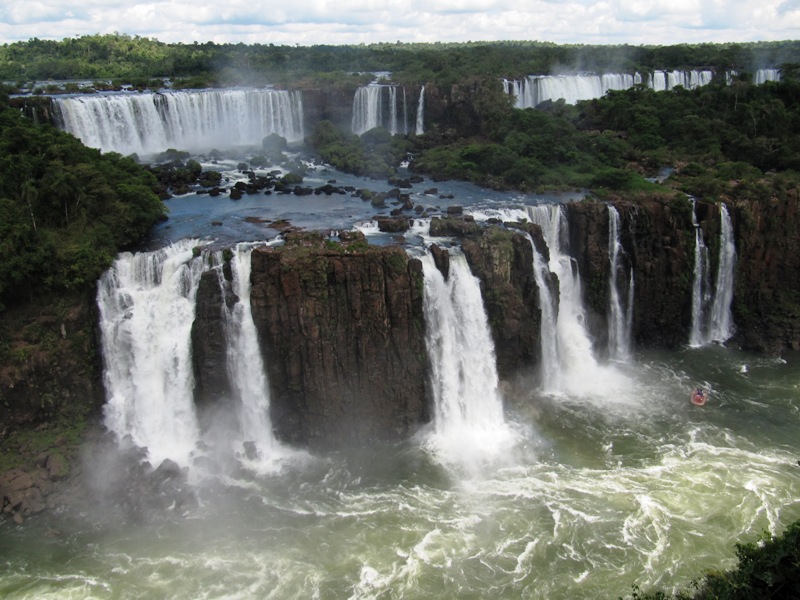
Foz do Iguaçu 2

Foz do Iguaçu with boat underneath

There is not just waterfall, there are hundreds.  A huge lake drains over cliffs that are 100-350ft.  The volume of water is breathtaking, 62,000 cu. ft. per second!  That is basically the entire volume of Lake Arrowhead in 2.5 seconds and Lake Anza in 0.5 seconds.  You look down and there are boats driving underneath the “smaller” waterfalls.  In a rush of excitement Carmen and I boarded one of these boats and we realized that this off-shoot waterfall was not small! volkswagen volumes of water dumped on us every second. With my yells “¡Ya estoy muy sucio!” and “Otra vez.” The driver dunked me another time.

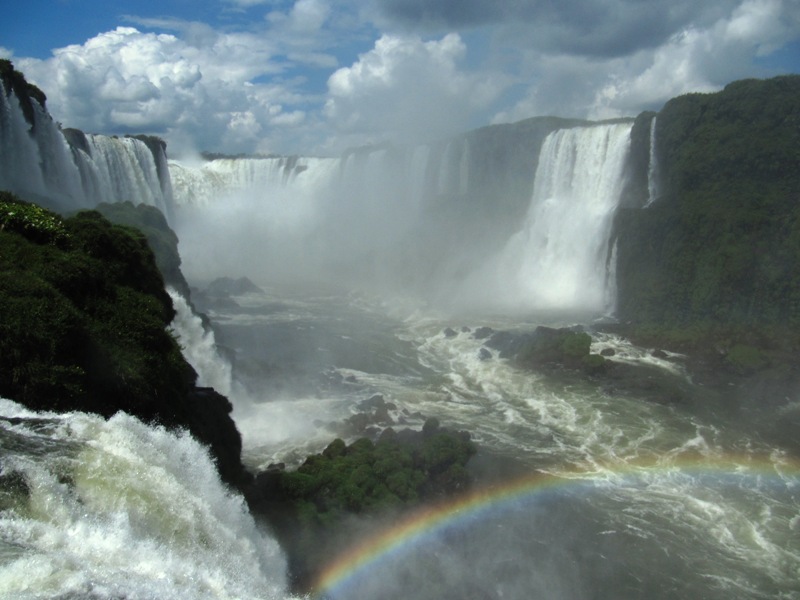
Rainbow and Garganta do Diabo in distance

Rainbow and Garganta do Diabo in distance

The last platform is the grand finally-  a concrete walkway and vista right in the mouth of the Garganta do Diabo (Devil’s Throat).  You stand so close that it is impossible to stay dry or even take pictures.  This is not because we stood underneath the waterfall, but because the mist engulfed us in a wet cloud.  This also made for some colorful rainbows.

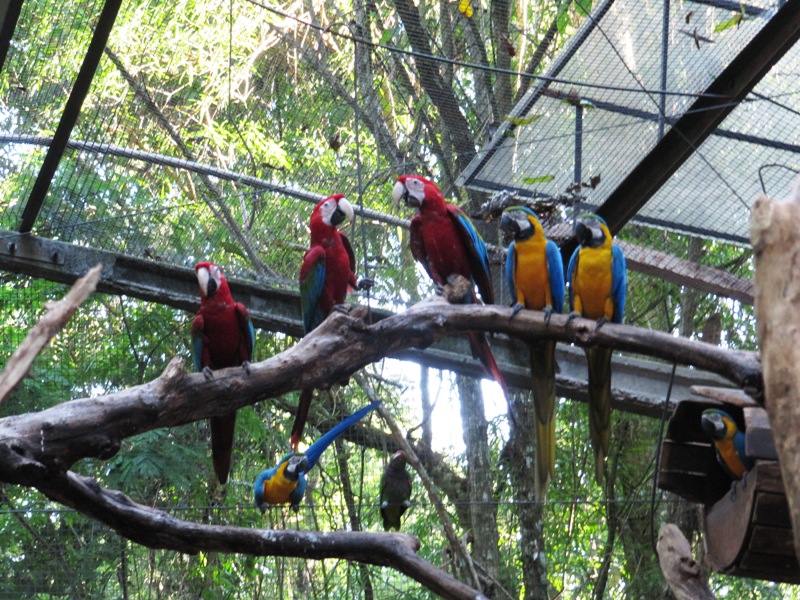
Ominous makaws

Ominous makaws

A five minute walk from the Brazil-side entrance is a phenomenal bird park.  I usually dislike zoos, but I was fascinated to see one dedicated to tropical birds.  There were so many colors and patterns, I had no idea that this many birds even existed.  In one of the “experience” cages Carmen and I stood in a small hangar with thirty or so macaw parrots of bright red, purple, blue and orange.  Suddenly they all dove off of their perches right at us.  They swooped and we dropped to the ground covering our heads imagining that this was a colorful version of the Hitchcock film, “The Birds.”  We survived and were entertained to find out that they were just flying to the other side.

Foz do Iguaçu is a beautiful place.  It is memorable in every way, an essential destination to every South American trip.  I am so ecstatic that Carmen and I had this opportunity.

LA + NYC = São Paulo (by Carmen)

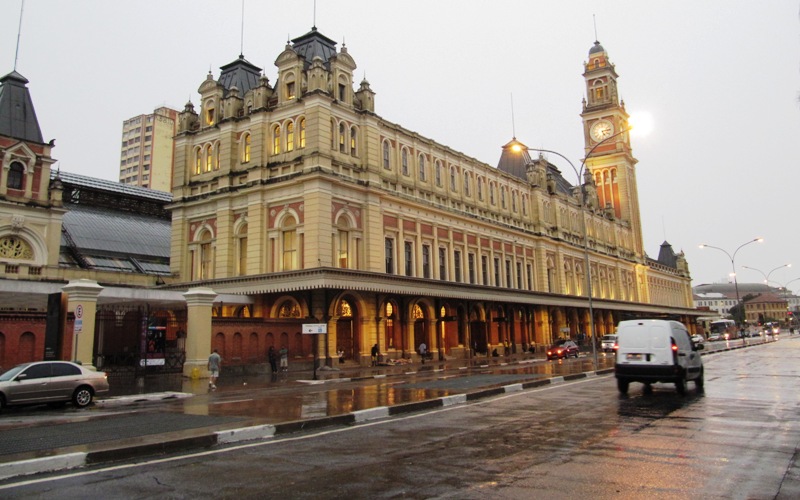
Estacão de Luz

Estacão de Luz - there aren't a whole lot old buildings in SP. Actually, most of it is modern and, well, ugly. But this train station provided us some shelter from a downpour.

In Anthony Bourdain’s episode on São Paulo he mentions that the city feels as if Los Angeles threw up on New York. A rather crude description but pretty accurate as well.  Like NYC, SP has a great subway system, a huge population (20 million people in the metro area!), more than a few skyscrapers and a wide variety of cultural activities.

The clean metro of São Paulo

The clean metro of São Paulo

Like LA, SP is a sprawling city laced with numerous choked up freeways.  Since it’s so spread out it’s not a city to wander around by foot.  It really helps if you have a friend who lives there and can show you around. 

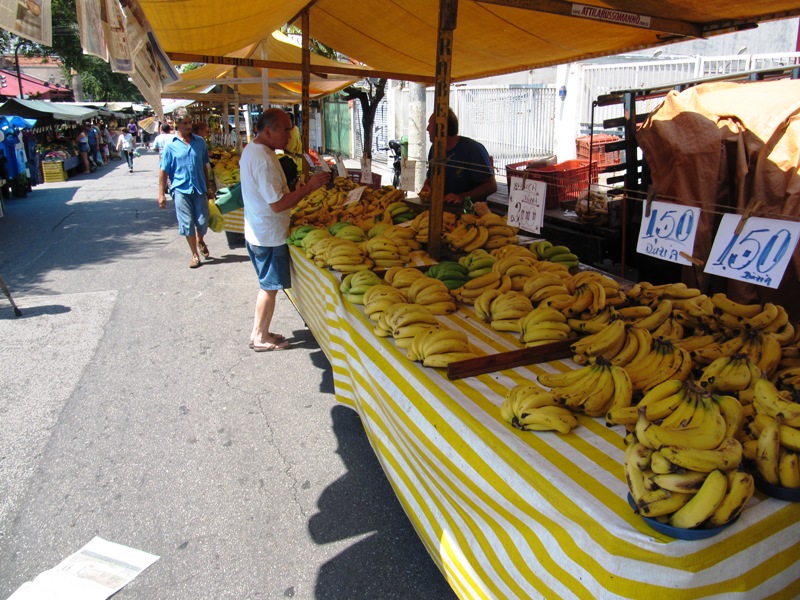
Banana stand at the farmers market

Banana stand at the farmers market

Alas, Nathan and I didn’t have a friend living in SP so we explored on our own.  Slowly, the city grew on us.  Especially as we sampled some of its culinary offerings.  Our first day in the city we wandered around the farmers market.  Being Brazil, the tropical fruits are bountiful and the banana stand in particular was huge.  But almost anything you could want was there.  I have to admit that I missed having my own kitchen to cook all the succulent ingredients.

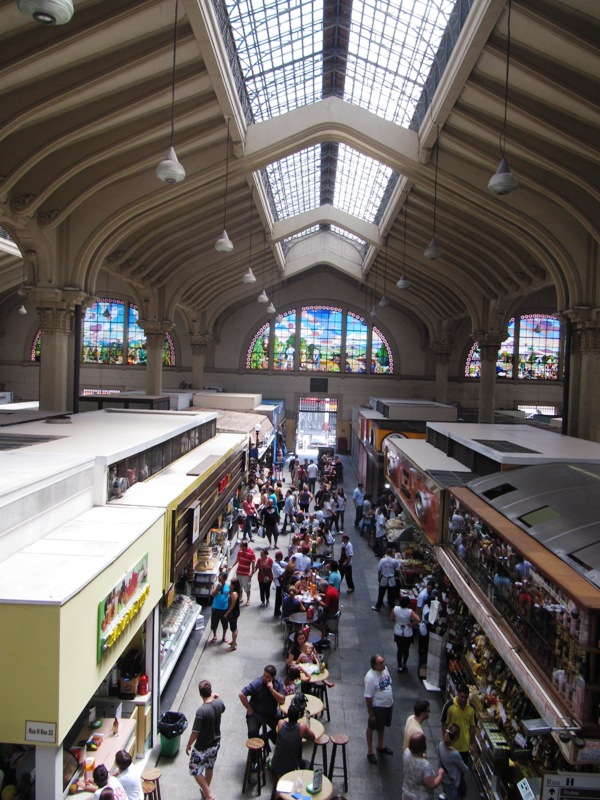
Municipal Market

Municipal Market

Mortadella sandwich

Mortadella sandwich

Later in the trip we stopped at the municipal market to pick up a SP classic, the mortadella. We chose the stand with the most people and scooted up to the counter.  A mortadella is basically a simple bun piled high with warm, thin sliced bologna.  Cheese and mustard completed the sandwich.  Pretty awesome paired with a beer, but I was missing some potato chips to go with it.

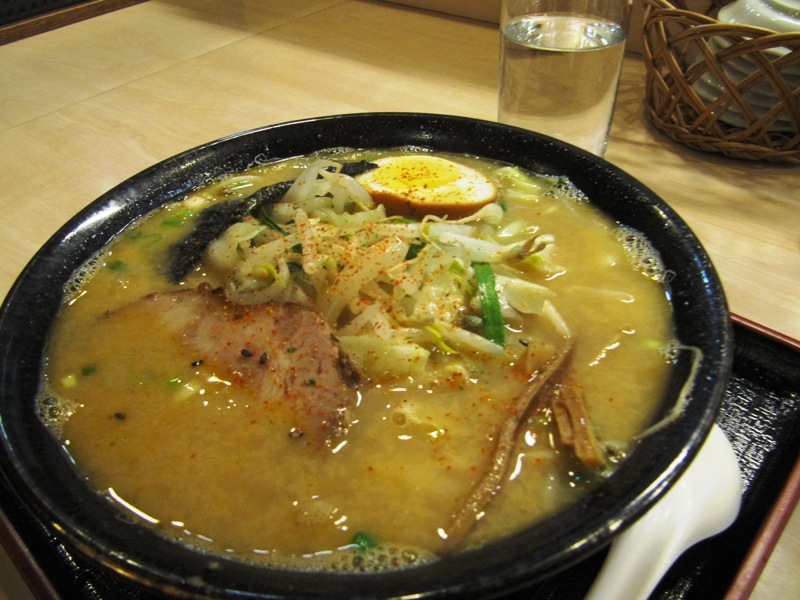
Ramen at Aksa

Ramen at Aksa

It rained everyday in SP so to beat the chill we were craving some soup.  Luckily for us, SP has a large Japanese population.  In Liberdade, essentially the Japantown, we popped into Aksa and ordered a steaming bowl of ramen.  Oh so comforting.

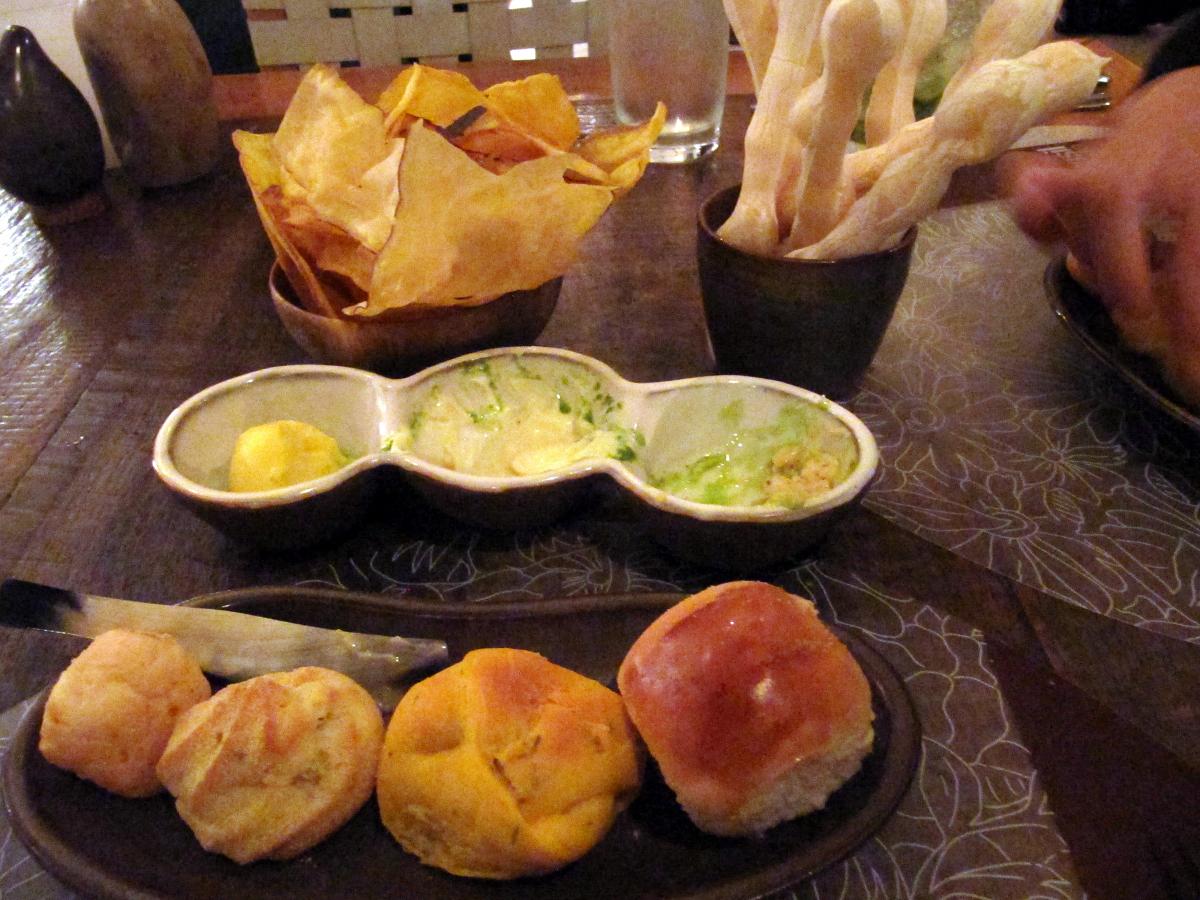
Brasil a Gosto

At Brasil a Gosto you get three types of butter, three types of potatoes and four types of bread!

Our last night in SP we decided to splurge a bit.  Everyone mentions Brasil a Gosto as the place to eat nouveau brazilian cuisine.  This means it takes traditional ingredients but prepares them in new ways.  For example, I had pork smothered with an amazonian berry sauce accompanied with creamed mantioc and lightly fried bananas.  (Sorry, the picture came out too dark to post.) The food and service were superb but borderline pretentious – the menu was a full on book!  But overall I’d recommend it because it was unlike any food I have had before.

Nathan loves his açai

Nathan loves his açai

As we headed out of town we couldn’t help but grab one more bowl of açaí.  Nathan could not get enough of the sweet and earthy flavors.  And then we were on our way to Iguazu Falls!

City, Beaches, and Cristo Oh My (by Nathan)

Rio de Janiero is engulfed by skyward reaching tropical mountains.  At the top of biggest and most prominent peak stands Cristo Redentor (Christ the Redeemer), the famed symbol of the city.  No matter where you are the Cristo is always overhead, always watching.  We wanted to see what he saw.  But we made our way slowly.

First we explored the lowlands, we baked in the sun at Ipanema, we drank coffee at Colombo, hiked the steps at Lapa and always just behind a cloud or shining brightly in the sun, the Cristo Redentor was there.

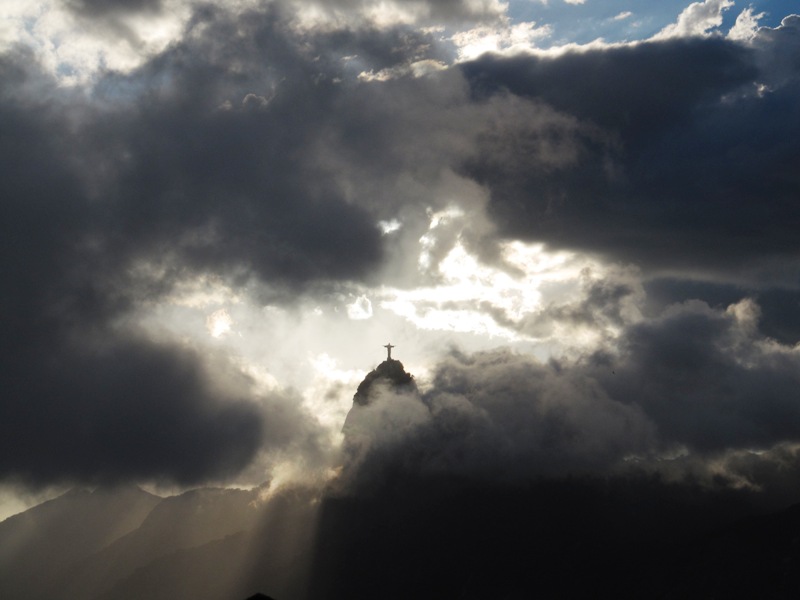
Parting of the clouds at Corcovado

Parting of the clouds at Corcovado

Our first vista of the city from any elevation was from the Morro da Urca.  This smaller mountain was a great little climb leaving us both out of breath and satisfied that this was at least a little training for our eleven days of hiking planned for the Peruvian Andes in May.

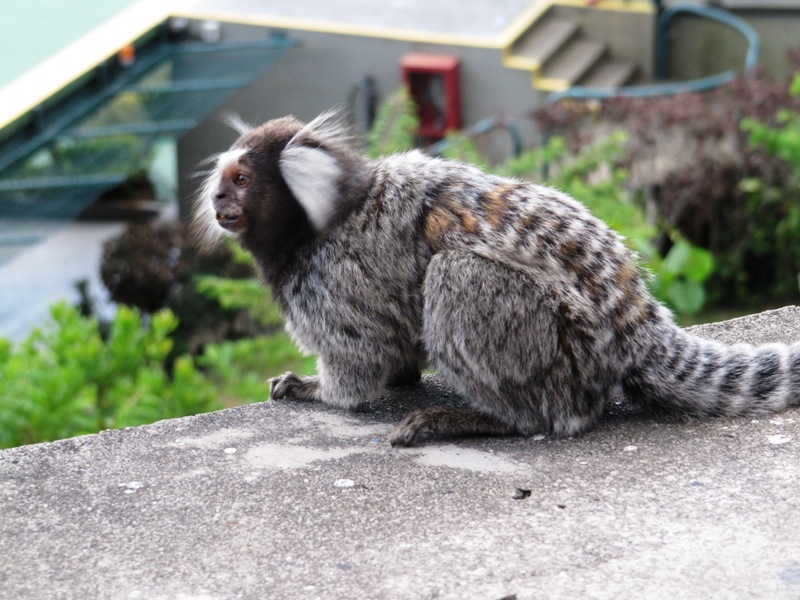
Marmoset at Morro da Urca

Marmoset at Morro da Urca

Upon reaching the summit we found another creature with an omnipresent watchful eye.  This common marmoset and his gang of friends looked like they would jump us and steal our granola bars if we approached too close.

Pão de Açucar from Morro da Urca

Pão de Açucar from Morro da Urca

The Morro da Urca can also be reached by cable-car for those not wanting a hike. From Morro we then took a cable-car to the main attraction, the Pão de Açucar (Sugar Loaf Mountain).  The hill is named after its familiar shape to the loaf of sugar made during pre-industrial refining.  It is a tall (400m) hill with shear and jagged cliffs all-around and of course has some of the best views of the city.

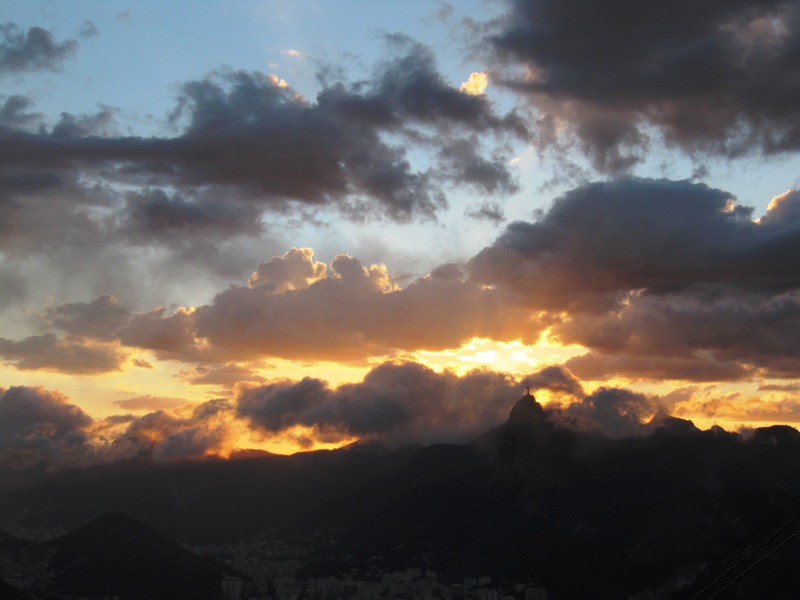
Sunset from Pão de Açucar

Sunset from Pão de Açucar

We arrived at sunset and we gazed out into the golden city.  The Cristo, high up on the Corcovado peak was shrouded by his apostle clouds.  The colors transitioned from a warm tangerine orange, then cadillac pink, then in flowed the deep purples, that, with the darkness brought the cool night.

Cristo Redentor

Cristo Redentor

The day finally came for us to visit the Cristo Redentor statue.  Up close we were able to view the intricate details  cast into the concrete: the seemingly flowing fabric, the tranquil facial expression, and the arms spread wide welcoming everyone to him and to Rio.  The statue is an elegant piece of art deco, angular, flowing and full of emotions.

Rio from Corcovado

Rio from Corcovado

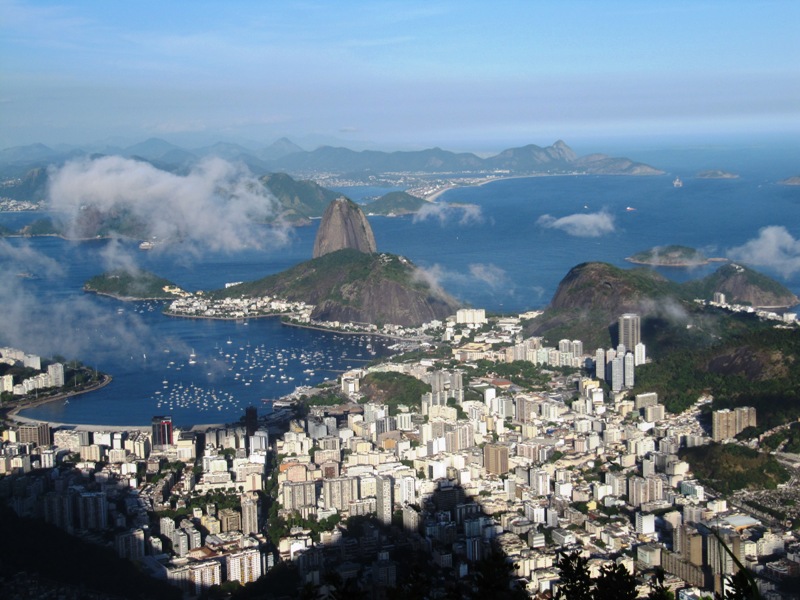
Turning around from the Cristo we saw the city of Rio from his perspective.  The botanical gardens, Copacabana, Pão de Açucar were all there, tiny specks in this beautiful city.  The buildings kissed the sand and the ocean appeared endless as it wrapped around the urban landscape.  Rio de Janiero has it all: food, music, dance, beaches, city and transit.  Could we move here and learn Portuguese?

Rio Historic (by Carmen)

Central Rio's narrow streets

Central Rio's narrow streets

I often think of Rio de Janeiro as a modern city complete with problems caused by rapid, unplanned urbanization.   I hadn’t much thought of historic Rio but it was a pleasant surprise to find it.  I know not all of you are not history buffs.  I am no expert either, but I love my hostoric trivia.  For example,  the city was founded in 1565 and has functioned as an important port for centuries.  It was also the seat of Latin America’s only monarchy.  Don Pedro I and Don Pedro II reigned from 1822 to 1889, when Brazil was declared a republic.  Ok… I´ll tone down the trivia for the rest of the post.   :)

Cafe Columbo

Cafe Columbo

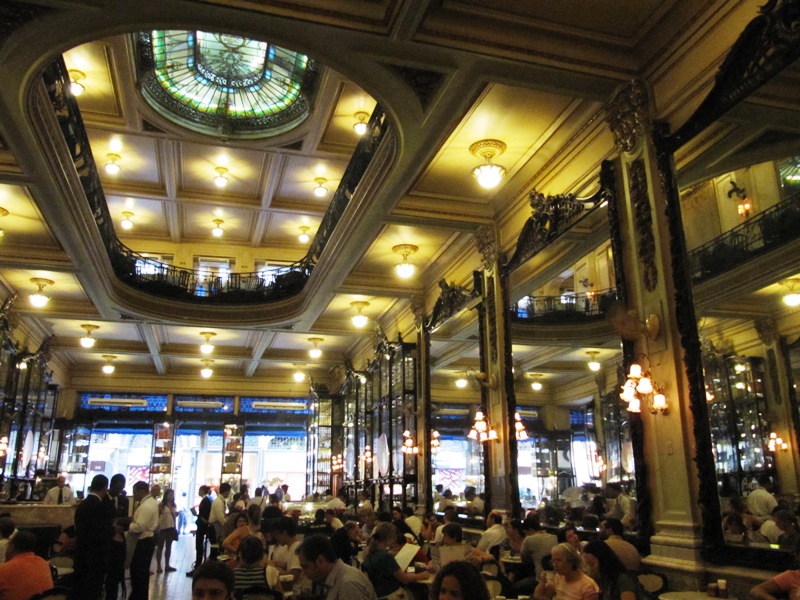
A mix of colonial and modern buildings fill in the narrow streets of Rio’s center. It’s on one of these streets that Cafe Columbo can be found.  After all the historic cafes of Buenos Aires I wasn’t expecting much from this one.  But I was wrong. It was beautiful, bright, elegant and airy.  Huge mirrors lined the walls so that soft light bounced throughout the cafe.  The sweets they offered weren’t as spectacular as the surroundings but they were still good.  Drinking coffee and eating a fruit tart at Cafe Columbo is a lovely way to spend an hour or two.

Sad transit breaks my heart

Sad transit breaks my heart

Just uphill from the center area is the Santa Teresa neighborhood.  We tried to take the historic streetcar that rides along the city’s old aqueduct (history AND transit, woot!) but it wasn’t running.  The strange thing is no one would tell us why.  Finally, a friendly shop owner told us that a few years ago the streetcar had flipped over killing 6 people!  It was a tragic accident that the government says they are fixing.  But they are taking too long and the residents are upset.  Hence the crying tram.  I hope the city gets their act together by 2014 because the tram is an important lifeline for the residents of Santa Teresa.

Funky Brazilian flower

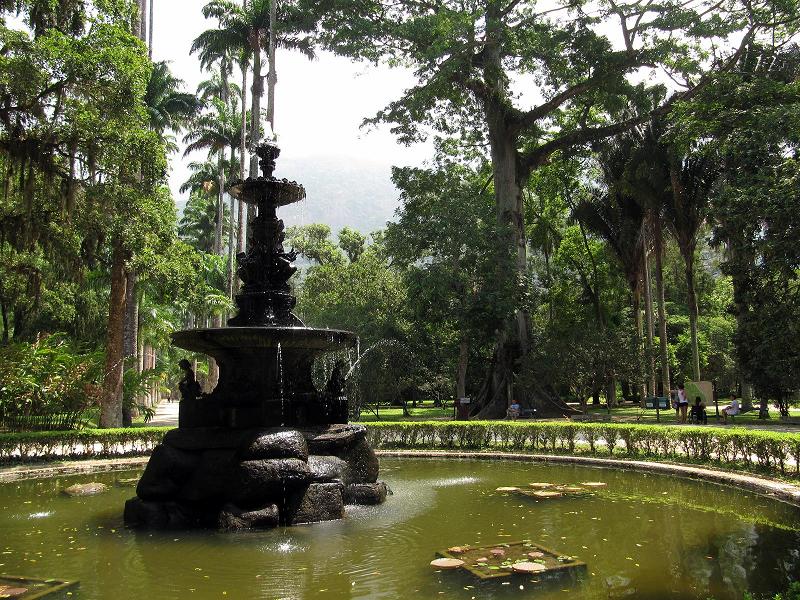
Fountain at Jardim Botanico

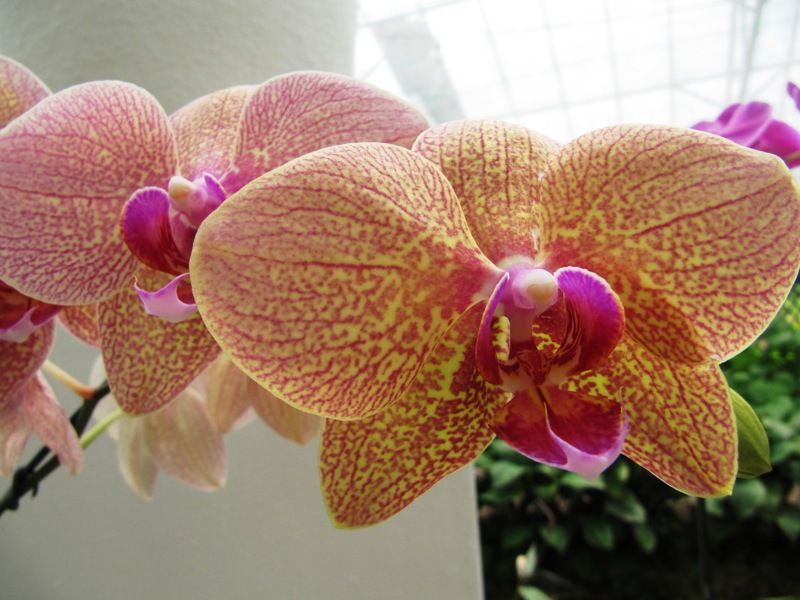
One more history lesson was at the Jardim Botanico, founded in 1808.  Since Rio was our most tropical destination, I was pretty excited about this one. It had some pretty extraordinary flowers, like the one with thick red petals and a prickly yellow center.  And of course, they had plenty of orchids.  But my favorite part turned out to be the historic central fountain.  Palm lined paths led up to it and it was backdropped by the Corcovado (the mountain with the famous Cristo statue on top of it).

Orchid at the Jardim Botanico

Orchid at the Jardim Botanico

Rio’s history added another layer to this beautiful city.

Finding Heart and Soul in the Favela (by Nathan)

Reading a guidebook about Rio can make you think that you need an armored tank to move around the city.  “Do not go to the beaches at night”,  “take taxis at night” and “watch your belongings” were statements that echoed in our ears over and over.

What we found was quite different- a city that was full of community and great people wherever we met.  That does not mean that we ignored these suggestions, but we recognized that, like any city in the world, tourists are easy targets for theft.  With our heads down and hands tight on our bags 8 feet 4 mouths (ie. us & Carmen´s parents) had a memorable trip to this great city.
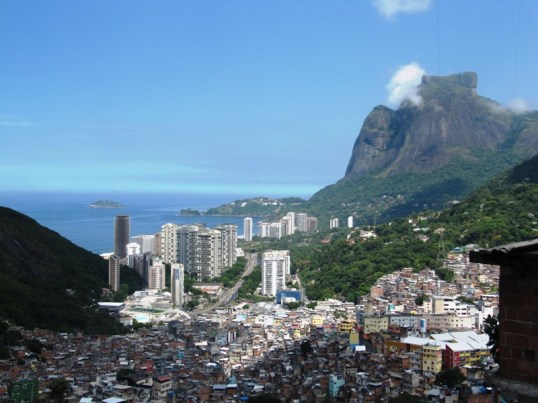
Rocinha favela from above

Rocinha favela from above

Part of the reason Rio is recognized for its crime is because multiple favelas are perched next to the main sights and the city.  A favela is basically a squatter community that houses thousands of people that need to work in the city, but cannot afford the city.  So in Rio when rural populations rushed the city for jobs, they built their homes on the cliffs surrounding the city.  Now, the squatter communities have expanded and grown to form huge networks of buildings and businesses.

I was so intrigued about this intertwined network of buildings, people and  resources.  I wanted to see it for myself.  I wanted to walk through the randomness of it, I wanted to get lost in the alleys and experience the favelas in some way more than just squinting from afar.  But wondering through a favela is pretty unsafe.  And on a tour I did not want to be the spectator that exploited the poverty of the people.  It was a torn decision, but I ended up walking with a small group and guide through one of the favelas.  The end experience was rewarding in ways that I could never have anticipated.
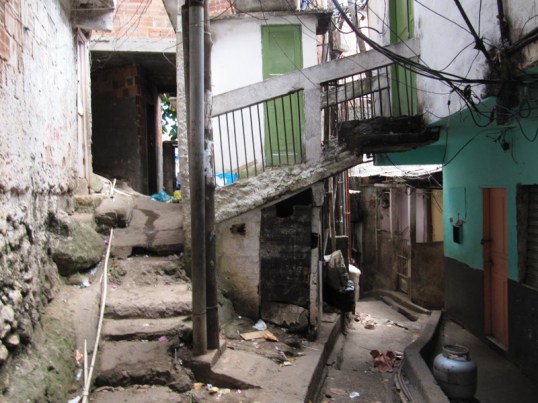
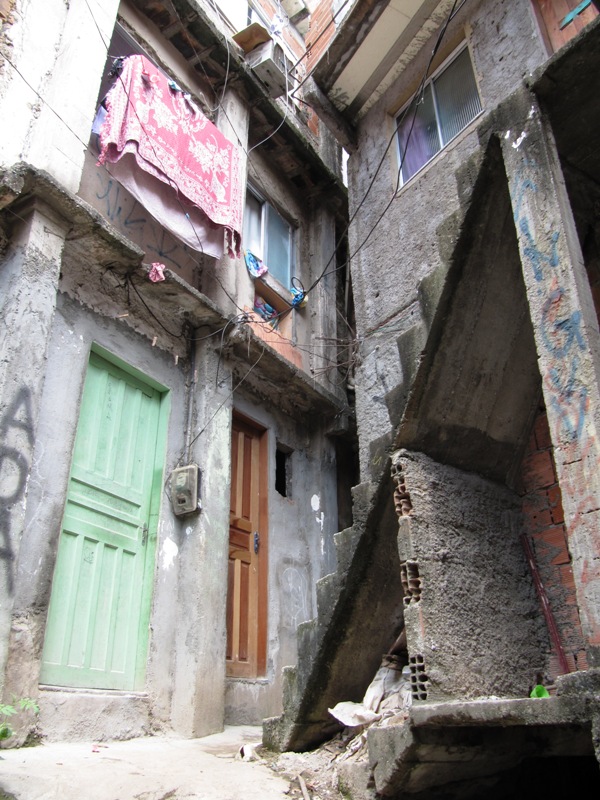
Favela doorway

Favela doorway

My day started with a minivan picking me at the hostel and taking me to the base of the biggest favela in Brazil, Rocinha.  There are only 4 roads in this favela and only one gets to the top.  All the buildings are connected with tight paths and staircases.  Although busses attempt to navigate these roads, I hopped on the back of a scooter, the favela taxi.  Imagine Lombard St. in San Francisco, a little wider, a little straighter and just as steep.  Now add a bus coming downhill, road construction taking up a third of the road and fifty or so motorcyclists with passengers racing eachother to be the first to the top.  The German tourist I made friends with in the minivan wore a pink helmet and I could not help but laugh and give him a thumbs up as my driver revved and pried his way between the front of the bus and his scooter.

We made it to the top without incident.  The main street in the favela was nothing that you would expect.  This was not some lean-to hodge-podge of a settlement, this was a mini city.  And the four main roads were the downtown of this mini city.  There was everything here: markets, appliance stores, restaurants and even pet stores all lined up on this winding street that snaked up the mountain through the favela.

Favela Walkway

Favela Walkway

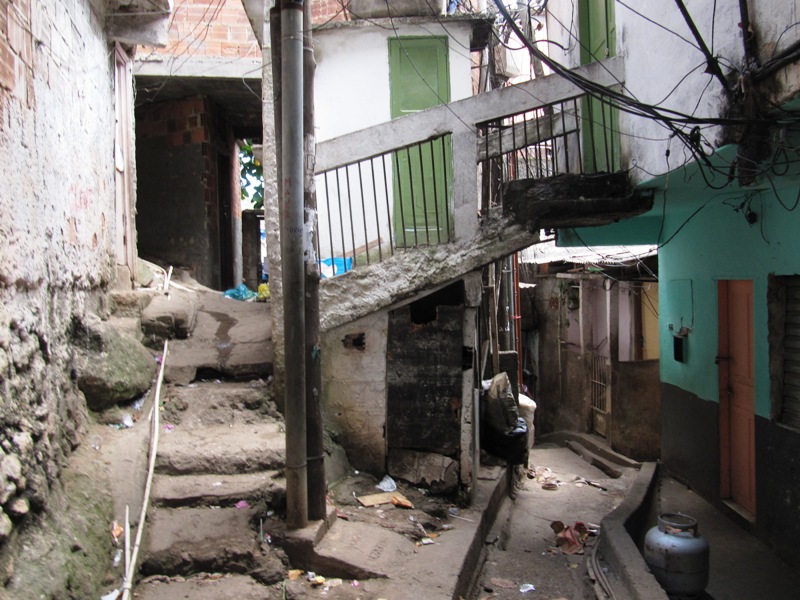
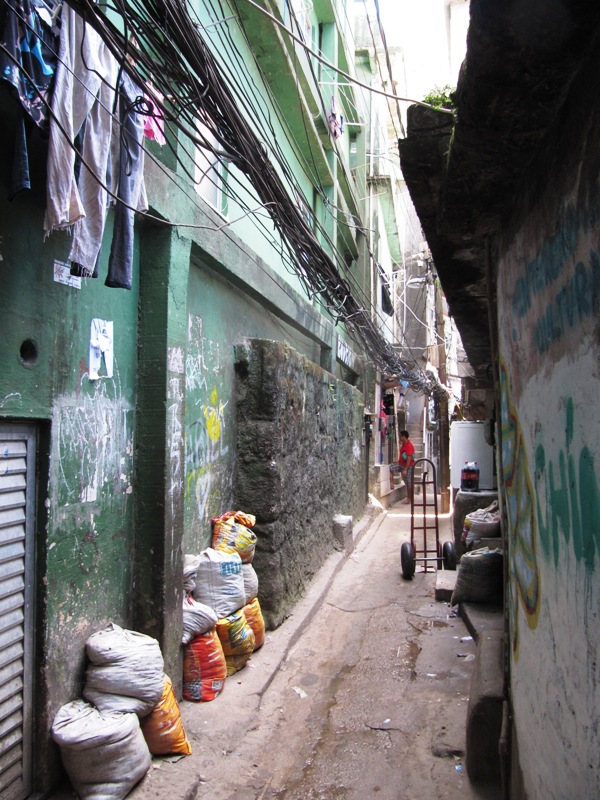
Stepping off of the paved road was an immediate change of climate to a network of tight alleyways and staircases that weaved there way through the community.  And again buildings were not what I had anticipated, this was not a shanty town, not a slum, but a streetless city of real buildings, a favela.

There is major construction happening here, two and three story masonry buildings with concrete columns.  And what an effort because everything has to be carried or wheel-barrowed through the winding paths.  Every building appeared to be part of some bigger plan, with a little more money another room could be added, or maybe next month the plaster could be complete.  The people and community worked day-to-day and month-to-month to build shelter for their families.   The construction was not the greatest but in most cases it looked straight and they even had some rebar in it.

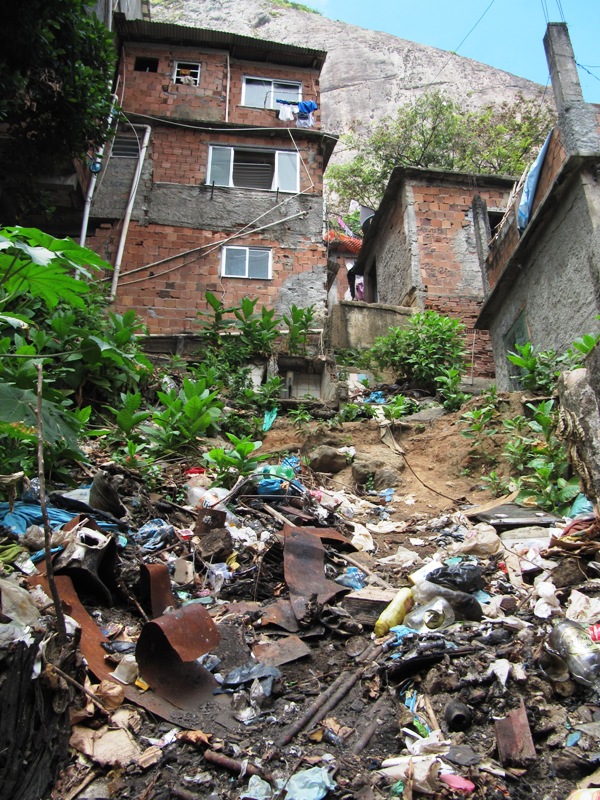
Trash and rubble from mudslide

Trash and rubble from mudslide

The positioning of buildings is chaotic with very little order.  The pathways follow the way of least resistance zig-zagging through the hillside.  As we approached the steepest parts of the hillside we started seeing the effects of the storms of the previous rainy season.  Whole homes crumbled from mudslides and toppled over one another until eventually it was contained.  The pathways were cleared and the rubble remained.  I guess it stays until the next family forgets about the incident and decides to build their home there.
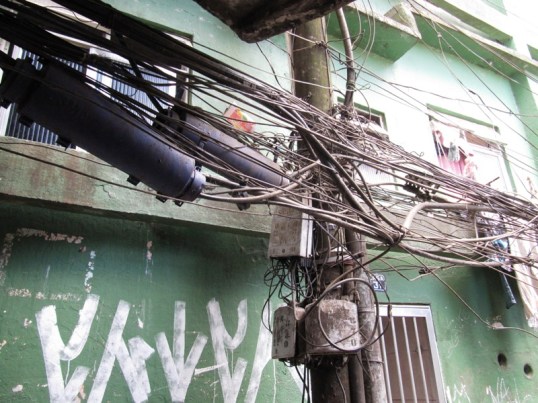
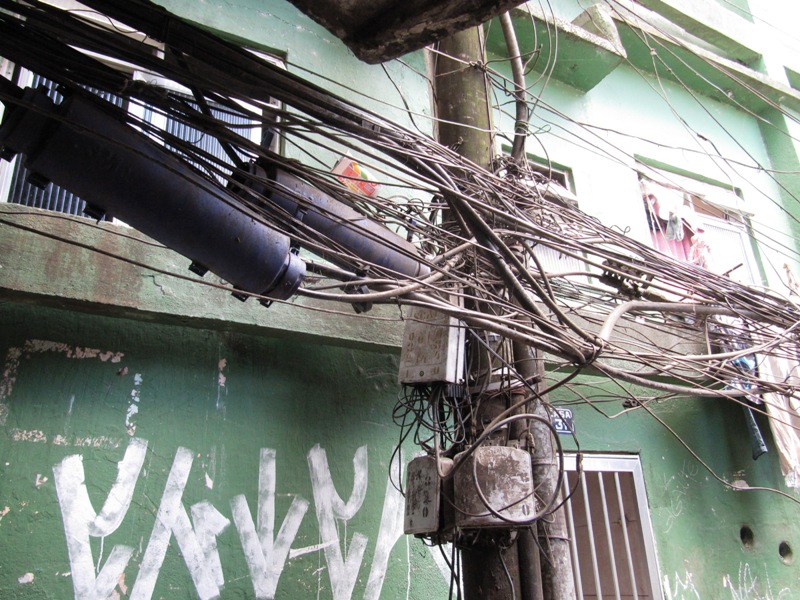
Electricity Nest

Electricity Nest

The squatter aspects of the favela are most apparent when looking up along the sides of the buildings.  Electricity connections merge into nests of spliced and re-spliced wires and cables.  Water is supplied by the city, but the pipes run along the alleyways and are similarly spliced and split.  Sewage was not so “organized,”  sometimes it ran in pipes, othertimes in trenches and well othertimes, the greywater just overflowed onto the tight alleyway.  The biggest issue was for the downhill residents when it rained, because everything flowed towards them.

We continued our walk through the favela, meandering down through the alley ways, slipping around corners and discovering more of the labyrinth of buildings.  Amazingly, there is an estimated 200,000 people that live in this one favela that is one square kilometer in area.

Favela colors

Favela colors

We stopped at multiple locations in the city for the guide to talk about the favela, teach us about the schools inside the community as well as welcome us into the local businesses.  It was here that I realized that we were not just spectators of the impoverished favelas, but as tourists we were part of something bigger that supported and contributed to the community.  We bought art, crafts, drinks and food which brought money into their economy.  We listened the drum style and dance that originated from the favelas.  And we  oohed and awed at all the little children napping in the preschool.

Our walk through the favela was completely safe.  Residents said “hello” to us to practice their english and we replied with our few known words of portuguese.  I enjoyed seeing how happy people were.  All the residents appeared to know my guide and they gave him high-fives and compliments wherever went.

Favela stairs

Favela stairs

The scramble to the bottom took a couple hours.  It is extremely impressive to imagine climbing these walkways on a daily basis.  Thousands of people do it, in fact there are over a million people living in favelas in Brazil.  We walked along and stepped to the side from time to time as a group of men carried a refrigerator up the steep steps or a group of school girls passed talking on their mobile phones.  Yes, many of these residences had all sorts of appliances.  An hour walk from the main road and we could peek into a home and see a family cooking a delicious feast, and others watching TV from their sattelite dish and more just enjoying the sun on the patio.  How is this different from anywhere else?

I think what I like most about the Rocinha was the whole collaborative community aspect of living in the favela.  Despite that everyone was thrown into this random maze of buildings, the people found the time to help each other, to laugh and to work together for their community.  The colors of the buildings and the bright smiles of the people are to be remembered forever.
Eating too much and staying up late in Rio (by Carmen)

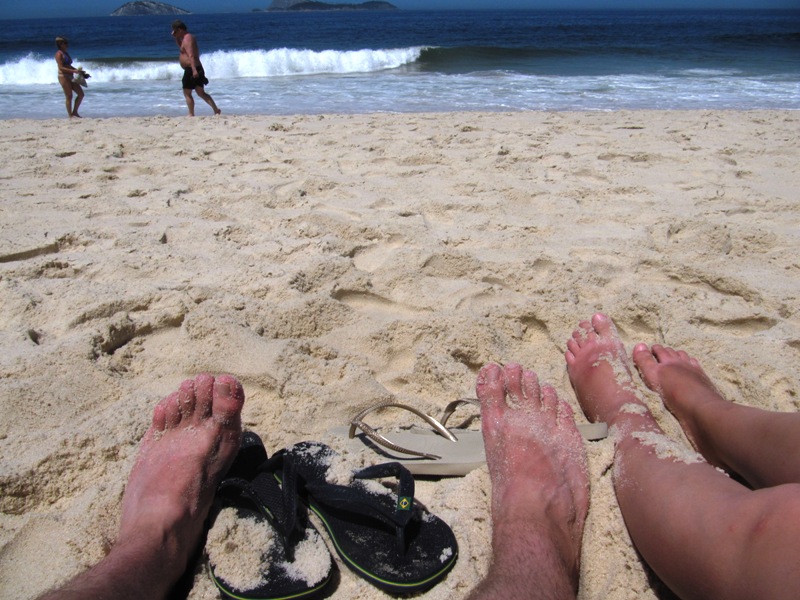
4 feet in the sand

4 feet in the sand

So we didn’t spend all day at the beach!  Although it was tempting.  We mixed it up with some good sights, food and nightlife too.  Our entire time in Rio was spent with my parents.  Four mouths to feed usually means that we got to try even more dishes when eating out.  But on our first night in Rio, all four wanted the same thing: feijoada.

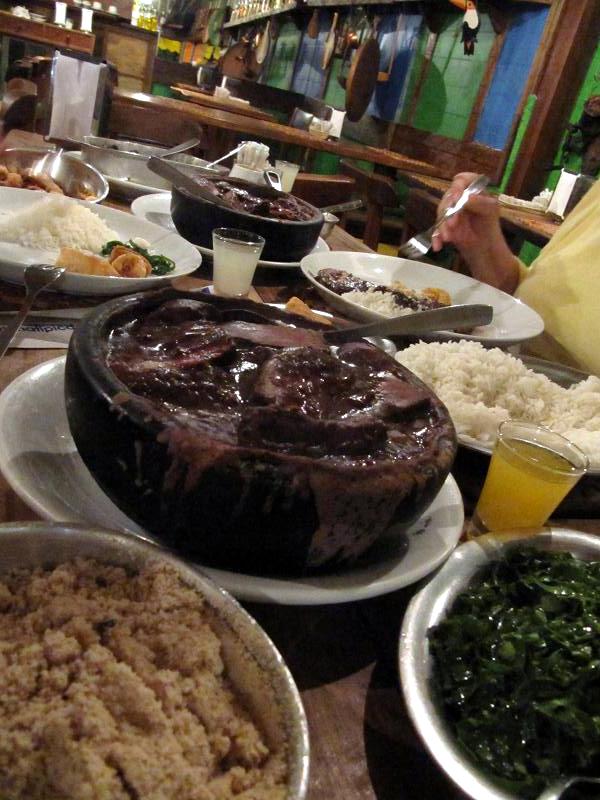
Feijoada

Feijoada

Feijoada is the national dish of Brazil.  It consists of black beans stewed with meat, served over rice and other side fixings.  We chose a place that specializes in feijoada and were pretty excited to fill up on some homey comfort food.  All four of us ordered the feijoada but the waiter kept shaking his head and saying that was too much food.  He kept suggesting that we mix it up with something, such as la truta (trout).  It didn’t seem like he was getting money out of us – it was more of a cultural misunderstanding. Nonetheless, we insisted on getting feijoada and 4 huge bowls of it landed on our table.  We could’t even make a dent as it was a feast for ten people.  But it was good. And now, whenever a misunderstanding occurs (which is often) Nathan and I shrug our shoulders and say ¨la truta!¨(you have to say it very emphatically with a long drawn out “ah” : )

Bossa nova nightlife

After the feijoada we were in food coma mode.  But we charged on to the bossa nova club.  It was awesome!  The singer performed a mix of old standards and a few less familiar songs too.  My dad would play bossa nova while I was growing up and I’ve loved the genre ever since.  This was a special treat.

Shrimp wrapped with fried noodles at Manekineko

Shrimp wrapped with fried noodles at Manekineko

Brazil has a lot of Japanese immigrants so we were excited to find Manekineko, a japanese brazilian fusion place.  Fusion in this case means mostly japanese food with the chefs adding cheese and frying things when they found the opportunity.  Nothing amazing but it was fun.

Fresh juices and smoothies at Market

Fresh juices and smoothies at Market

I think the best thing about the Rio food scene (and Brazil for that matter) is the wonderful array of juices.  Everything from pineapple to kiwi to avocado to pears.  Mixed the way you want.  I want a juicer now!

Palm hearts and sashimi at Market

Palm hearts and sashimi at Market

One of our best lunches was in the palm shaded patio at Market.  The organic certification reminded me of California.  As did the quinoa salads and salmon sandwiches.  But after so many heavy dishes, I liked being reminded of home.

Samba club in Lapa

Samba club in Lapa

Our meals fueled us up for a big night out in the Lapa district, which is a hub of Rio nightlife.  We went to the club with the biggest crowd and loudest samba band.  I loved how people of all ages were dancing between the tables.  It was great to put my year of samba lessons to use!  This inspired me to come back for Carnivale…maybe next year…

Copa and Ipanema, the Beaches of Heaven… (by Nathan)

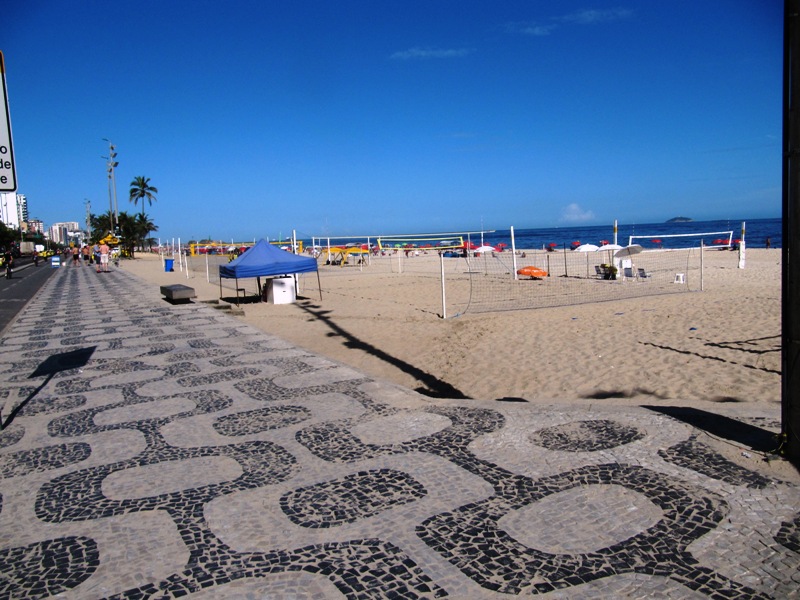
Sidewalk along Ipanema

Sidewalk along Ipanema

Rio is by far one of the most beautiful and exciting cities.  Imagine walking along a beach with incredibly soft sand.  The waves are crashing in front of you.  Behind you there are majestically steep mountains surrounding a city of highrises that come right to the water.  These are the beaches of Rio.  And they are blissful.  The beaches and laid back atmosphere sometimes reminded us of California.   But the setting was much more urban.  Los Angeles can learn a lesson from Rio on how to build a proper beach side city.  LA, you planned it all wrong!
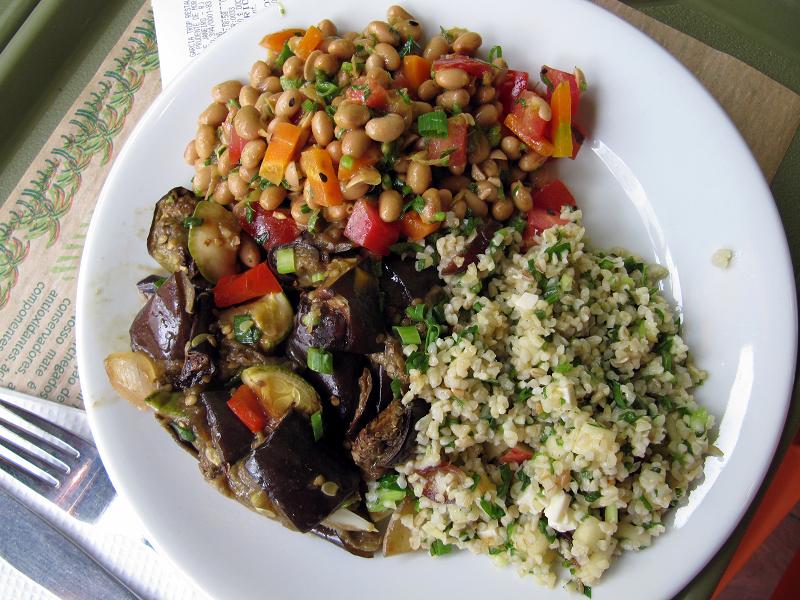
Delirio Salads

Delirio Salads

Even the food has a California type feel with an abundance of fresh local salads.  At one of our first restaurants we were hit with the flavors of Brazil and the realization that finally we were in a country that loved their veggies.  The variety of salads is something to awe  at.  Vegetables cooked and raw and delecately infused with new and known spices.  And Brazil cares about variety so we lucked out.  2 blocks from our beashside umbrella on Ipanema was Delirio Salads which was had some 20 options that were all fenomenal.

Girl from Ipanema (i.e. Carmen)

Girl from Ipanema (i.e. Carmen)

First let´s describe the sand.  The magic I think must be in the sand.  The beaches are not exactly white sand, but the texture is soft, real soft.  Slipping your feet into this sand is like having your feet wrapped in warm velvet.  The sand is like like brown sugar and just as sweet for your toes.

Copacabana Beach

Rio’s beaches are enormous.  The two popular ones, Ipanema and Copacabana make up about 5 miles of bliss.  The waves were big and there was a hefty riptide.  There is also a beautiful sidewalk along the full length of the beach, tiled with Poruguese black and white patterns.

Sunset on Ipanema over ¨Two Brothers¨

Sunset on Ipanema over ¨Two Brothers¨

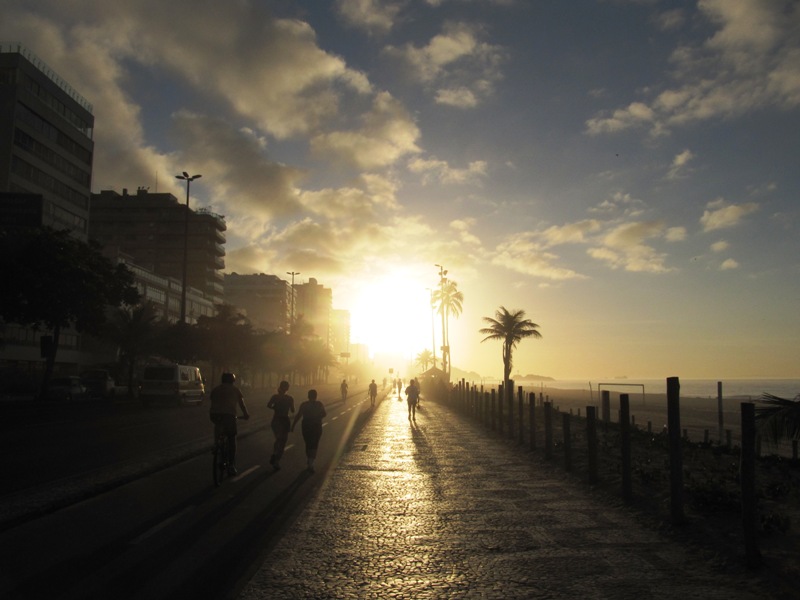
The beaches can be enjoyed at almost all times of the day.  The sunsets there are breathtaking and the sunrises are passionate with color.  The beauty is omnipresent.
Ipanema sunrise

Ipanema sunrise

These beaches are destination worthy sights on their own.  Thrown in the amazing food, the history, the samba nightlife, the mountain-top vistas and crazy high-speed bus rides and Rio has become one of my favorite cities.

¿Why Uruguay? (by Nathan)

Uru-what?  Everyone keeps asking us why we are going to Uruguay. And all that we can say is why not?

I was fascinated by Uruguay.  It is so rarely mentioned as a country, but with a little research I found out that it is considered one of the most stable, advanced countries in South America.  On top of that they were also the first country to provide laptop computers to every grade-school student.  It sounded like more than just a satellite of Buenos Aires, but a modern city.  And I was tired of tripping on the many holes found throughout BsAs sidewalks.

Uruguay is a ferry ride away from Buenos Aires and turned out to be an amazing experience.  Many people seek the historic town of Colonia, but we decided to go directly to the capital city of Montevideo.  What we found was some of the best barbeque, beautiful beaches and a clean progressive city vibrant with life.

Montevideo Fountain

Montevideo Fountain

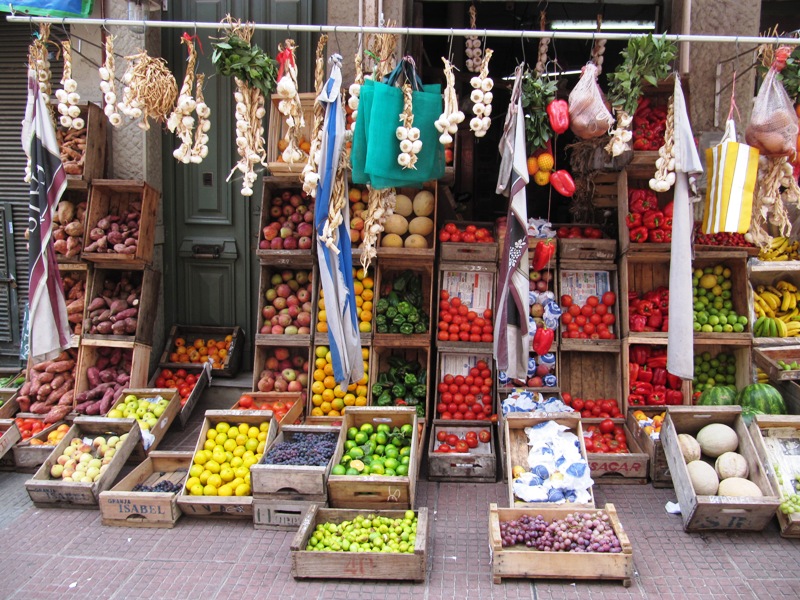
The city is filled with picturesque nooks and crannies.  Peeking around a corner and we were often surprised to find beautiful colonial buildings, fountains and of course markets selling deliciously plump produce.

Montevideo produce market

Montevideo produce market

One great benefit of having friends and family join you on a trip is that the cultural experience of a city seems to increase exponentially.  Interpreting the culture, tasting the food and seeing the sights is a group activity shared with laughs and conversation.  Carmen’s parents joined us for two weeks, making us 8 feet 4 mouths to explore and eat our way through more parts of South America.

Dinner at La Otra

Dinner at La Otra

Our first meal in Montevideo immediately put all the parilla barbeque places in Buenos Aires to shame.  We went to La Otra, it was a sleek dimly lit restaurant with a woodsy theme.  I felt right at home as they decorated all their wall using a wallpaper of stacked and chopped wood. Although I did not miss those hours of my childhood chopping and stacking wood.  The food included an array of excellently grilled meats and vegetables.

Slanted grill at out lunch restaurant

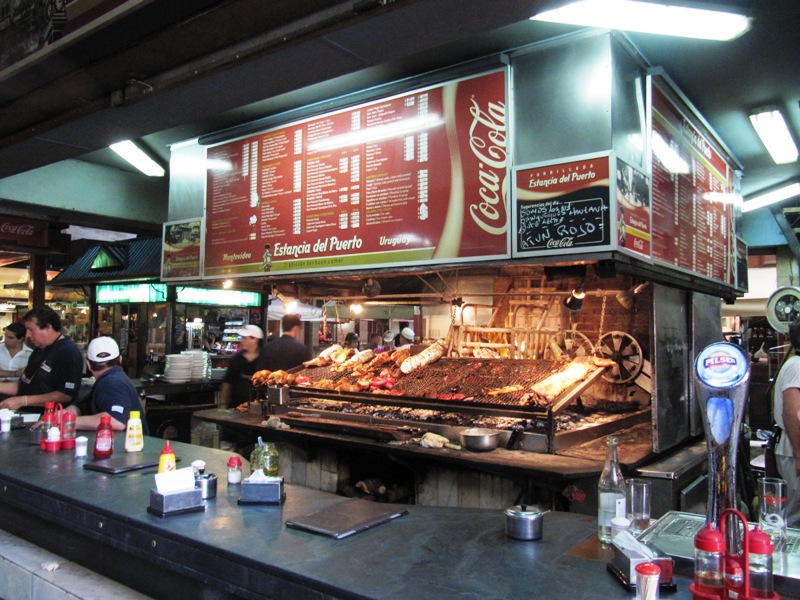
Slanted grill at Estancia del Puerto

One of the main differences between Argentinian and Uruguayan barbeques is the use of a slanted grill.  A simple advancement, but the Uruguayans have worked out a better way to not overcook their meat.  There is this amazing market (Mercado del Puerto) with twenty or so barbeue restaurants all grilling theit best meat and seafood.

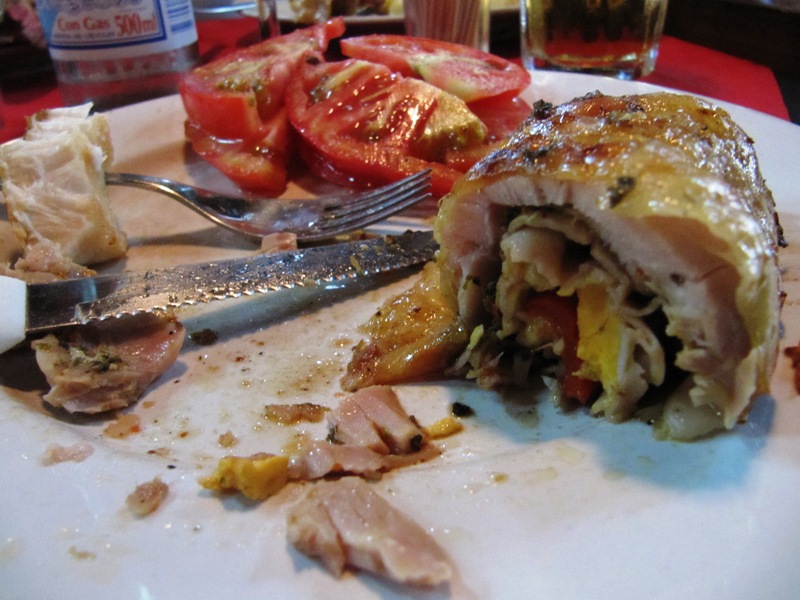
Pomplona de pollo

Pomplona de pollo

They also have their own variations of grilled concoctions.  I ordered a pomplona de pollo which was a piece of chicken that had been flattened and rolled with ham, bacon, cheese and grilled vegetables, then grilled over an open fire. Mmmm.

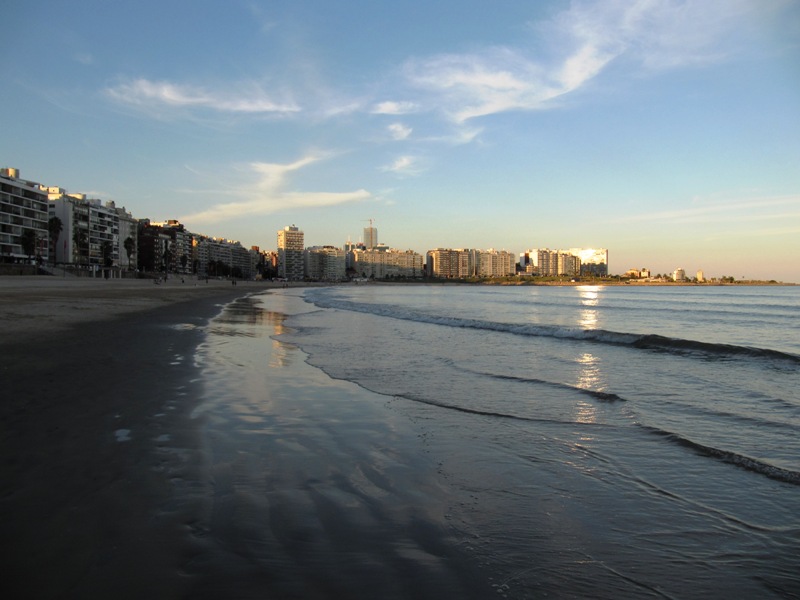
Sunset on Montevideo Beach

Sunset on Montevideo Beach

By this time in our trip we had been wanting water.  The heat in Buenos Aires was sometimes stifling.  To our great relief, Uruguay had an amazingly beautiful beach and a rambla (coastal sidewalk) that stetched for miles.

Montevideo was an amazing experience, delicious food, beautiful buildings and landscapes and the question changed from ¨Why Uruguay?¨ to:

Why not more time in Uruguay?

Moving to Buenos Aires? (By Carmen)

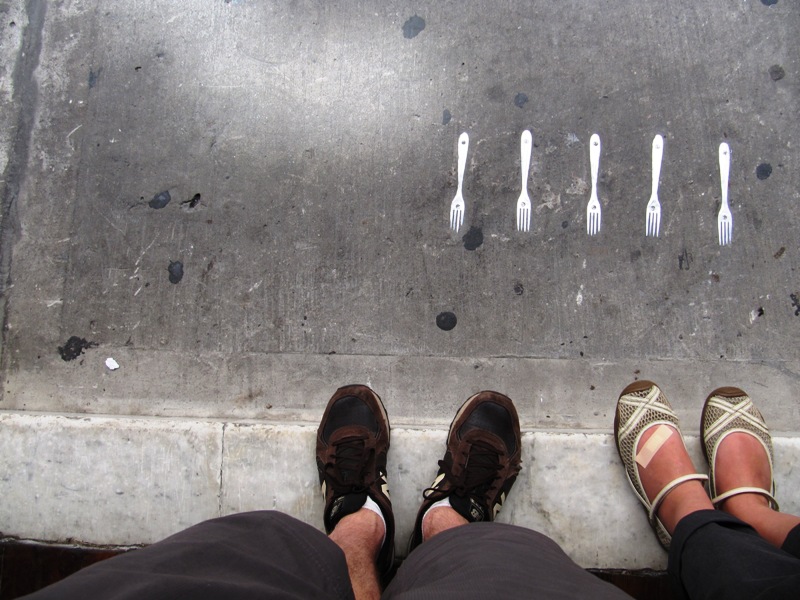
4 feet 5 forks - we found these embedded in the sidewalk. Seemed appropriate :)

The question Nathan and I ask ourselves about every city is, “Could we live here?” BsAs has its pros and cons.  We´ve written about the highlights such as great markets, fanatic fútbol culture, tango, inexpensive transit and good food and wine (particularly pizza).  There are a couple other items we didn´t have time to cover:

Nightlife – A good night out isn´t hard to find in BsAs.  That is, as long as you can stay up late enough.  Things don´t really get started until 2am or so.

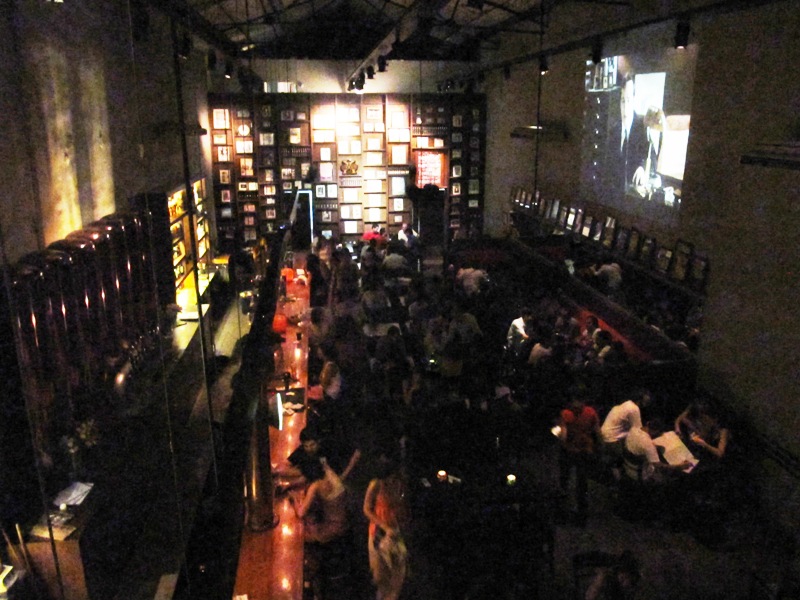
Antares Bar on a Friday night

One of our first outings was at Antares, a local microbrewery.  Because we were still jet lagged, the late night was easy! It wasn´t the best beer we´d ever had but the bar was hopping  and had a great atmosphere.

The marble bar at Million

Another night we went to Millon, an upscale bar in a beautiful setting and prices to match the name.  Friendly bar tenders, good cocktails, 2 for 1 happy hour.

La Bomba de Tiempo at the Konex Center

Every Monday there is an awesome drum show called La Bomba de Tiempo at the Konex Center.  This is one of the rare early nights in BsAs since the show is from 8-10pm.  It attracts a young crowd that jumps in rhythm to the 12 or so drums on stage.  You can´t help but want to dance.

La Peña de Colorado

On our final night we checked out the Peña de Colorado.  There we heard more traditional music with guitars, harmoicas and vocals.

Menu from the closed door restaurant

Blurry picture of me on the stage with my raffle winnings

Closed Door Restaurants – One of our favorite nights was at a closed door restaurant in the Almagro neighborhood. A classmate from the spanish school invited us to join in.  She actually lived in the house where the restaurant took place every Friday.  Her roomates were the chefs and the entertainment since their band also performed.  The food was great, the crowd was lively, the tunes were awesome.  I won the raffle too so I got a CD of their music!  After this night, I really started to feel comfortable in BsAs.

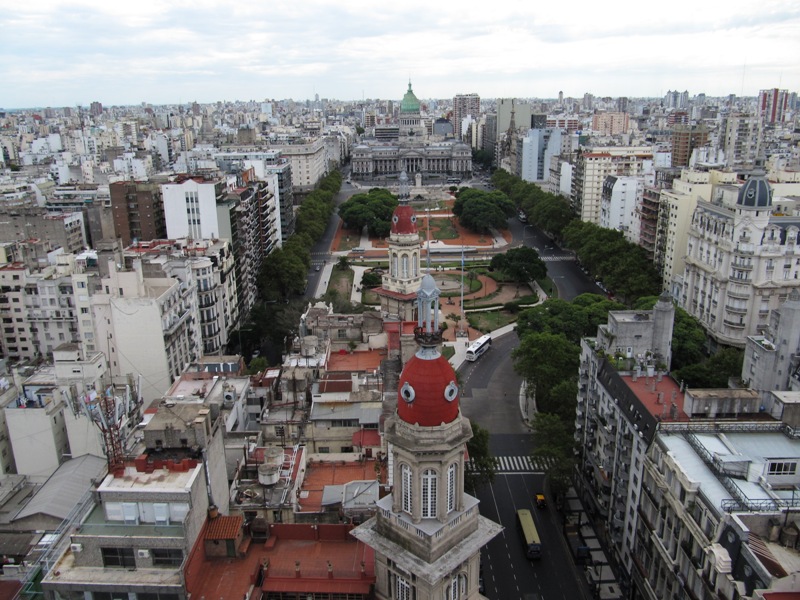
View of Plaza Congreso in Buenos Aires

Calle Florida

Architecture – Another great characteristic of BsAs is its elegant architecture.  This is probably what makes it feel most like Paris, the city it’s always compared to.  Beautiful buildings can be found on almost any street.

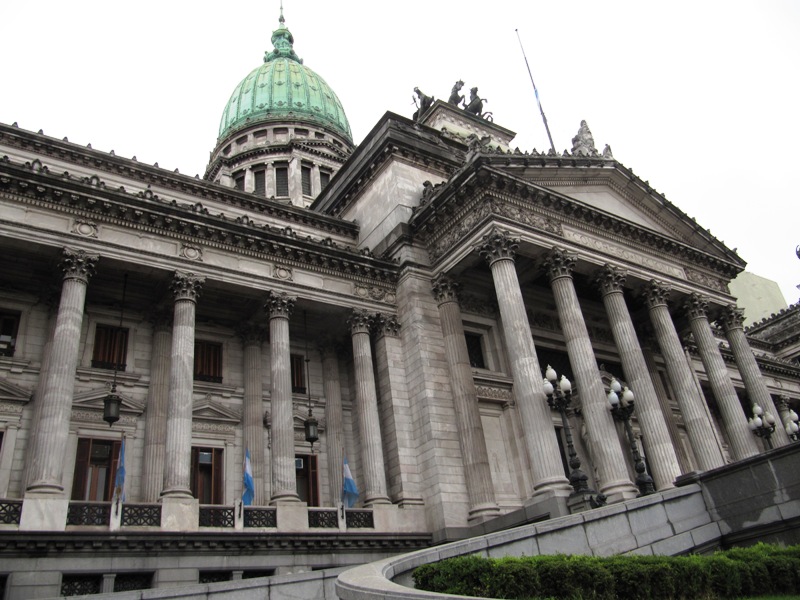
El Congreso

One of the landmark ones is the Congreso, where their national government meetings are held.  I highly recommend the tour of the inside.

Palacio de Aguas Corrientes

Another beauty was the Palacio de Aguas Corrientes (Palace of Running Water).  It was constructed to hold the city´s first water pumps.  Today it still has the pumps as well as a museum about plumbing.  Complete with old toilets.  Awesome.

So the question is, could we live here?  For me the answer is yes.  The city has totally charmed me.  There are definitely drawbacks.  For example, you can´t hurry an Argentinian.  You sit at restaurants for 20 minutes waiting for the bill you already asked for.  But at the same time, this pace of life forces you to relax.  And looking out the window of a cozy cafe in BsAs is a pretty great place to relax.  I’ll miss you BsAs!

Finally, just for the fun of it, here are a few more pics we couldn’t fit in elsewhere:

View from the river in Tigre, a cute town on the edge of BsAs

The Recoleta Cemetary was one of our favorite sights in the city and has one of the best weekend markets outside its gate

The seal of Argentina can be found everywhere

Pierinos again! Delicious ravioli

Post Navigation