4 feet 2 mouths

walking and eating our way around the world

Archive for the category “Latin America”

4 feet 4 paws 3 mouths (by Nathan)

What is it about the companionship of a dog that is so rewarding?  There is of course the loyalty between the animal and the owner and something soft to pet whenever the need.  But there is also the unconditional love between the two.  Chile and Northern Argentina have an abundance of stray dogs.

On a daily basis all types of dogs roam the street, sleeping in plazas, playing in parks and just being happy dogs.  The amazing part is that all of these dogs seem really healthy with shiny fur, seemingly well fed and the most sweet demeanors.   Sometimes they follow you.  The join you in your walk, they frolic along side of you with an occasional nudge or lick.  Then after just minutes or hours the relationship is severed.  This is the story of some of our newest and lost friends.

I write this sitting on a bus after leaving one of the kindest dogs we have spent time with.  Carmen and I stayed the last few nights in Tafí de Valle; it’s a tiny town, but we were able to spend a long day hiking.  An hour into our trek and we were in the wilderness with infinite lengths of rolling hills and a scattering of wild horses.
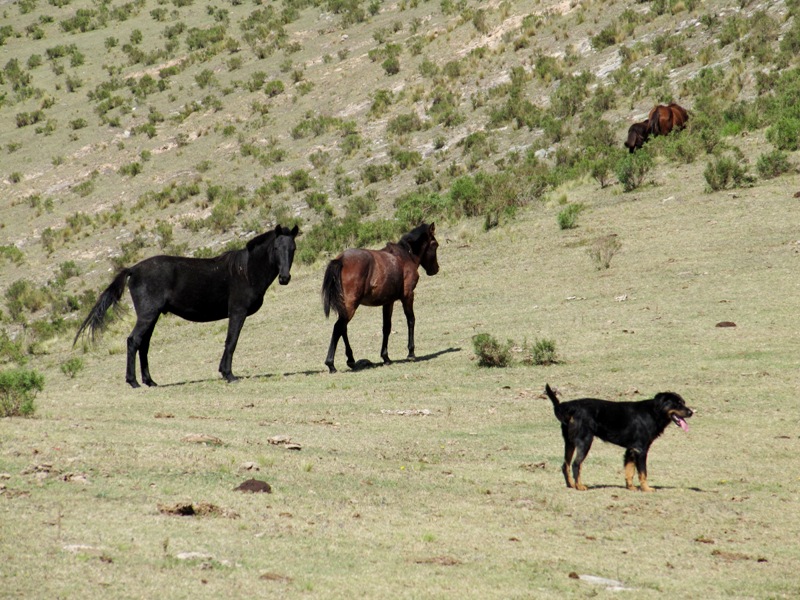
Our shaggy friend keeping us safefrom the horses

Suddenly this dog runs up from behind us barking, but not at us, instead he was herding the horses away from us.  He stayed with us the entire day nudging us with his head, rolling into us as we took a break to eat cheese.  He was so content to just have someone to walk with.  We hiked for hours, scrambling down rocky mountains then jumping rocks in the creek.  When we arrived to the town he joined some of his dog friends and although saddened, I was happy it was a clean break-up.

Enjoying a long hike

Then at the bus station the following morning this black shaggy dog with brown paws and eyebrows prances across the field.  The dog was absolutely elated to find us, thrilled to see us after probably searching the entire night.

He tried to say good morning to everyone, but instead we watched a woman push him away with her boot disgusted that this thing would try to get close to her.  He liked it, willing to accept all the petting he could get.  It must be easier for some people to act aggressive in these situations; they harden themselves against the world, locking down all emotions.

I’m different.  My new friend plopped between my legs and immediately fell asleep.  I must have been the only safe thing he has had in weeks.  Then, it was time for me to board the bus.  My friend looks longingly at me, Carmen gives him a last pat on the head and we leave, his heart broken and a little of mine too.

I also remember the tall skinny one that was white with brown patches in Santiago.  He walked with Bobby, Stephanie, Carmen and me for a half hour.  He was very skilled at crossing the street.  Can you imagine dogs walking only on sidewalks, stopping at red lights and only crossing after looking both ways and a “walk” signal?  The dogs in Santiago can do this!  This dog was particularly sweet, with so much joy just to be walking with some people.  An occasional nip of my fingers or throwing his body against my kneecaps was his way of saying that he liked my company.  Suddenly we saw our local bus, we ran for it, paid our fare and our friend pressed his face against the glass, and barked “Why can’t  I come?”  He ran alongside of us weaving around people, leaping in and out of the street, then, when almost being hit by a car, he gave up.

Mollar pre-Incan pillars and another companion

Then there was the little female that followed us into the archeological site in Mollar.  I gave her some rind from our cheese and she looked at me with the excitement of a child´s Christmas.
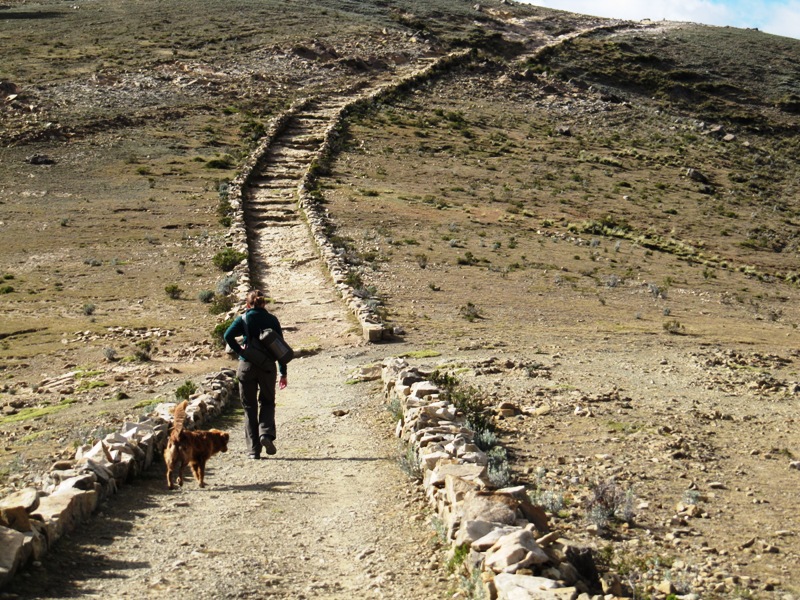
Carmen and another friend

Another dog followed for five hours on the sacred Incan ridgeline of Isla del Sol in Bolivia.

I do not want to forget the famous Pancho of Lujan de Cuyo, the half dachshund, half pug and a half something else.  He waddled his way through the winery of Pulmony with us. And there was the skittish black shepherd in Mendoza that found us three days in a row.  He had some sort of death wish because he liked to bite front bumpers.  I doubt he is still alive.  There was also the mother and pup that fought for our affection.  The most adorable puppy trotted around with us at the hot springs, so clumsy that I thought he was going to fall into the hot water.

Numerous friends, numerous relationships have ended, but are not forgotten.  Although it is sad that there are so many strays it has been nice to make these new friends.  Throughout South America we have had an obvious language barrier, but for some reason a scratch behind the ear does not work for most Brazilians.  To a dog I give a little recognition and they give loyal unconditional love.  They are indiscriminate with their friendship and similarly I can only hope to be that type of friend.  To be a companion that is compassionate, without judgment and loyal to the end.

**Two weeks after writing this, Carmen and I were stopped in our tracks by a not so friendly enormous rottweiler.  We had to load our fists full of rocks and a very spiny bush.  Luckily we were able to sidestep him on another road.  On another occasion a pack of three dogs went for me in Bolivia and I was able to stave them off with a few rocks.  There is a distict difference between the homeless loving strays and the fiercesome dogs left to roam away from their homes.

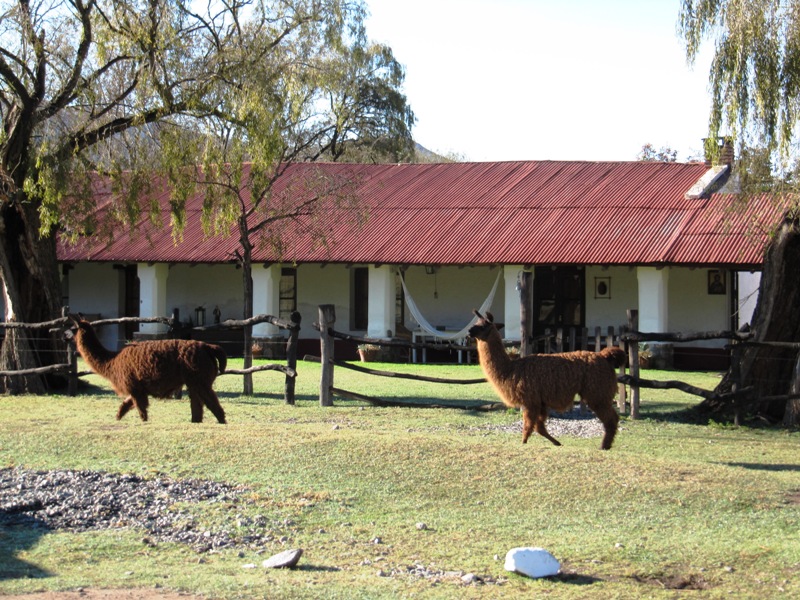
Tafí del Valle (by Carmen)

Mountains with clouds and shadows

Lonely Planet is both a blessing and a burden.  Their South America on a Shoestring guide is basically the travel bible for the continent.  It is packed with information you need from bus times and costs to great places to pick up empanadas.  Some people don’t “do” Lonely Planet to make themselves feel like more original travelers.  Nathan and I still find it valuable to check out their recommendations but keep our eyes open for serendipitous discoveries as well. At the same time, depending on a single text means that you end up where all the other gringos go.

Estancia Los Cuartos

But just when you think you are going to chuck the heavy book from your backpack, along comes an “our pick.”  These are supposed to signify an extra special find. Not all cities have such an accolade; they are actually few and far between.  So I took note when the small mountain town of Tafí del Valle had an “our pick” hotel called Estancia Los Cuartos.

Our historic suite

It was wonderful. The estancia was an old ranch house from the 1700’s.  Our room came with thick walls, a stone floor, dark wood book cases, a thatched roof and warm blankets.  I love history and it felt like I had stepped back in time a bit.  There were a few key modern amenities, such as a heater.  A nice touch since it rained heavily for part of our stay.

Breakfast with Tafí cheese

Another highlight of the estancia was breakfast.  The dining room overlooked the beautiful mountain scenery.  We enjoyed the typical courses of coffee, bread and jam but the best part was the homemade cheeses.  Tafí is known for its cheeses, which are modeled after a Spanish-style manchego (one of my favorites!).  Each year, the town hosts the national cheese festival.  We missed the festival but did indulge in a large block of cheese, which we enjoyed with a rosé we brought from Mendoza.

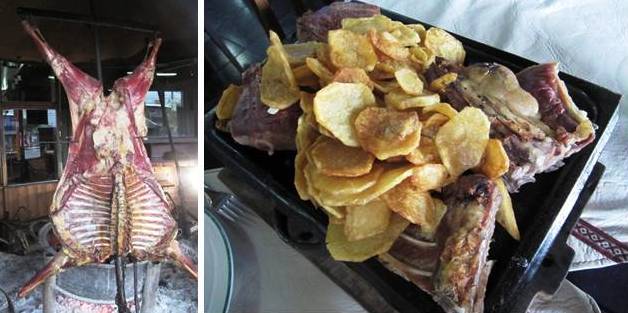
Barbecued goat and potatoes

In addition to good cheese, the main strip of Tafí has a few good parrillas.  We stopped into one that had a nice fire built in the front with meat roasting above it.  Their specialty was chivito (goat).   We ordered a grill plate for two which came heaped with chunks of juicy meat and delicious, crispy slices of potato.  Truly some of the best potatoes I’ve ever had.

Wild horses on mountain

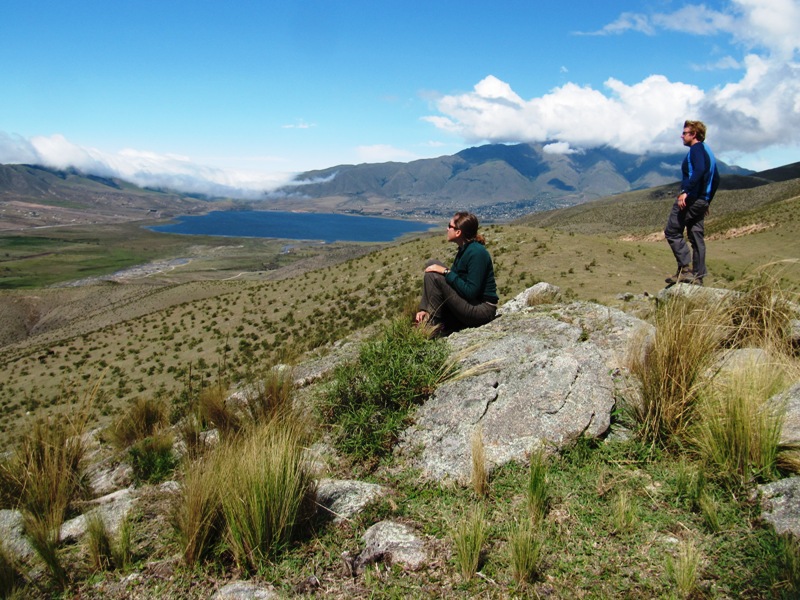
We needed to work off all these heavy meals so we did a nice hike to the cerro de la cruz (peak of the cross).  From here we could look over the town and the nearby lake.  Herds of free roaming horses grazed nearby.  Seriously, how much more idyllic can you get? At least for me, it was a blissful weekend.

On the overlook

Higher Learning in Condoritos (by Nathan)

Another name for this post might be “The Best And Worst Day In Condoritos.” Vacation is not all about relaxation, but frequently a memorable experience is about a little pain, fantastic views and numerous lessons learned. Visiting the Parque Nacional Quebrada de Condoritos was one of these adventures.

Park entrance...finally

Park entrance…finally

Our trip to the canyon containing the Andean condor breeding grounds was another two hour bus ride from Córdoba. We travelled high into the mountains and high into a thick cloud that we did not expect. Our driver was supposed to drop us off at the unmarked dirt road entrance, but he forgot. He pulled over on the side of the highway and informed us it was “really close” and that we just had to “walk around the corner.” An hour and a half later we arrived at the visitor center, time to “begin” the hike.

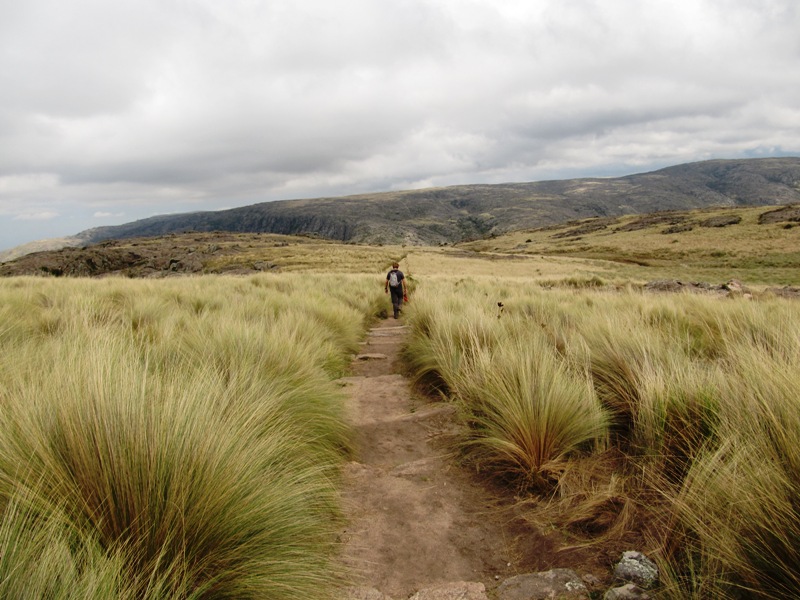
Windswept pathway

Windswept pathway

We checked our return bus schedule to Córdoba and we were off. We planned on a five hour hike that would give us plenty of time to get the 6:30 bus.

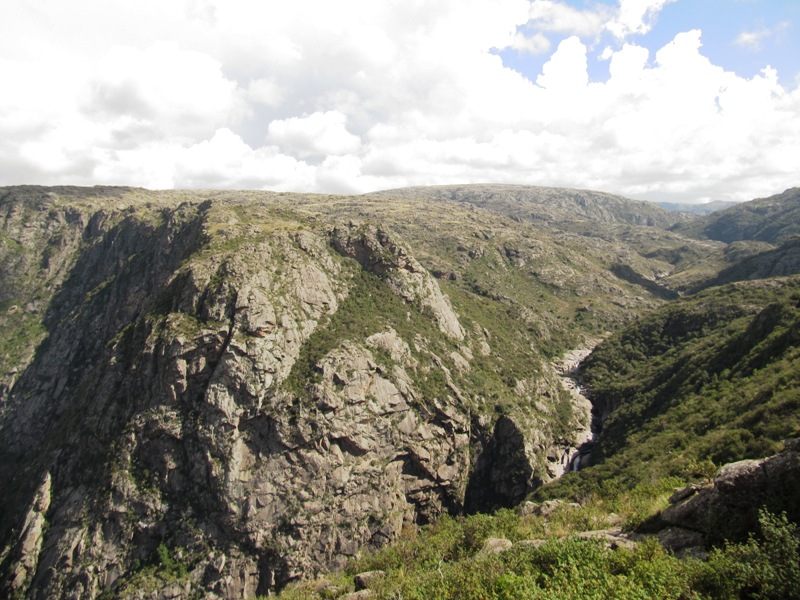
Cliffs of the quebrada de los condoritos

Cliffs of the quebrada de los condoritos

The canyon of condors was magically sensational for the eyes. We saw huge boulders, green grass and an occasional field of wispy golden grains that danced in the breeze. We sat on the cliff edge hypnotized by the souring condors gliding effortlessly into the thermal columns of the canyon. We quickly ate down our lunch of carrots, cheese and apples then cooked in the sun like two lizards on a rock.

Breathtaking valley

Breathtaking valley

Our return hike was even more fantastic. The clouds dispersed and everything sparkled in the golden sun. The trail glistened with huge crystals of quartz and flakey mica. We climbed and descended over the hills and repeated this cycle several times on our way to the highway.

Andes Condor souring above

Andes Condor souring above

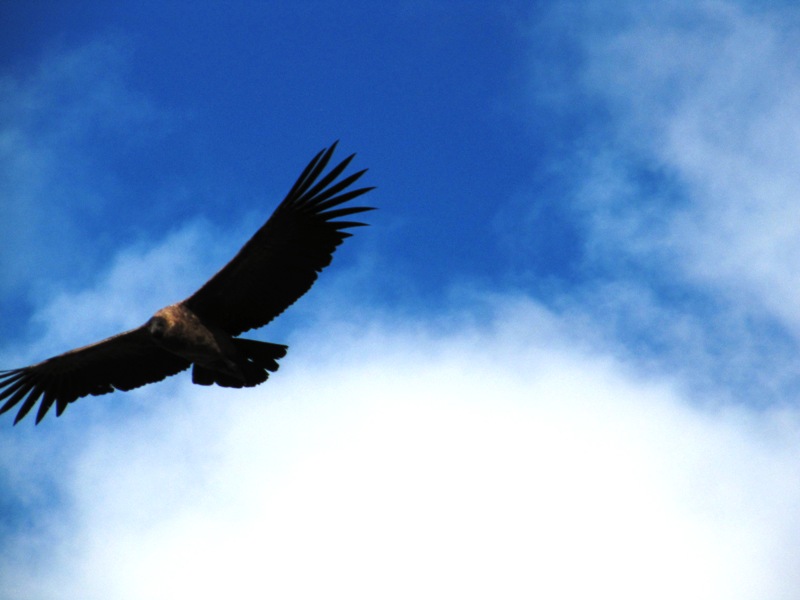
Huge condors flew overhead.  This bird has a wingspan of up to ten feet and a body the size of my thigh (it´s a big thigh). In the last dirt section of our trail a condor soured over us to better investigate. His huge wings fully spread with its white finger-like tips barely moved and his huge body hovered fifteen feet above out heads. With a gentle tilt of his wings he quickly maneuvered into the valley.

We were tired from 30km (19mi) of hiking and we plopped our throbbing bodies on the side of the road in anticipation for our bus.  An hour and a half passes and we realize that the bus is not coming. Another couple arrives loaded with camping gear and plans to hitchhike to Córdoba. Every half hour a microbus similar to the one we took to the park would fly by. We wave our hands eagerly, but we faintly remember the driver telling us that only the collectivo (big bus) would stop for us.

The sun began to set, the winds pick up and the temperature drops. Carmen and I huddle for warmth, but this does little to stop the shivering. Carmen screams out at the bus that never came, tears dropping as the freezing temperatures take their toll.

Then Carmen got a little warmer and there was hope. The back-packing group lent Carmen a hooded sweatshirt and thirty minutes later they saw my violent shivering and passed me the warmest pullover of my life that was soft and light with llama wool.

Another hour on the roadside shielding ourselves behind a concrete barrier and a third couple arrives from the dark. Jumping up and down and waving frantically the 7:30 bus does not stop for us. We attempt to hitchhike as well, but no one hesitates for six hikers and no car stops for us. There is only one more bus, one more chance. Carmen and I make plans to break into the visitor center for shelter.

The third couple fed us cookies to keep up our spirits. Then there is an idea: FIRE. Frantically we scramble to assemble the dried reeds. I was the craziest of all. I built a blazer and nearly threw myself into it to take in the heat. Our hysterical actions blinded the fact theat we could start the whole national park ablaze. Carmen pointed out that the three foot sideways windblown flames were inching their way to the dray brush.

We create a fire ring and restart the fire. Across the valley we notice a red glow, our last hope- the 8:30 bus. Our jumps and waving is even more frantic. We are desperate to get to Córdoba. It stops! Our boots stomp out the fire and we douse it with a liter of juice. Magically the bus pulls over onto the dirt shoulder and we sprint to the open doors excited to suck in the mixture of dust and exhaust. We stumble onto the dull bus and we find seats on the warm hard aisle floor. I refused to remove my layers because I enjoyed the tingle of sweat on my face that is so much better than frost in the nostrils. After three hours of waiting, we were finally warm and on our way to Córdoba.

This is not meant to scare, but more so to point out that this is traveling. The insatiable craving to explore brings about experiences good and bad. In every city there is joy and pain, frustration and delight and most of all knowledge and understanding of a culture and a place that only happens when we say “we have been there!”

Endless fields along our trail

Endless fields along our trail

Now, what are these lessons learned:

  1. Appropriate clothing: We had prepared for a cold day, but with three hours of waiting, we were not ready for a freezing night.
  2. Make friends: It was so much easier to endure this pain alongside our circumstantial friends. Their kindness was genuine and sincere.
  3. Know more about the transit: We headed out on a brief recommendation without full understanding of how to get back. We so rarely wing it, but in the future it is better to over plan.

Culture Clash Argentina – Villa General Belgrano & Cumbrecita (by Nathan)

Argentina is a big country and getting out of it means a long bus ride.  Lucky for us we were able to hop over to little Germany with a recommendation from our friend Jenny.

Trees at Veilchental campground

Trees at Veilchental campground

We had this great idea to volunteer at an organic farm working every day for our food and lodging.  When we arrived we found a campground, no farm, no food and a freezing cold night.  The only work was chopping wood; I did not want to spend the week recreating the piles of wood from my childhood so we moved our packs to the nearby town of Villa General Belgrano (VGB).

View of Villa General Belgrano from Cerro de la Virgen

View of Villa General Belgrano from Cerro de la Virgen

VGB was settled in the forested mountains about two hours south-west of Córdoba.  Germans fled from Europe after WWII and there was no better place than the sierras of Argentina that so closely resembled their homeland.

Hiking Carmen

Hiking Carmen

There is a steep and rewarding hike to overlook the city.  From our perch in the sky we looked down on the cute log buildings, gentle crystal blue creek and the hundreds of Argentinean tourists that also wanted to be here on the semana santa (Easter week).

Pasta and rosé

Pasta and rosé

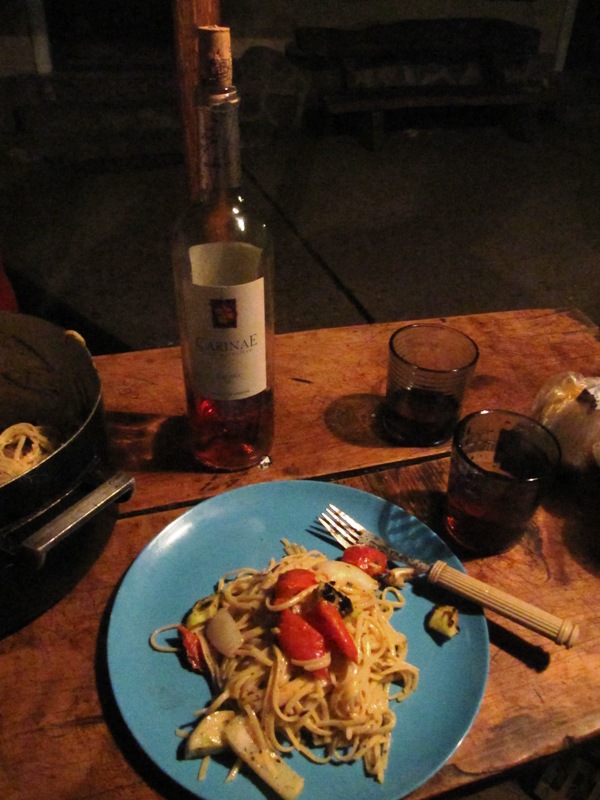
At night we cooked some awesome meals out of the outdoor hostel kitchen.  We grilled eggplants, peppers, onions, and garlic and tossed it with pasta, yogurt and lemon for a flavorful meal.

Cumbrecita German buildings

Cumbrecita German buildings

Forty-five minutes on a small bus from VGB is another adorable town: Cumbrecita.  The main street is lined with curios shops and stone and wood clad buildings, but the main reason we came was for the hikes.  In town we meandered around cobblestone streets that led to rocky trails to waterfalls and ponds tucked away in tree-lined cliffs.

Horse worn trail on rocky hillside

Horse worn trail on rocky hillside

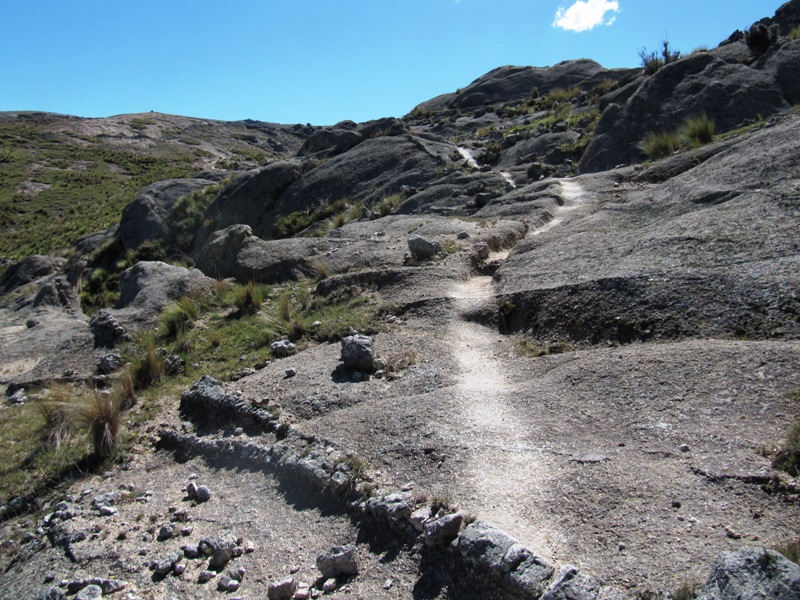
We found another rigorous hike to the summit overlooking the town.  Over an hour of switchbacks and we reached the summit and a view of expansive rolling hills that were forested as far as we could see.  In the other direction a canyon of boulders and a warn pathway from the gauchos on horseback that also trek this region.

Forested mountains

Forested mountains

Visiting these German villages was a delightful treat for our travels.  Better beer, bockwurst and sauerkraut and we even had apfelstreudel for breakfast.  Tucked into the mountains we could hike in the trees and just for a few days feel like we were in Europe, not South America.

The Cobbled Streets of Córdoba (by Carmen)

Cathedral in the golden sun

Cathedral in the golden sun

Having lived in Berkeley for so long I’m very comfortable in university towns.  Therefore, I was looking forward to visiting Córdoba. The city has been a center of learning in Argentina for centuries.  It is also Argentina’s second largest city, although it only has 10% of the population of Buenos Aires.

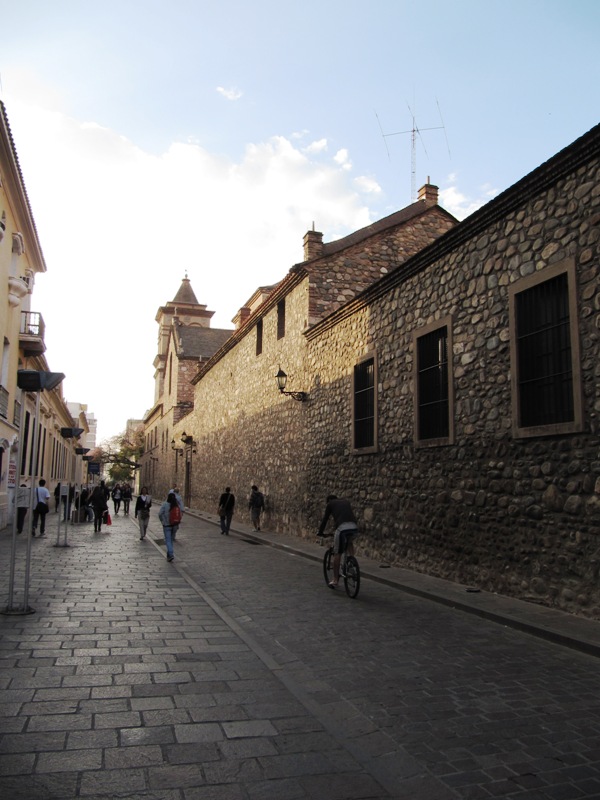
Cobbled historic street

Cobbled historic street

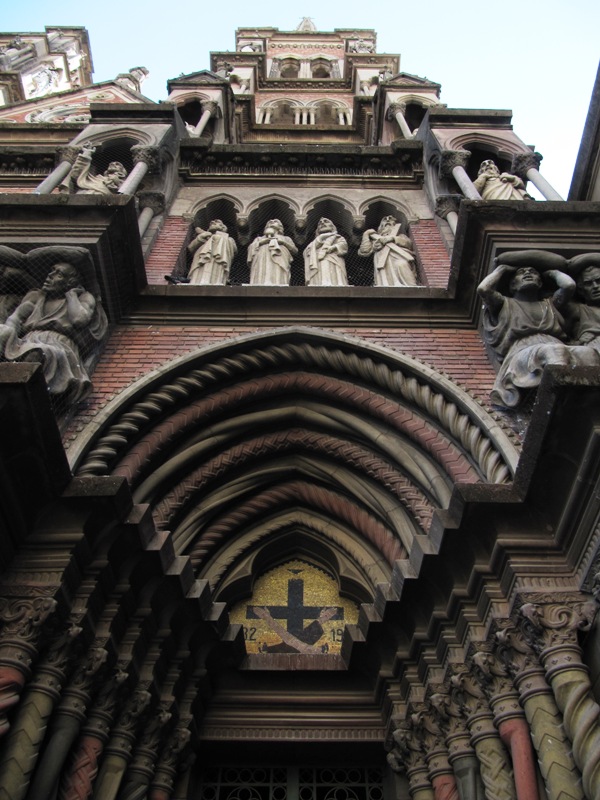
Lovely gothic style church not far from our hostel

Lovely gothic style church not far from our hostel

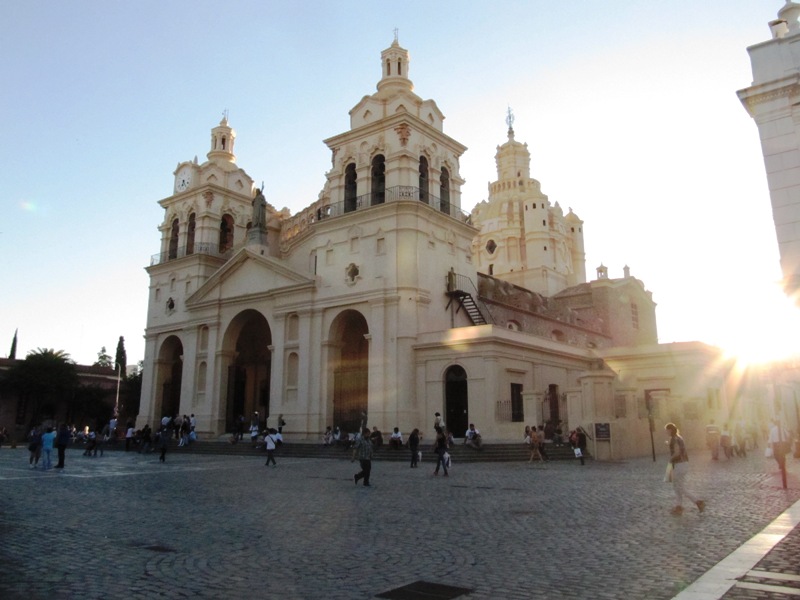
What we found was a very European feeling city with quaint plazas and grand churches, connected by cobbled streets in the center.

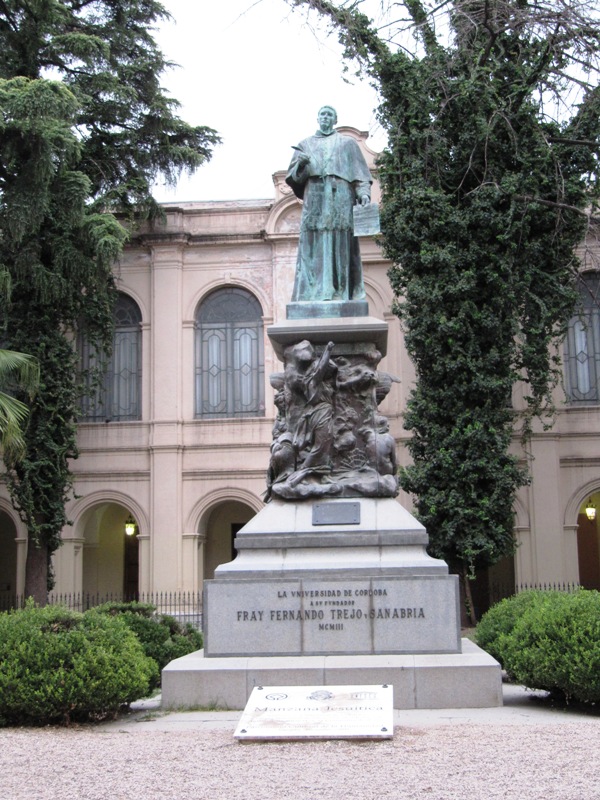
University courtyard

University courtyard

One of our favorite buildings was the university.  Amazingly, university education is free for anyone in Argentina, including foreigners!  We went on a tour which included a visit to the original Jesuit church that founded the town, built in the 1600s.  The guide was very passionate, particularly regarding the African slaves that were integral to building the town.  The Argentines are known for believing that they come from almost exclusively European descent.  But our guide informed us that slaves made up over half the Córdoba population even into the early 1800s.  Then they stopped being counted.  It was interesting to hear from someone trying to fight the “European Myth” that many Argentines still resolutely believe.

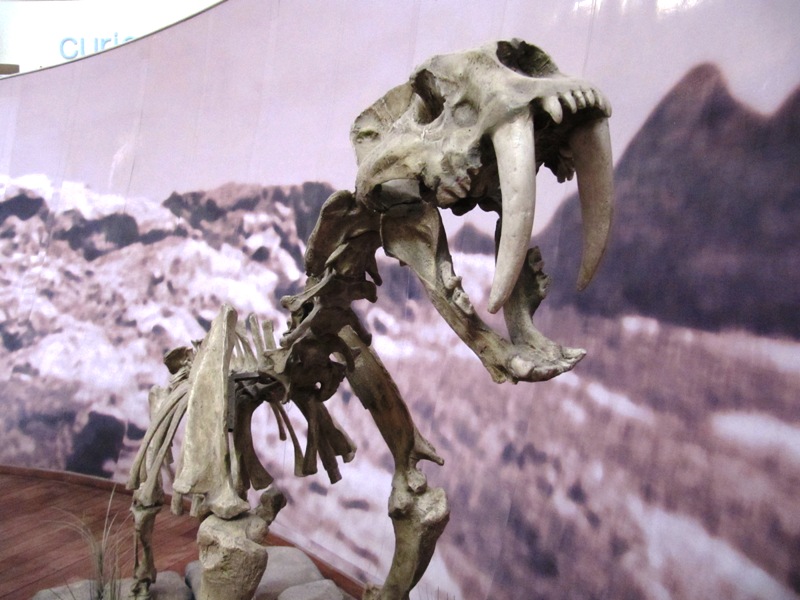
Saber-toothed tiger

Saber-toothed tiger

We furthered our education, but in a very different way, at the Museo de Historia Natural.  Ok, it was free museum Wednesday and backpackers can be cheap : )  But who can resist free saber tooth tiger viewings?

Crunchy gooey pizza from mercado norte

Crunchy gooey pizza from mercado norte

Finally, the food.  We enjoyed the crispy crust at a pizzeria in the market.

Locro and empanadas from La Candela

Locro and empanadas from La Candela

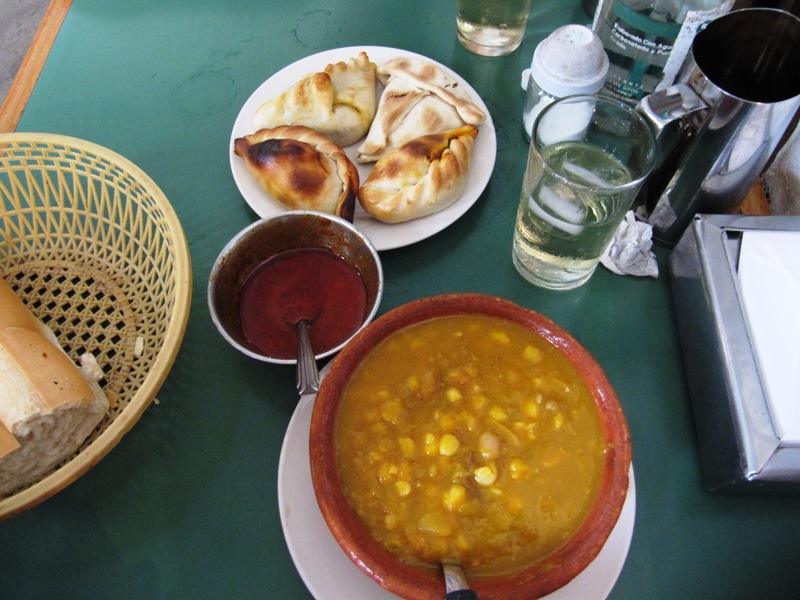
But we were finally able to enjoy more regional specialties unique to northwest Argentina. For example, locro, a meaty corn based stew.  It’s definitely comforting, especially when accompanied by a plate of fresh baked empanadas.  We tried two great places, Vieja Esquina and La Candela.

Córdoba street and trick half-building

Córdoba street and trick half-building

Córdoba was a great experience, especially since we met up with a friend of a friend.  Andres showed us around to see how the locals live.  We had a great time, but the small towns beckoned us northward, closer and closer to Bolivia.

Hermosa Mendoza (by Nathan)

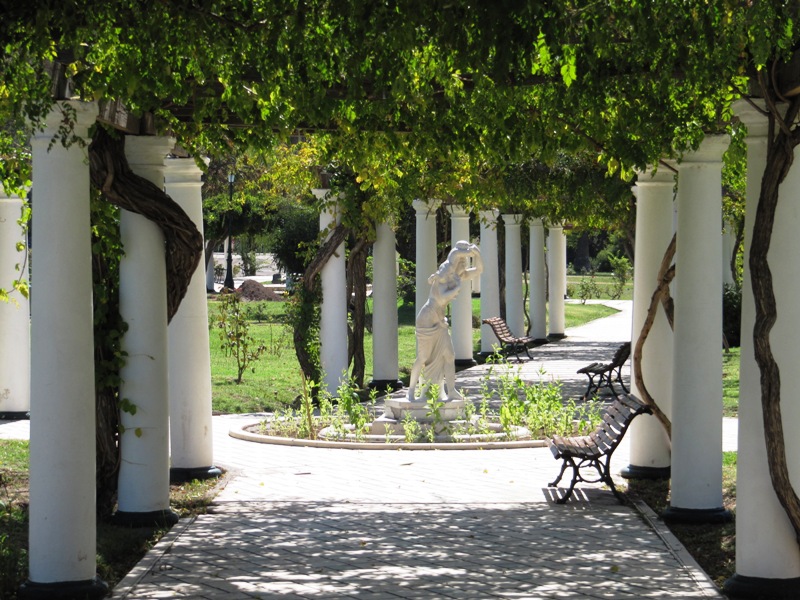
Picturesque parque gerneral San Martín

Picturesque parque gerneral San Martín

It is exciting to be back in Argentina.  After three weeks of beautiful Brazil we were doing pretty well with the Portuguese.  Santiago spanish was incomprehensible to me.  They dropped all hard consonants, slurred the end of every word and spoke at rapid speed.  Although the Spanish is not the purest in Argentina, it was nice to descend from the majestic Andes into a place more familiar.  ¡Bienvenidos a Mendoza!

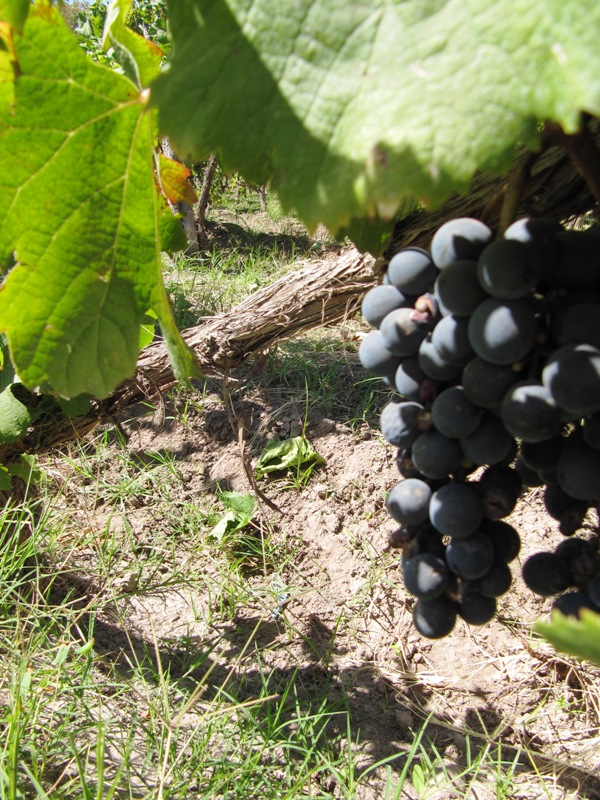
Ripe malbec grapes

Ripe malbec grapes

Our welcoming to Mendoza could not have been better.  Our first steps were met with a glass of malbec and an invitation to a homemade Italian dinner at our awesome accomodation, Hostal Lao.  Mmm licking my lips.

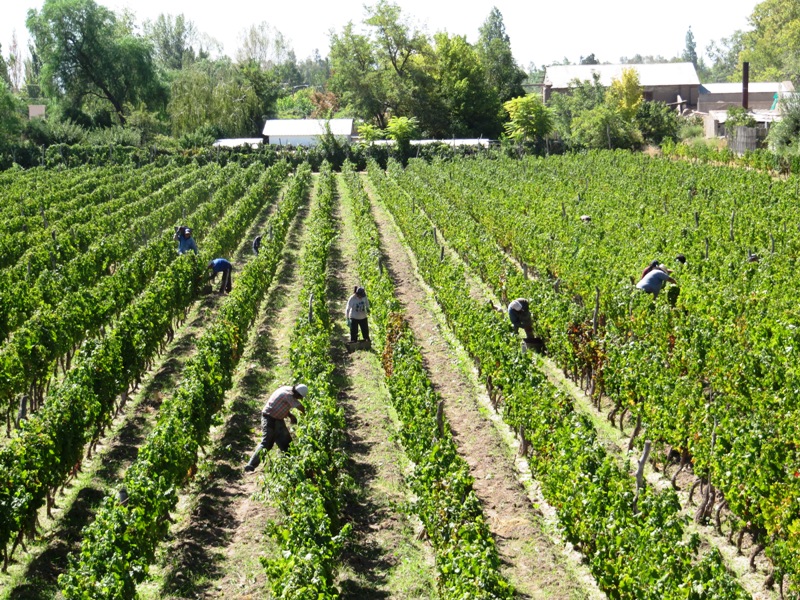
Harvesting grapes

Harvesting grapes

The malbec wine of the world is grown in Argentina and the bulk of it comes out of Mendoza.  Our timing was perfect and we arrived during the two weeks of harvest.  We tasted at several places and at each there was a flurry of work and the deliciously pungent smell of freshly crushed grape juice beginning fermentation.

Historic concrete vats

Historic concrete vats

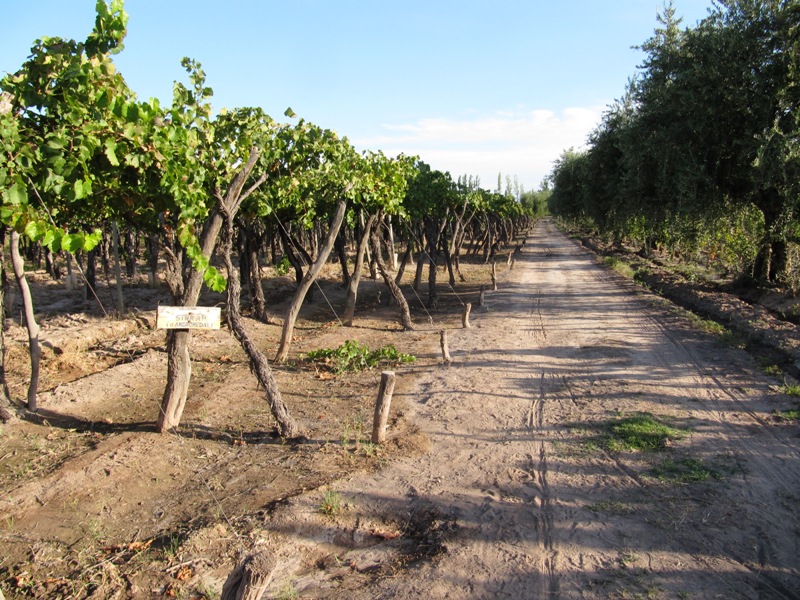
The style of wine making is significantly different from what we see in northern and central California.  First of all, the vineyards are hundreds of years old and each cellar houses enormous concrete tanks.  At each vineyard we learned that they fermented, filtered and blended almost all of their wine entirely from these vats.  They also had their premium wines that they put in oak for three to six months.

Carmen biking to the next winery

Carmen biking to the next winery

The place to go for tasting wine is the Lujan De Cuyo area.  There are about fifty boutique wineries all with their own blends, cabernet, torrontes and of course malbec.  We rented a bike from Bacchus Bikes for $6USD and the owner gave us a map with his recommendations.  He even called ahead so that the wineries could expect us.  Each winery had an extensive walking tour through their facilities describing why their winemaking is superior.  Tours were mostly in English, but at times we would break into Spanish for clarity.

CarinaE vineyard

CarinaE vineyard

After the tour we would be led to a table overlooking the vineyard, or a pair of glasses tucked between rows of barrels in the cellar.  They would pour a delicious variety of wine and even the freshly pressed grape juice.

Our favorite winery was CarinaE which was actually in Maipu Valley.  We tasted an extensive variety of 14 different wines.  They were so good that we lugged two bottles around for two weeks afterwards.  The second best wines were at Alta, a bigger winery with an informative staff and generous pours.  We also tasted at Filosofos and Pulmony and at each place we learned a little bit more about wine and Argentina.

Mendoza bus and huge sidewalk trench

Mendoza bus and huge sidewalk trench

Back in town we had to be careful after our wine tastings.  The gutters of Mendoza are uncovered, meaning a nasty fall if you don’t pay attention!

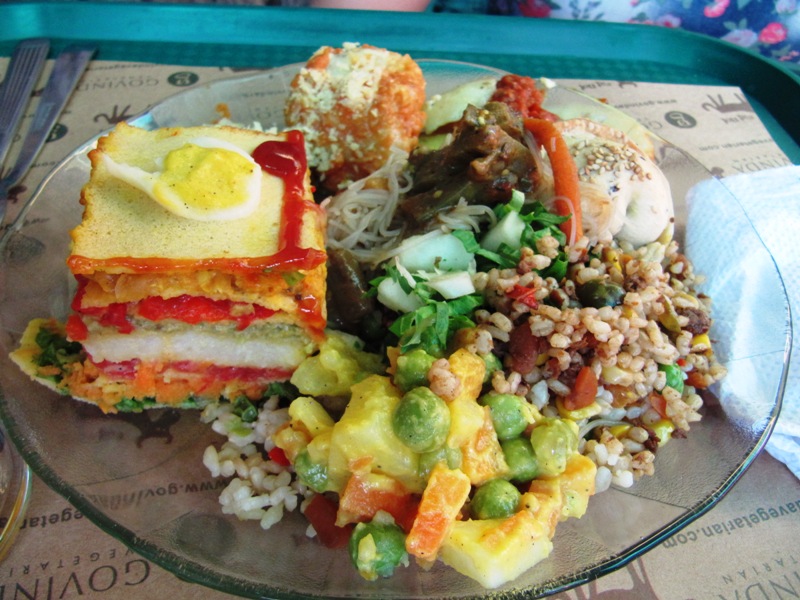
Plate of food assembled at Govinda

Plate of food assembled at Govinda

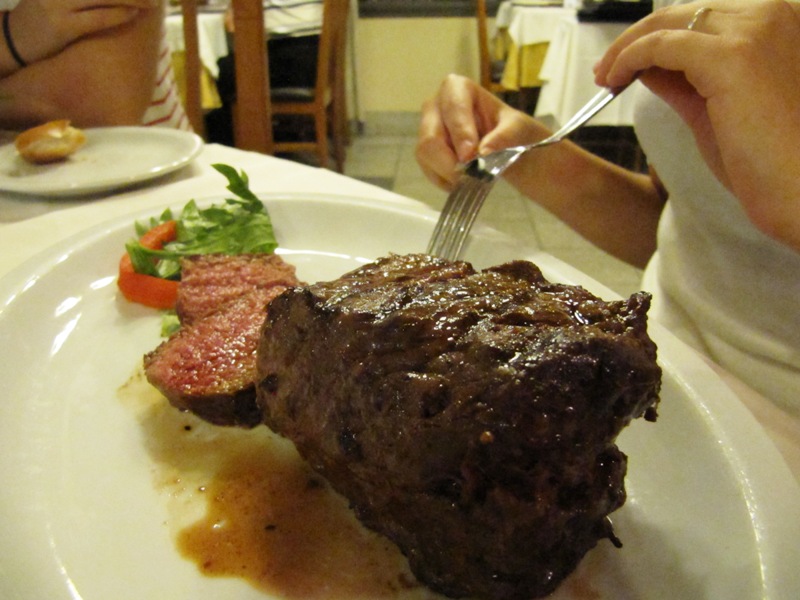
Bife de chorizo at Don Mario

Bife de chorizo at Don Mario

We ate delicious food and we met new friends in Mendoza as well.  It was nice to get some satisfying veggies at the vegetarian per kilo restaurant Govinda.  Our new friends Nick and Caroline invited us to Don Mario for the biggest juiciest steak I have ever attempted to eat.  I learned that Argentinians can cook their meat, really good meat…just not in BsAs.

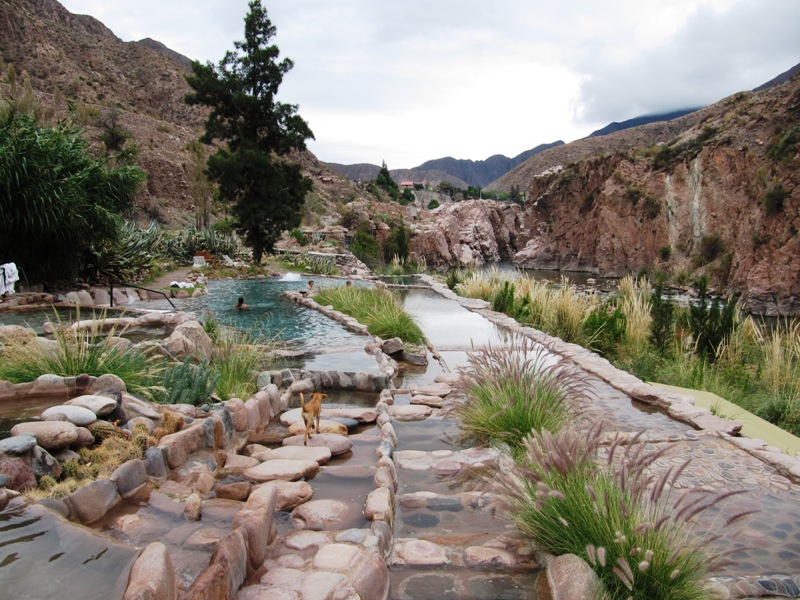
 Termas Cacheuta

Termas Cacheuta

We had an extra day so we decided to splurge and go to the Termas Cacheuta.  It was a spa tucked away inside a jagged and majestic canyon.  The pools varied from burn your back to freeze your ass.  We would bounce between the pools enjoying the various bubble jets and the time to relax.

Buffet lunch at  Termas Cacheuta

Buffet lunch at Termas Cacheuta

Lunch time meant that the pools cleared out and everyone rushed the buffet.  The choices were a large variety of veggies for a make-your-own salad and, of course, an asado of Argentinian meats.

Mini canyon and creek close to the termas

Mini canyon and creek close to the termas

Mendoza had some tantalizing tastes and beautiful views.  I was happy that we had the time to savor them both.

The Best Bus Ride Ever (by Carmen)

Valley and creek

Valley and creek

Long bus rides come with the territory when traveling in South America.  Extremely long in some cases – I’m talking 24 hours or more!  Nathan and I have avoided such journeys, keeping our trips to 10 hours or less.  On some of our longer journeys we take an overnight to save on money and time.  These can actually be quite comfortable with seats that recline nearly flat.  But there are some bus rides worth being awake for. Such is the case with the trip from Santiago to Mendoza.

Andes cliffs

Andes cliffs

A few years ago my cousin traveled around South America.  She endured numerous bus hours but one trip in particular stuck out in her mind: Santiagoto Mendoza. Ever since, I’ve actually been looking forward to the eight hour journey.  (Thanks Adri!) The two cities are separated by the Andes. It’s a mean job for the bus to get up and over these mountains, but for us it made for spectacular views. 

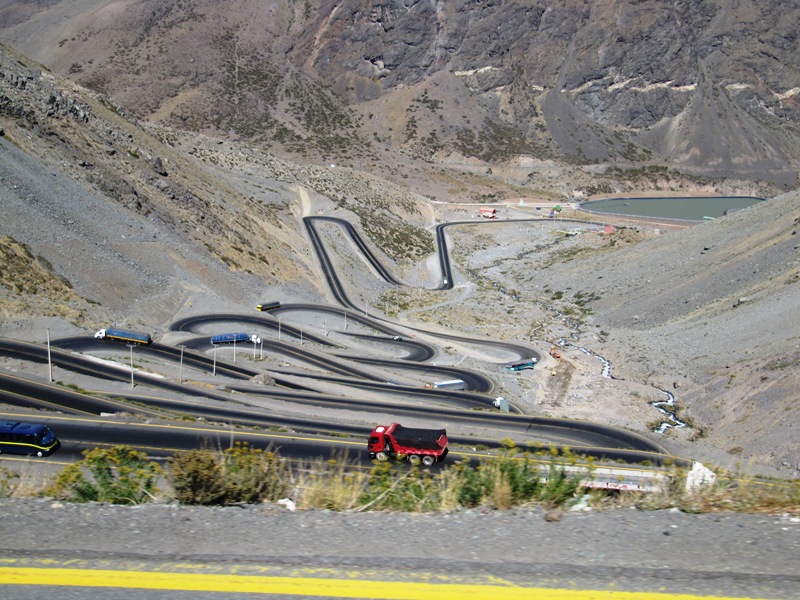
A ribbon of road

A ribbon of road

Glacier in the distance

Glacier in the distance

As the bus trudged up switchback after switchback our eyes were practically glued to the windows.  We were enveloped by high cliffs carved by the swift river running alongside the road.  Glaciers peeked out from distant mountain peaks.  The drama of it all made the ride feel much shorter than it actually was.  Bring on the 24 hour bus trip!  Ok, not really but we are looking forward to more scenic drives through northwest Argentina.

Valley with mossy river

Valley with mossy river

Tall Andes valley

Terremotos in Santiago (by Nathan)

View from Santa Lucía

View from Santa Lucía

Sometimes the best way to see a city is with friends by your side.  When those friends live in foreign countries, even better!  Santiago is a flourishing city wrapped with steep mountains and bustling with 50% of Chile’s population.  Many of the best sights and food are only known to locals, so we were excited to temporarily move in with our friends Bobby and Stephanie.

Vinyards and Chilean flag

Vineyards and Chilean flag

Lunch at Bodega Isidrio

Lunch at Bodega Isidrio

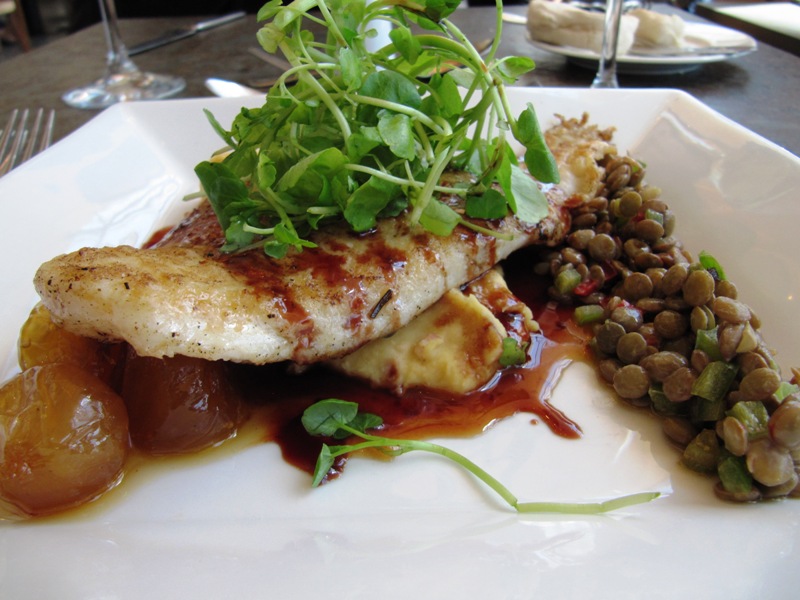
The last time we were together we had a great time exploring the wineries of Napa Valley.  For our first day in Santiago, we decided to repeat the experience with a day trip to visit the Casablanca wine region as well as the coast.  There are few better Saturdays than sipping on wine and going to the beach, so we had a perfect day planned.  On a beautiful morning we rented a car and ascended from Santiago to find a valley lush with grape vines.  Our first stop was Emiliana Organic Vineyards.  The excellent tasting took place in a beautiful glass, wood and stone building.  We bought two deliciously inexpensive bottles and we were on to the second winery.  Cerro San Isidro is a modern, bleach white villa perched on the hillside.  Overlooking the valley we enjoyed a delicious lunch.

Viña Beach

Viña Beach

Back in the car and we were on our way through the mountains and then dropping in the colorful beachside communites of Viña del Mar and Valparaíso.  We enjoyed a walk along the beach boardwalk of Viña.  We sipped pineapple juice, ate churros and admired the local crafts.

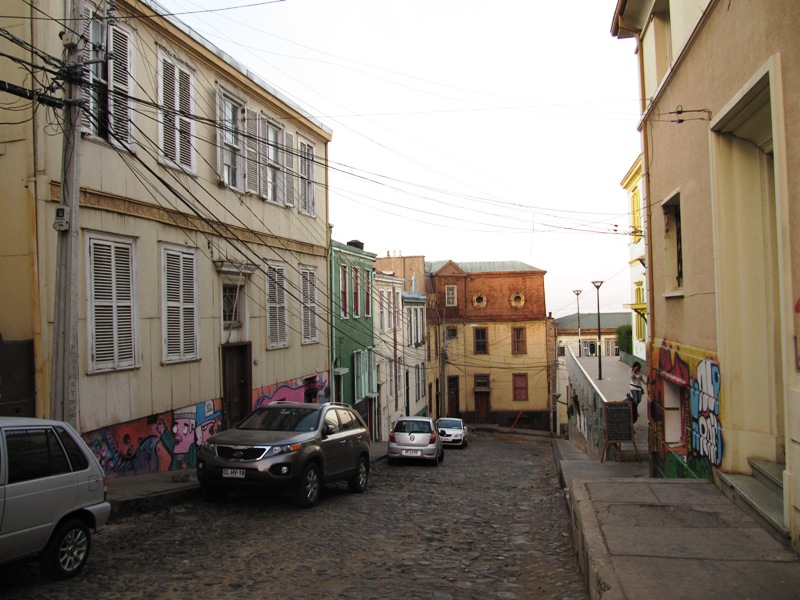
Valparaíso Streets

Valparaíso Streets

Valparaíso overlook

Valparaíso overlook

A short subway ride away (yes, they have a subway) and we were in Valparaíso.  This small town has a colorful charm, steep hillsides with boxy buildings clinging to the slope.  The streets are cobblestone and every visible wall and surface is artfully painted with murals.  The art was political, scenic, cultural and sometimes just tagging.  But the graphic images gave the city an intriguing sense of place that was fun to explore.

Backyard Asado

Backyard Asado

A late night drive brought us back to Santiago.  We were able to experience an excellent day trip only possible with local friends.  The next day we tagged along to a backyard asado (BBQ) and birthday party that rocked our world with a wonderful home-cooked meal.  First there was pisco sour made awesomely pink and delicious with imported Arizona tuna (cactus apple).  The main course was a fall off the bone lamb cooked in an stone oven then finished over coals and a brine bath.  Sebastian and Laura were excellent hosts.  Great food and a chance to speak Spanish with some interesting Chileans made for a special afternoon.

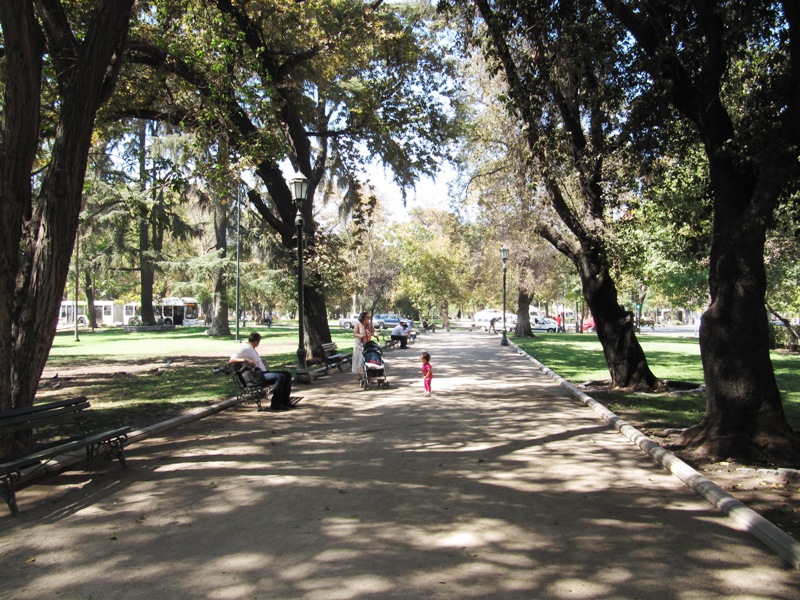
Parque Forestal

Parque Forestal

Ice cream from Emporio La Rosa

Ice cream from Emporio La Rosa

There are more than enough activities to keep busy for a few days here.  We were staying in the Las Condes area that had a beautiful rose-lined park. Close to the center the slender Parque Forestal offered Parisian-like strolls and locally crafted ice cream.  We enjoyed frutas del bosque (forest fruits) and thai ginger. 

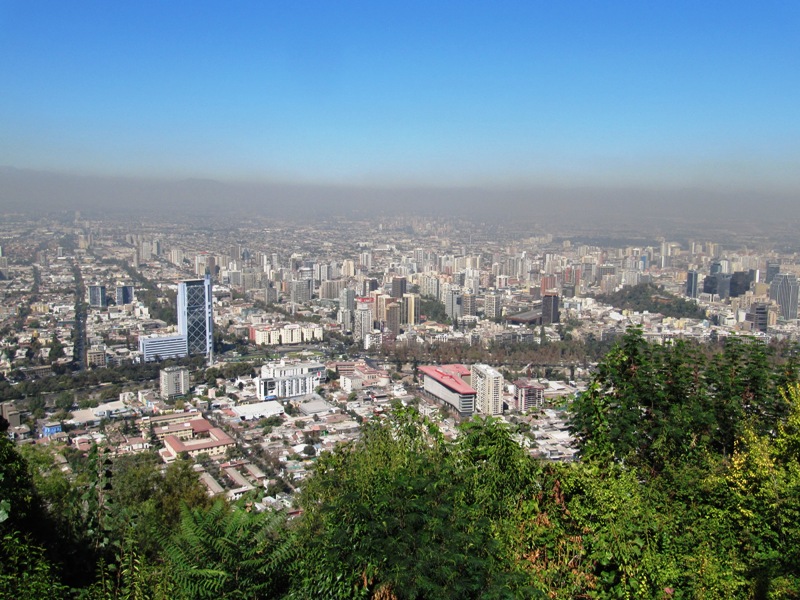
Santiago and its smog

Santiago and its smog

There are a few vistas in the city, but be warned that the air quality is pretty bad.  Santiago is surrounded by mountains that offer crisp snowcapped views in the winter, but in the summer the smog and dust becomes trapped, entombed by the mountains waiting for a storm to clear it out.  Unfortunately our timing in Santiago was one of those bad air times.  With our throats raspy and our skin scaly we climbed the Cerro de Cristóbal.  We were surprised to find that we could only see a third of the city.   In the center of the city we walked to Cerro Santa Lucía and we found an urban look at Santiago under the smog.
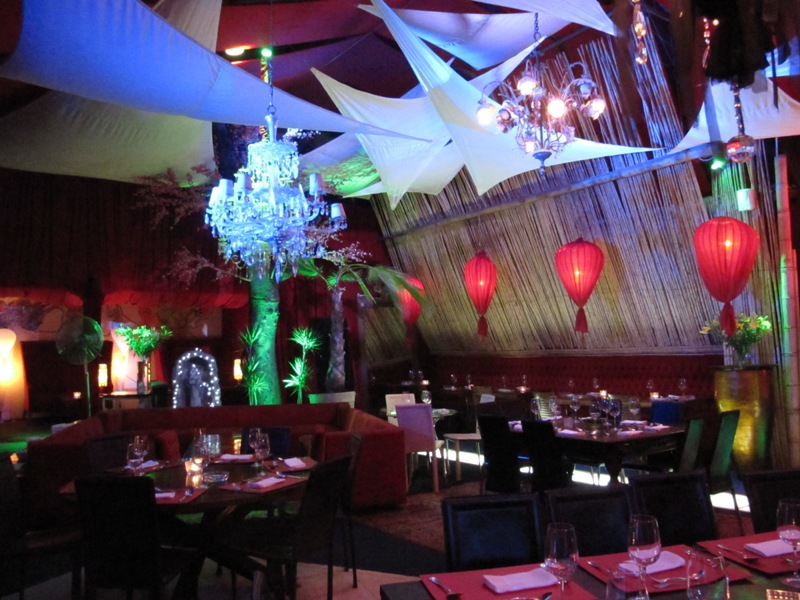
Kai hidden Thai restaurant

Kai hidden Thai restaurant

There were many great places that we found only because of our friends Bobby and Stephanie.  Kai is this vibrantly colorful and ornate Thai restaurant   There was no sign, no entrance, but we walked through an unmarked doorway and found some deliciously spicy food.  It’s funny how I miss certain flavors, and finally after weeks of travel Bobby and Stephanie showed me a place to excite my spicy taste buds.

First round of terremotos

First round of terremotos

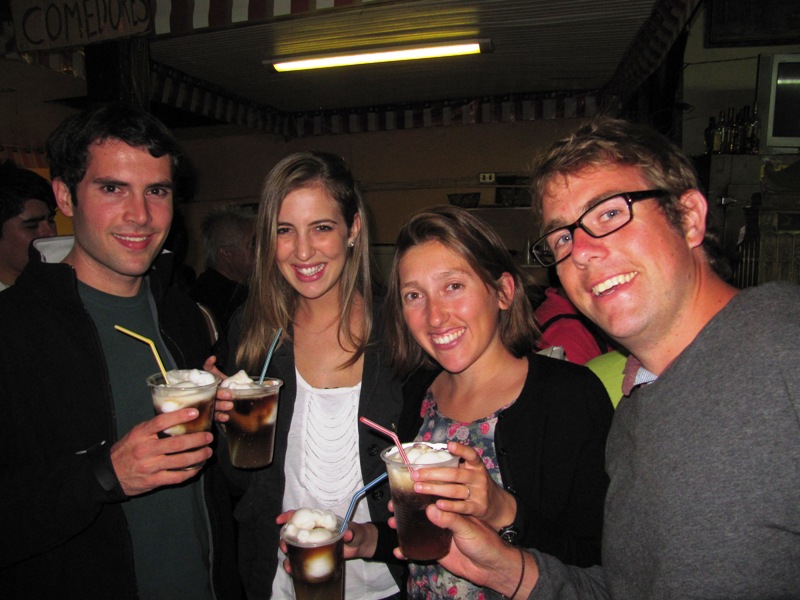
From one hidden door restaurant to the Chilean drinking hall of La Piojera we were welcomed into a new community of expat and Chilean friends.  It was an initiation into the Chilean culture with cheek kisses and a round of terremotos (earthquakes).  La Piojera definitely makes the ground feel like it’s moving as they scoop an iceberg of pineapple sorbet into a goblet of white wine and top it with a downpour of syrupy mead-like liqueur.  The end result: an off-the-richter drink!

The name terremoto is very apt and almost taunting because, like California, Chile has its share of ground shaking.  To our benefit they have a good grasp on their earthquake engineering.  One shaker caught us on the 25th floor of Bobby and Stephanie’s apartment.  We stood there frozen and watching the building sway against the horizon.

The politically exciting Bar Clinic

The politically exciting Bar Clinic

But the earthquake didn’t stop us from enjoying a few more drinks.  Bar Clinic delivered an excitingly political atmosphere and a few local draft beers for us to enjoy the afternoon sun in downtown.  The walls were decorated with odd parodies and humor reminiscent of “The Onion.”  Close by there were a few nice museums and plazas that dotted the city.  Unfortunately the pre-Columbian museum that we were excited about was closed for renovations.  We settled on the eye opening Botero exhibit on Abu Ghraib which coincidently enough was on loan from the Berkeley Art Museum.

Sizzling shrimp and garlic

Sizzling shrimp and garlic

Santiago has a culinary dish that we frequently spied on other tables.  They grill up tiny shrimp in butter, garlic and optional chili peppers in a small cast-iron pan.  It is delivered sizzling on the table.  Each shrimp turns bright red, perfectly cooked and succulent.  We liked it so much that we ate it twice, once at the excellent restaurant Galindo and then again at the seafood market.
Fresh seafood market

Fresh seafood market

The fresh food market in downtown Santiago is enormous.  Carmen and I spent hours roaming the aisles of meats and produce and we did not nearly see all of it.  The first of the markets is the fresh seafood.  Fifty or so vendors and another fifty or so restaurants called out to us as we walked by.  They held up huge pieces of salmon and others showed off their practically alive mackerel.  We settled for the tiny, perfect little shrimp.
Vega herbs

Vega herbs

Vega vegetables

Vega vegetables

Across the street is where the craziness of fresh food begins.  The first building is relatively empty and almost fooled us, except that this is where we found all the locals eating their farm to table fill of local meats and vegetables.  Further on there are a series of buildings and warehouses each with dense stalls of vendors.  This area is called La Vega (the field).  We found a vendor selling thirty types of peppers, another tomatoes, and another showed a seemingly life-cycle display of the onion.  He had mounds of chives, perfect green onions and even bright purple and plump onions, to complete the family huge leeks overflowed their crate.  We were most excited for the paltas (avocados) which were tender and ready to eat for only $1/lb.  There were dried fruit vendors, grains in bulk and, of course, meat.  Huge sections were devoted to poultry or beef and occasionally we’d see a rack of lamb.  All cuts were displayed their glass cases and ready to take home to cook.

Back in the kitchen

Back in the kitchen

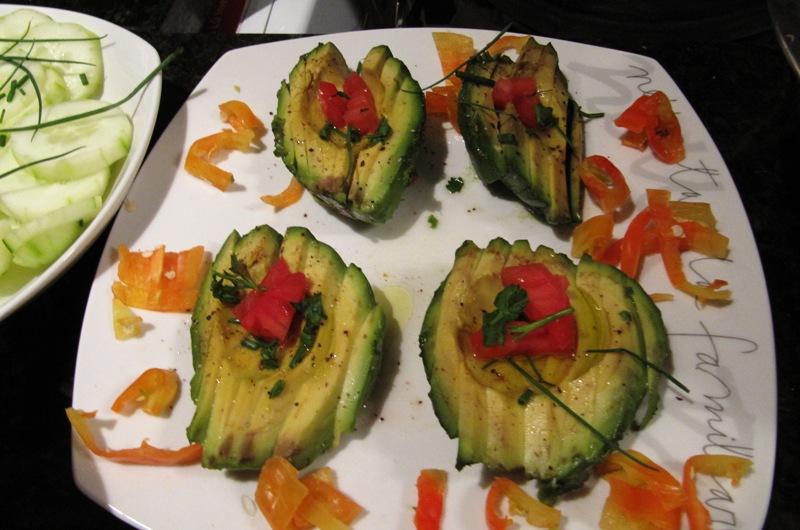
Chilean avocados

Chilean avocados

We wandered through the fresh food market gaining inspiration for a delicious meal.  We picked the spiciest peppers, colorful quinoa, and a mix of plump veggies.  Back at the apartment, we cooked a feast and shared some wine.  A home cooked meal that was perfectly fitting end to our days in Santiago.  Thank you to our wonderful hosts, Bobby and Stephanie!

Shrimp over quinoa and fruit salad

Shrimp over quinoa and fruit salad

The Tiny Island of Ihla Do Mel (by Nathan)

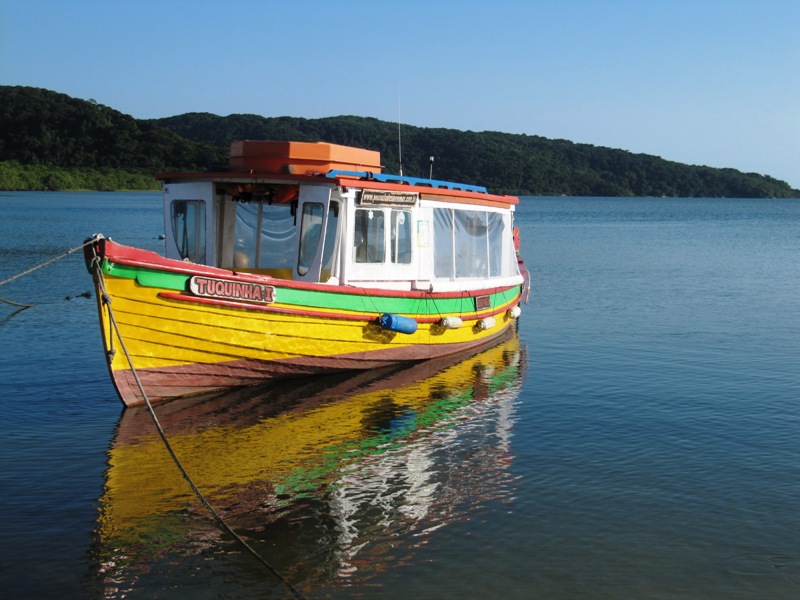
Colorful fishing boat

Colorful fishing boat

Time for a vacation from this vacation.  Traveling is hard work. Every few days we pack our rucksacks and transport ourselves to a new destination.  Each place is an adventure and every city requires planning for places to eat, sights to see and activities to entertain.  To us, this is the fun of traveling, an adventure wherever we go.

We try to spend an afternoon here and there reading or napping, but then we get to the point where we need a few days to really relax. We grabbed our swim suits and headed to the tiny Ilha do Mel (Honey Island).

Docks of Parana

Docks of Paraguaná

Originally it was a colonial fort, but now it has less than 1000 residents, no cars, no roads, just sandy paths, lush forests and pristine beaches.  I’m relaxing just writing about it!

Buffet in Paraná

Buffet in Paraguaná

The only way to get to the island is by ferry from Paraguaná or Ponta do Sol.  Before departing we grabbed lunch at a per kilo restaurant. The variety and quality of food at these places is wonderful.  We filled our plates with feijão (black beans) and salads and then waddled our way onto the boat.   Then we chugged along through the calm blue waters to the island.

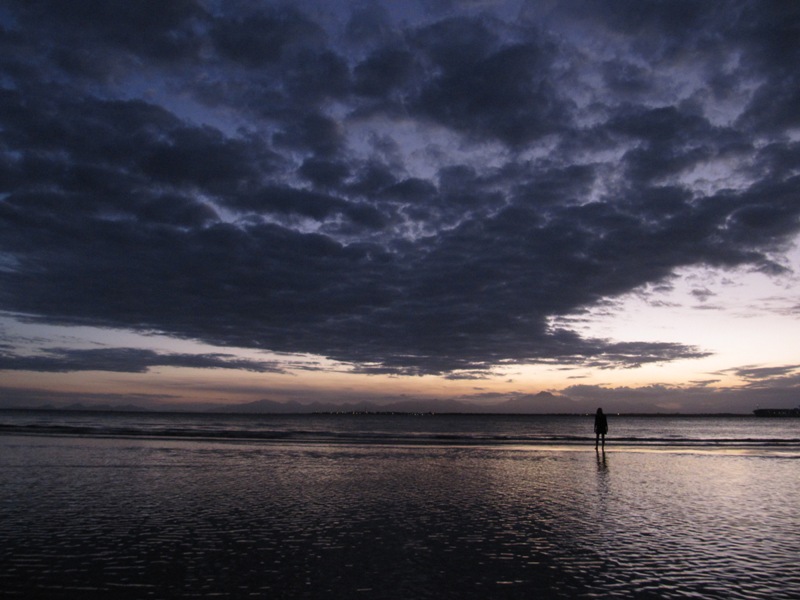
Water sunset

Water sunset

There are two villages on the island.  We stayed on the southern edge in Encantadas.  Our hostel was adorable with its own wooden balcony and two hammocks overlooking the beach.  A five minute walk and we were in the water watching the sun disappear behind the mountains.

Dinner in the sand

Dinner in the sand

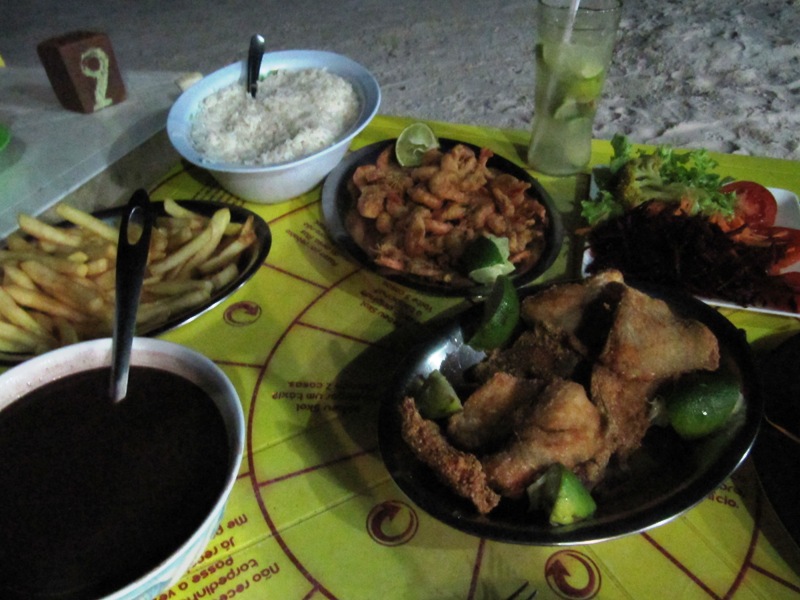
We had several options for dinner that night.  We walked along the beach with our sandals in our hands until we found a place that offered everything we wanted.  The owner suckered us in first complimenting our Portuguese then questioning us if we were Argentinean.  We gorged on fish shrimp, fries, salad, rice and feijão.  With our feet in the sand we quenched our thirst with a caipirinha or two.

Playa Grande

Playa Grande

Travel around the island is by foot along winding sandy trails through the forest that emerge on picturesque beaches.  We traveled here mid-week and the island was empty.  Supposedly the island is packed with thousands of people in January, but we were only aware of fifteen or so tourists during our stay.

Grilled fish with capers at Mar e Sol

Grilled fish with capers at Mar e Sol

We would swim at a beach, bathing in the sun for a few hours, then grab our day pack and hike to another part of the island.  The other village is called Nova Brasilia and there is about an hour and a half walk between there and Encantadas.  There is also a ferry that is about twenty minutes that runs every 1-2 hours.  For lunch we plopped our sandy bodies down on the bench seats of Mar e Sol.  They grilled us a delicious fish, heaped high with capers the size of small grapes, bursting with salty brine in every bite.

Ihla do Mel fort

Ihla do Mel fort

A few hours more in the sun, and miles of beaches later, we arrived at the northern tip.  Here we found the remains of the historic fort with thick ornate white-washed walls and canons to protect the island from the Spanish.

Carmen on a sandbar in the sunset

Carmen on a sandbar in the sunset

Our little beach in Encantadas has this special sand bar.  The tide would recede in the evenings abandoning the fishing boats in the sand.  It was a challenge to become fully submerged.  We walked 300-400 feet from the shore and the water was still knee deep!

In the morning the water would return and wipe away the foot traffic of the previous day.  The revived boats bobbed happily in the water.

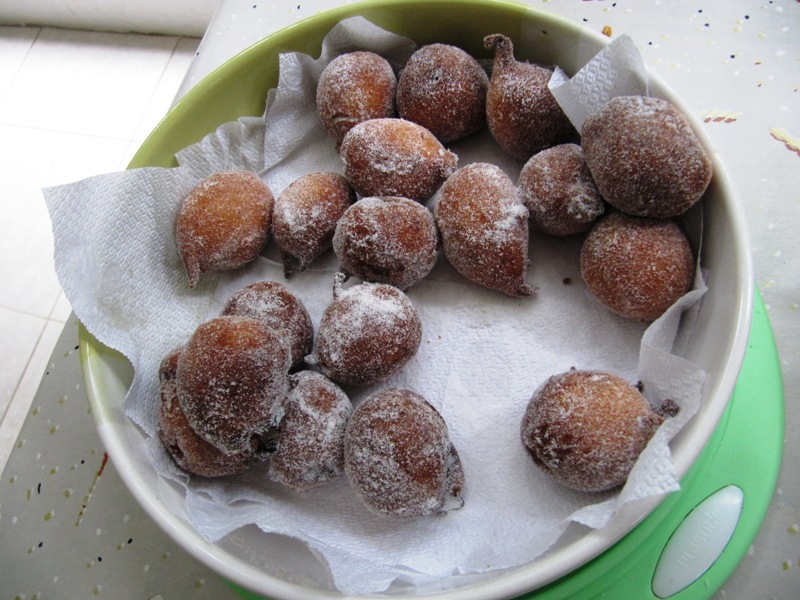
Banana fritters

Banana fritters

Our hostel served us a particularly wonderful breakfast of fresh papaya, mango, watermelon, bananas, bread and jam.  On the last morning  the quiet young woman that ran the hostel made us these delicious banana fritters (if you know the name please comment).  Crispy and sweet on the outside and gooey oozing banana on the inside.  Perfect dumplings of joy from the perfect and beautiful little Isla do Mel.

Checking Out the Hype in Curitiba (by Carmen)

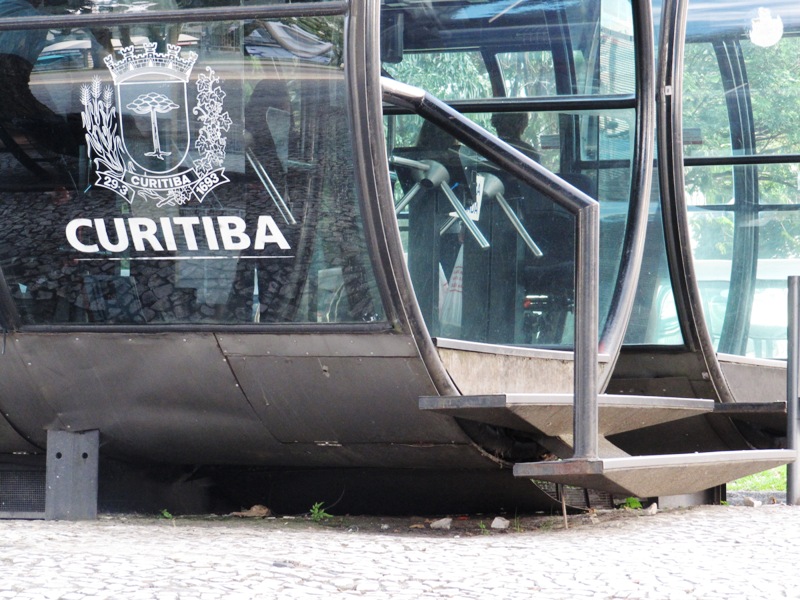
Curitiba seal on bus tube

Curitiba seal on bus tube

Anyone who knows me knows that I love transit.  Buses, trains, streetcars, subways…they all hold a special place in my heart. I had drafted a long paragraph on all the reasons I feel this way; how transit is an important part of environmental sustainability, social equity, economic efficiency and public health.  But Nathan said it was a bit of a snooze for people who aren’t as passionate about this topic.  So I’ll spare you the details.  But I will say this:  Everyone deserves a balanced transportation system (including transit, walking, biking and driving) that gives people choices on how to travel depending on when, why and where they are going.

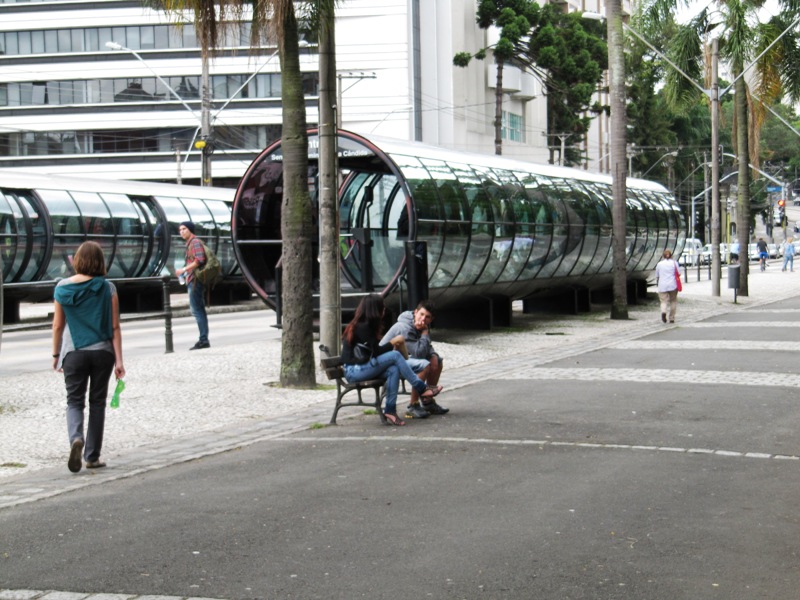
Bus rapid transit stop

Bus rapid transit stop

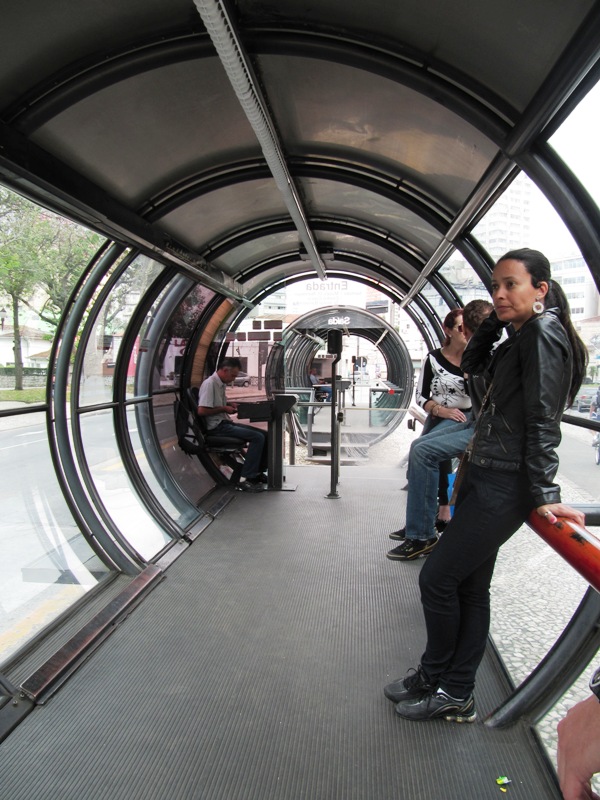
All this transit talk is a preface to my post on Curitiba.  This city in Brazil is known throughout the world for its investment in bus rapid transit (BRT).  The BRT system is essentially an above ground subway with buses instead of train cars.  As they built the BRT in the 1970s, the government encouraged tall buildings along the routes so that more people could benefit from the system.  What more could a transit lover ask for?

Waiting for the bus

Waiting for the bus

I’ve heard a lot about Curitiba over the years and I’ve often wondered if it would live up to the transit hype.  Also, would there be anything worth seeing besides the BRT?  And of course, the bottom line for us –  how is the food? The answer to these questions are yes and good!

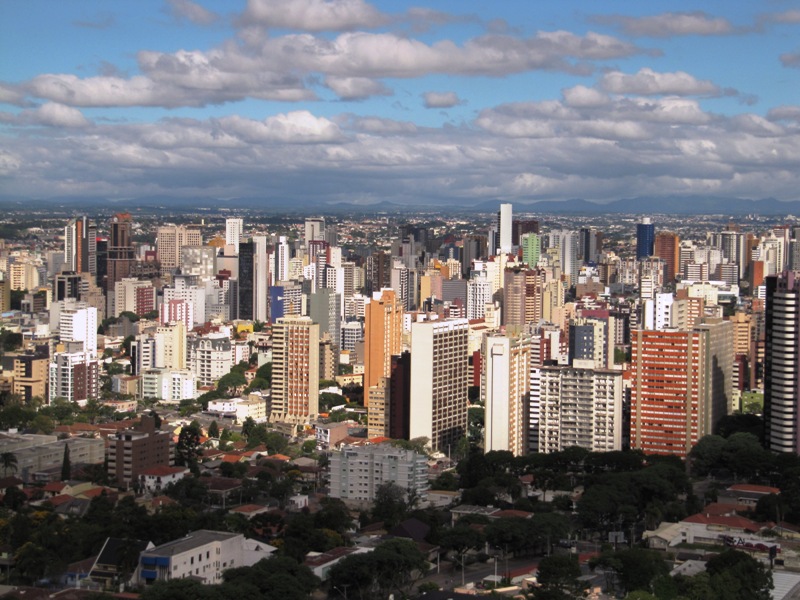
Curitiba Skyline

Curitiba Skyline

Curitiba Skyline 2

Curitiba Skyline 2

The success of these bus lines is evidenced by the dense land uses lining the routes.  These development patterns are no accident.  The city planners encouraged tall buildings in these areas to enable more people to take advantage of the transit.  My only complaint is that they did not always do enough for pedestrians.  Once people left the safety of the bus tubes, there are areas with no crosswalks or lights for people to safely cross busy streets.  But in the end, I was impressed and happy to finally see this transit system we (ok, more specifically transit fanatics) so often put on a pedestal.

Colonial plaza

Colonial plaza

There was more to the city than good transit.  It also had a cute colonial center which on Sundays turns into a huge market.  We found everything from bus key chains to pierogies!  Pierogies (Polish dumplings) are a strange thing to find in Brazil but this area actually had a lot of German and Polish immigrants in times past.

Brazil meets Germany at Schwarzwald´s

Brazil meets Germany at Schwarzwald´s

Which is why they had Schwarzwald´s, a German restaurant modeled after a medieval Bavarian beer hall.  I couldn´t get enough of their submarinos or mini-steins with pictures of Curitiba on them.  They would stick these in your glass of beer for no other reason than as a set of trophies to how many drinks you have had.

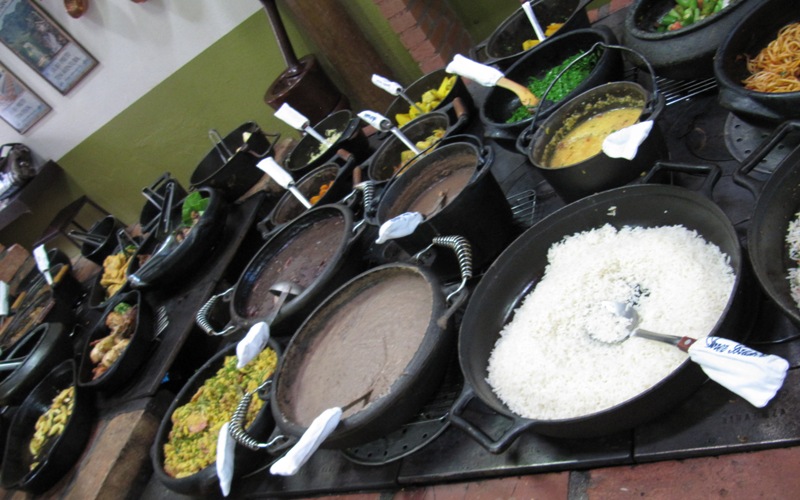
Tempero Brazilian buffet

Tempero Brazilian buffet

0.65 Kg of deliciousness

The next day we filled up our bellies with the best buffet we found in Brazil.  Tempero de Minas is a per-kilo restaurant, meaning they charge by the weight of your food.  The stews and veggies looked so good we had no trouble filling our plates to the brim.  Fortunately, it tasted as good as it looked.  Savory, slow-cooked goodness.

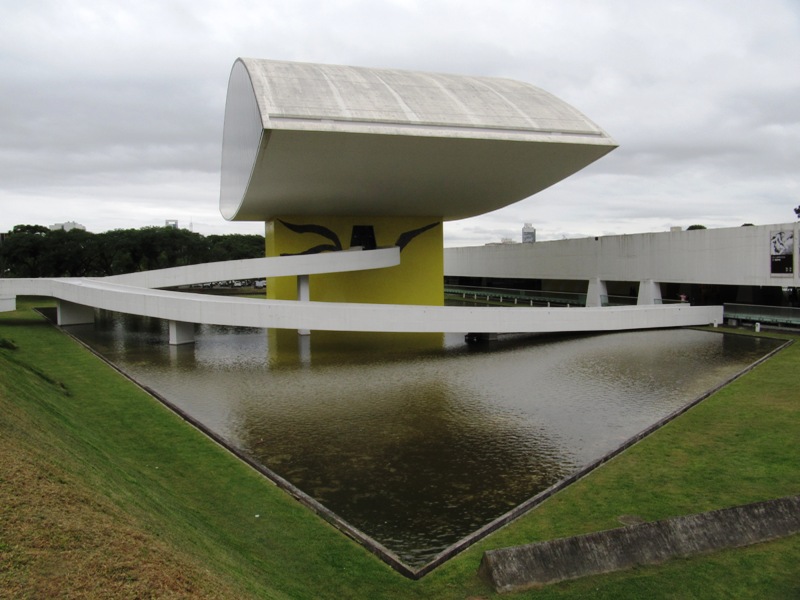
Oscar Niemeyer Museum

Oscar Niemeyer Museum

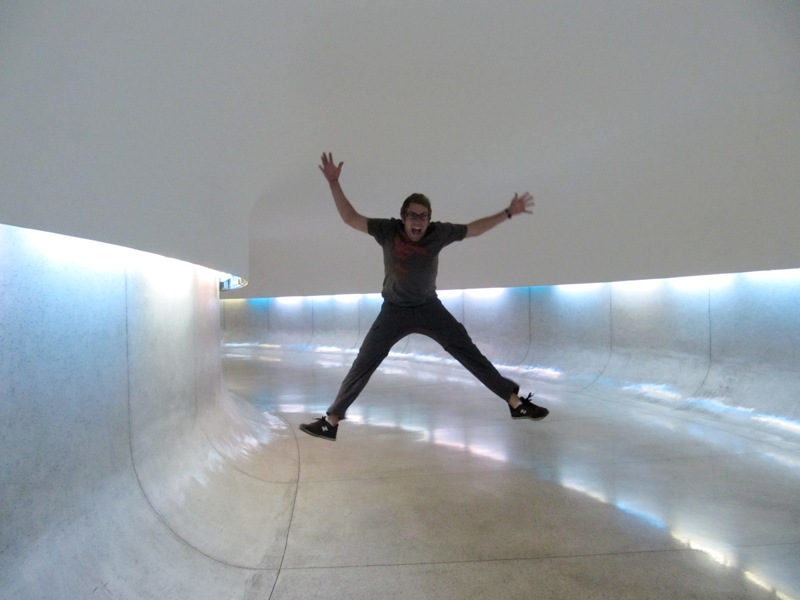
Leaping Nathan

Besides transit, a major attraction of Curitiba is the Oscar Niemeyer Museum.  It mostly consists of modern art in a basic square building with this funky “eye” shaped bit in front.  We enjoyed ambling through the ultra modern architecture although the eye was under renovations.

Opera House

Opera House

Another much advertized sight was the opera house.  It is a bare steel structure that seems to float above a lagoon.

Samba rehersal in a bar

Samba rehersal in a bar

After the sights we still had some energy to go out on the town.  I had heard about a cool samba club and since our time in Brazil was coming to an end, I couldn´t pass it up.  Of course the club was completely empty until 12am so we waited in a bar across the street.  Fortunately, this was where the band was warming up so we got a very personal concert.

Fun hot dog stand

Fun hot dog stand

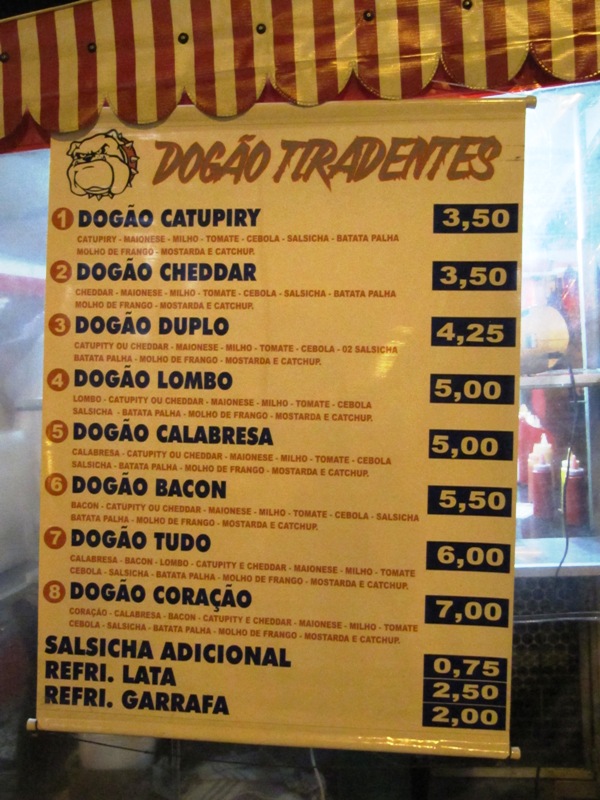
One more food adventure: hot dogão.  Everything in Portuguese ends with “ão”, pronounced “ow”, so why would hot dogs be any different?  We found them at a little stand on Plaza Tridentes that was hopping with people.  The strange toppings convinced us to try one.  Truth be told it wasn´t the greatest dog but the novelty factor was worth it.

4 feet on Portuguese style sidewalk

4 feet on Portuguese style sidewalk

Overall, I´m so happy to have made it to Curitiba. It deserves its reputation as an inspiration for bus transit systems.  Also, special thanks to Nathan for supporting my transit geek out excursion : )

Me headed to the bus rapid transit boarding stations

Me headed to the bus rapid transit boarding stations

Post Navigation