4 feet 2 mouths

walking and eating our way around the world

Archive for the tag “Nature”

Tafí del Valle (by Carmen)

Mountains with clouds and shadows

Lonely Planet is both a blessing and a burden.  Their South America on a Shoestring guide is basically the travel bible for the continent.  It is packed with information you need from bus times and costs to great places to pick up empanadas.  Some people don’t “do” Lonely Planet to make themselves feel like more original travelers.  Nathan and I still find it valuable to check out their recommendations but keep our eyes open for serendipitous discoveries as well. At the same time, depending on a single text means that you end up where all the other gringos go.

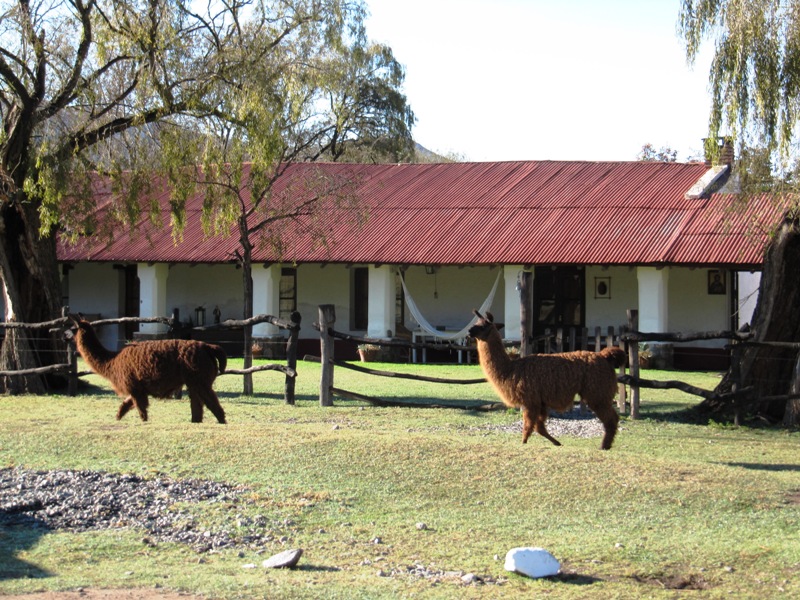
Estancia Los Cuartos

But just when you think you are going to chuck the heavy book from your backpack, along comes an “our pick.”  These are supposed to signify an extra special find. Not all cities have such an accolade; they are actually few and far between.  So I took note when the small mountain town of Tafí del Valle had an “our pick” hotel called Estancia Los Cuartos.

Our historic suite

It was wonderful. The estancia was an old ranch house from the 1700’s.  Our room came with thick walls, a stone floor, dark wood book cases, a thatched roof and warm blankets.  I love history and it felt like I had stepped back in time a bit.  There were a few key modern amenities, such as a heater.  A nice touch since it rained heavily for part of our stay.

Breakfast with Tafí cheese

Another highlight of the estancia was breakfast.  The dining room overlooked the beautiful mountain scenery.  We enjoyed the typical courses of coffee, bread and jam but the best part was the homemade cheeses.  Tafí is known for its cheeses, which are modeled after a Spanish-style manchego (one of my favorites!).  Each year, the town hosts the national cheese festival.  We missed the festival but did indulge in a large block of cheese, which we enjoyed with a rosé we brought from Mendoza.

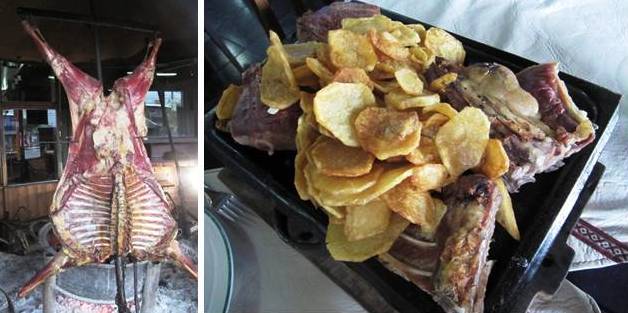
Barbecued goat and potatoes

In addition to good cheese, the main strip of Tafí has a few good parrillas.  We stopped into one that had a nice fire built in the front with meat roasting above it.  Their specialty was chivito (goat).   We ordered a grill plate for two which came heaped with chunks of juicy meat and delicious, crispy slices of potato.  Truly some of the best potatoes I’ve ever had.

Wild horses on mountain

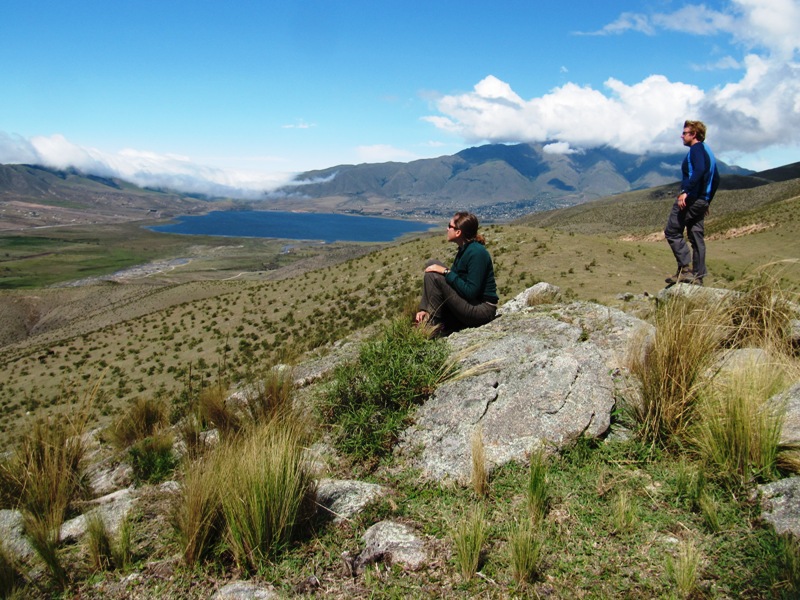
We needed to work off all these heavy meals so we did a nice hike to the cerro de la cruz (peak of the cross).  From here we could look over the town and the nearby lake.  Herds of free roaming horses grazed nearby.  Seriously, how much more idyllic can you get? At least for me, it was a blissful weekend.

On the overlook

Higher Learning in Condoritos (by Nathan)

Another name for this post might be “The Best And Worst Day In Condoritos.” Vacation is not all about relaxation, but frequently a memorable experience is about a little pain, fantastic views and numerous lessons learned. Visiting the Parque Nacional Quebrada de Condoritos was one of these adventures.

Park entrance...finally

Park entrance…finally

Our trip to the canyon containing the Andean condor breeding grounds was another two hour bus ride from Córdoba. We travelled high into the mountains and high into a thick cloud that we did not expect. Our driver was supposed to drop us off at the unmarked dirt road entrance, but he forgot. He pulled over on the side of the highway and informed us it was “really close” and that we just had to “walk around the corner.” An hour and a half later we arrived at the visitor center, time to “begin” the hike.

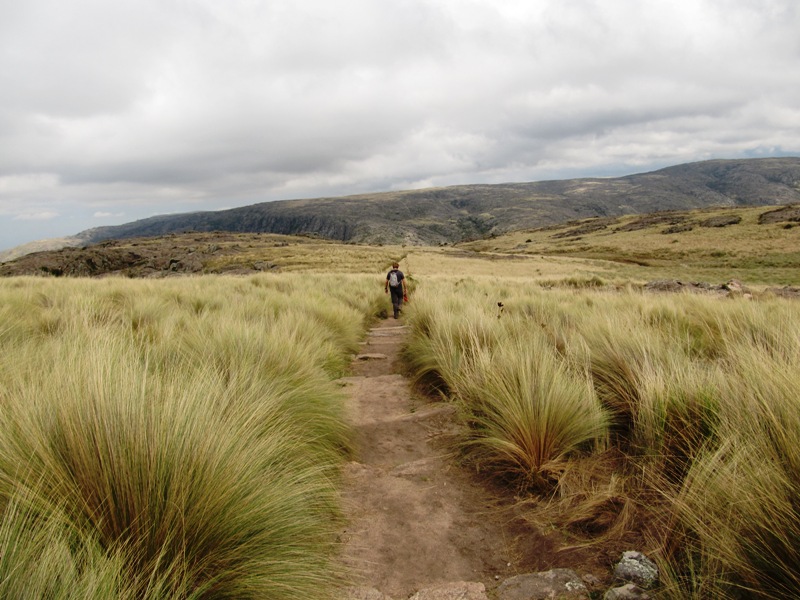
Windswept pathway

Windswept pathway

We checked our return bus schedule to Córdoba and we were off. We planned on a five hour hike that would give us plenty of time to get the 6:30 bus.

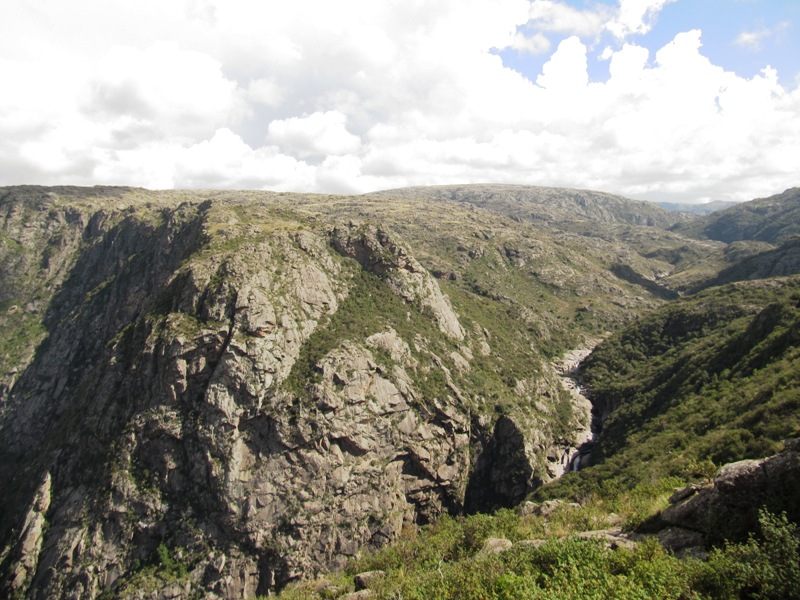
Cliffs of the quebrada de los condoritos

Cliffs of the quebrada de los condoritos

The canyon of condors was magically sensational for the eyes. We saw huge boulders, green grass and an occasional field of wispy golden grains that danced in the breeze. We sat on the cliff edge hypnotized by the souring condors gliding effortlessly into the thermal columns of the canyon. We quickly ate down our lunch of carrots, cheese and apples then cooked in the sun like two lizards on a rock.
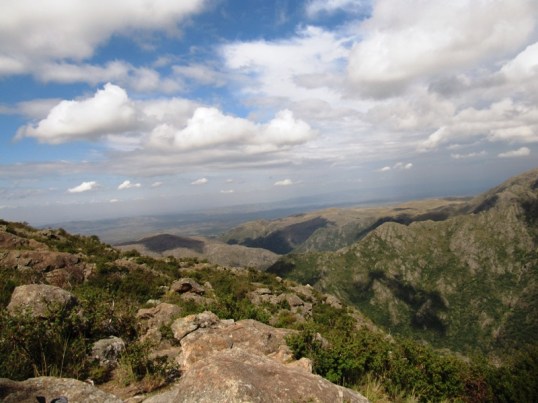
Breathtaking valley

Breathtaking valley

Our return hike was even more fantastic. The clouds dispersed and everything sparkled in the golden sun. The trail glistened with huge crystals of quartz and flakey mica. We climbed and descended over the hills and repeated this cycle several times on our way to the highway.

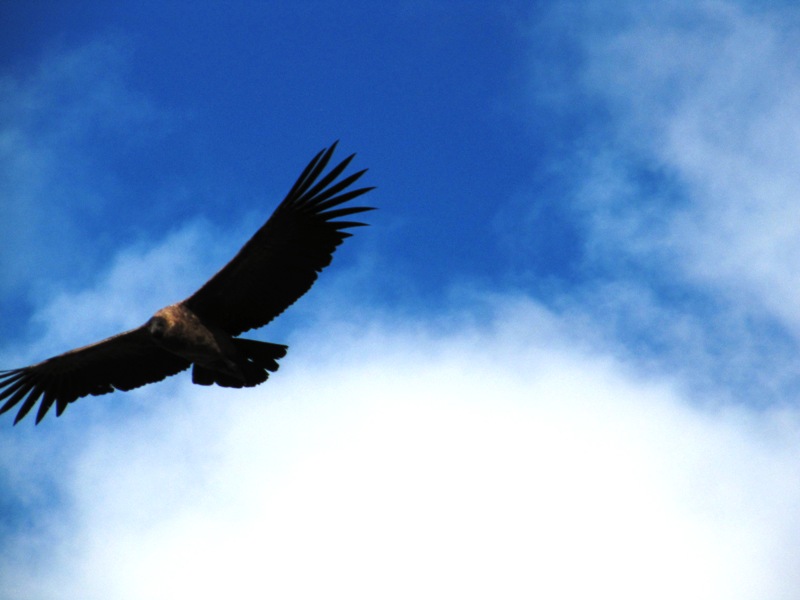
Andes Condor souring above

Andes Condor souring above

Huge condors flew overhead.  This bird has a wingspan of up to ten feet and a body the size of my thigh (it´s a big thigh). In the last dirt section of our trail a condor soured over us to better investigate. His huge wings fully spread with its white finger-like tips barely moved and his huge body hovered fifteen feet above out heads. With a gentle tilt of his wings he quickly maneuvered into the valley.

We were tired from 30km (19mi) of hiking and we plopped our throbbing bodies on the side of the road in anticipation for our bus.  An hour and a half passes and we realize that the bus is not coming. Another couple arrives loaded with camping gear and plans to hitchhike to Córdoba. Every half hour a microbus similar to the one we took to the park would fly by. We wave our hands eagerly, but we faintly remember the driver telling us that only the collectivo (big bus) would stop for us.

The sun began to set, the winds pick up and the temperature drops. Carmen and I huddle for warmth, but this does little to stop the shivering. Carmen screams out at the bus that never came, tears dropping as the freezing temperatures take their toll.

Then Carmen got a little warmer and there was hope. The back-packing group lent Carmen a hooded sweatshirt and thirty minutes later they saw my violent shivering and passed me the warmest pullover of my life that was soft and light with llama wool.

Another hour on the roadside shielding ourselves behind a concrete barrier and a third couple arrives from the dark. Jumping up and down and waving frantically the 7:30 bus does not stop for us. We attempt to hitchhike as well, but no one hesitates for six hikers and no car stops for us. There is only one more bus, one more chance. Carmen and I make plans to break into the visitor center for shelter.

The third couple fed us cookies to keep up our spirits. Then there is an idea: FIRE. Frantically we scramble to assemble the dried reeds. I was the craziest of all. I built a blazer and nearly threw myself into it to take in the heat. Our hysterical actions blinded the fact theat we could start the whole national park ablaze. Carmen pointed out that the three foot sideways windblown flames were inching their way to the dray brush.

We create a fire ring and restart the fire. Across the valley we notice a red glow, our last hope- the 8:30 bus. Our jumps and waving is even more frantic. We are desperate to get to Córdoba. It stops! Our boots stomp out the fire and we douse it with a liter of juice. Magically the bus pulls over onto the dirt shoulder and we sprint to the open doors excited to suck in the mixture of dust and exhaust. We stumble onto the dull bus and we find seats on the warm hard aisle floor. I refused to remove my layers because I enjoyed the tingle of sweat on my face that is so much better than frost in the nostrils. After three hours of waiting, we were finally warm and on our way to Córdoba.

This is not meant to scare, but more so to point out that this is traveling. The insatiable craving to explore brings about experiences good and bad. In every city there is joy and pain, frustration and delight and most of all knowledge and understanding of a culture and a place that only happens when we say “we have been there!”

Endless fields along our trail

Endless fields along our trail

Now, what are these lessons learned:

  1. Appropriate clothing: We had prepared for a cold day, but with three hours of waiting, we were not ready for a freezing night.
  2. Make friends: It was so much easier to endure this pain alongside our circumstantial friends. Their kindness was genuine and sincere.
  3. Know more about the transit: We headed out on a brief recommendation without full understanding of how to get back. We so rarely wing it, but in the future it is better to over plan.
Culture Clash Argentina – Villa General Belgrano & Cumbrecita (by Nathan)

Argentina is a big country and getting out of it means a long bus ride.  Lucky for us we were able to hop over to little Germany with a recommendation from our friend Jenny.

Trees at Veilchental campground

Trees at Veilchental campground

We had this great idea to volunteer at an organic farm working every day for our food and lodging.  When we arrived we found a campground, no farm, no food and a freezing cold night.  The only work was chopping wood; I did not want to spend the week recreating the piles of wood from my childhood so we moved our packs to the nearby town of Villa General Belgrano (VGB).

View of Villa General Belgrano from Cerro de la Virgen

View of Villa General Belgrano from Cerro de la Virgen

VGB was settled in the forested mountains about two hours south-west of Córdoba.  Germans fled from Europe after WWII and there was no better place than the sierras of Argentina that so closely resembled their homeland.

Hiking Carmen

Hiking Carmen

There is a steep and rewarding hike to overlook the city.  From our perch in the sky we looked down on the cute log buildings, gentle crystal blue creek and the hundreds of Argentinean tourists that also wanted to be here on the semana santa (Easter week).

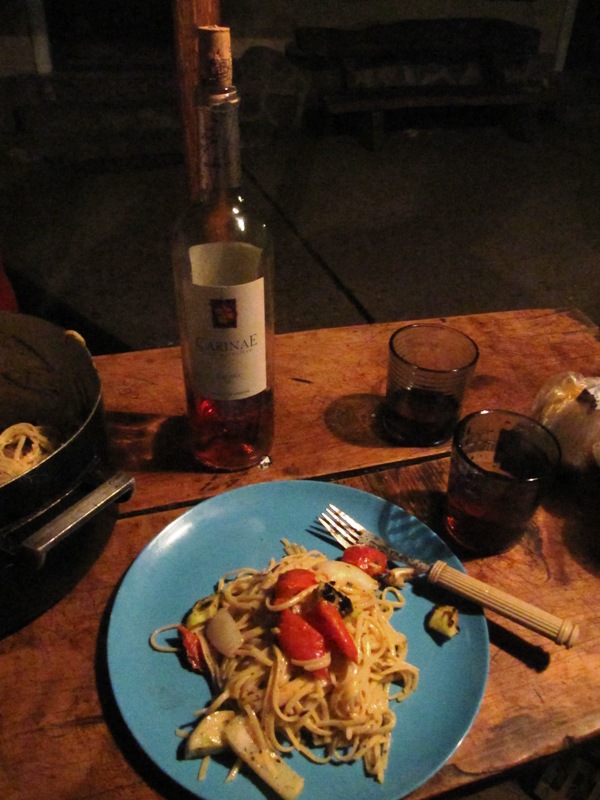
Pasta and rosé

Pasta and rosé

At night we cooked some awesome meals out of the outdoor hostel kitchen.  We grilled eggplants, peppers, onions, and garlic and tossed it with pasta, yogurt and lemon for a flavorful meal.
Cumbrecita German buildings

Cumbrecita German buildings

Forty-five minutes on a small bus from VGB is another adorable town: Cumbrecita.  The main street is lined with curios shops and stone and wood clad buildings, but the main reason we came was for the hikes.  In town we meandered around cobblestone streets that led to rocky trails to waterfalls and ponds tucked away in tree-lined cliffs.

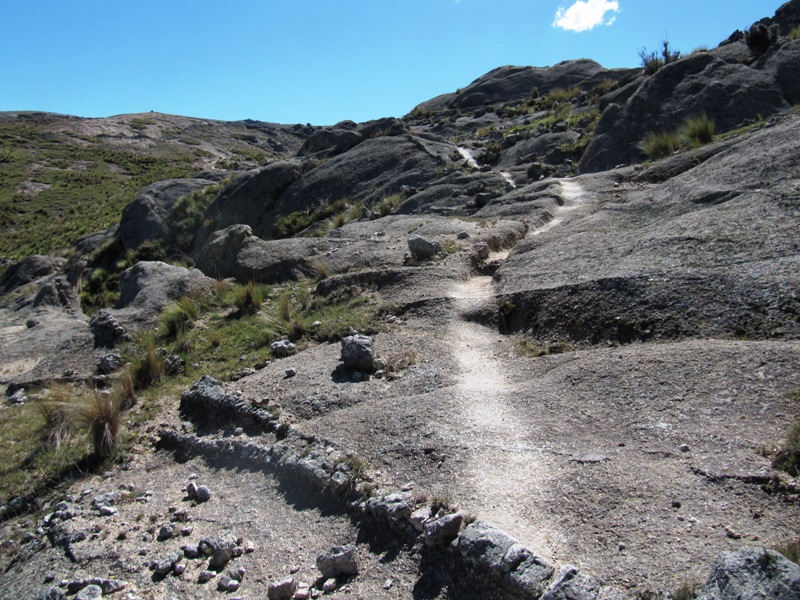
Horse worn trail on rocky hillside

Horse worn trail on rocky hillside

We found another rigorous hike to the summit overlooking the town.  Over an hour of switchbacks and we reached the summit and a view of expansive rolling hills that were forested as far as we could see.  In the other direction a canyon of boulders and a warn pathway from the gauchos on horseback that also trek this region.

Forested mountains

Forested mountains

Visiting these German villages was a delightful treat for our travels.  Better beer, bockwurst and sauerkraut and we even had apfelstreudel for breakfast.  Tucked into the mountains we could hike in the trees and just for a few days feel like we were in Europe, not South America.

The Best Bus Ride Ever (by Carmen)

Valley and creek

Valley and creek

Long bus rides come with the territory when traveling in South America.  Extremely long in some cases – I’m talking 24 hours or more!  Nathan and I have avoided such journeys, keeping our trips to 10 hours or less.  On some of our longer journeys we take an overnight to save on money and time.  These can actually be quite comfortable with seats that recline nearly flat.  But there are some bus rides worth being awake for. Such is the case with the trip from Santiago to Mendoza.

Andes cliffs

Andes cliffs

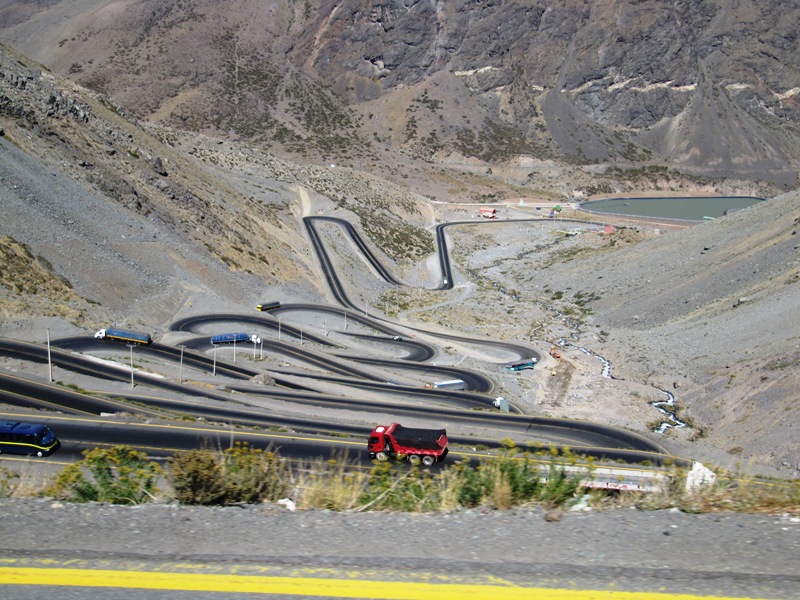
A few years ago my cousin traveled around South America.  She endured numerous bus hours but one trip in particular stuck out in her mind: Santiagoto Mendoza. Ever since, I’ve actually been looking forward to the eight hour journey.  (Thanks Adri!) The two cities are separated by the Andes. It’s a mean job for the bus to get up and over these mountains, but for us it made for spectacular views. 

A ribbon of road

A ribbon of road

Glacier in the distance

Glacier in the distance

As the bus trudged up switchback after switchback our eyes were practically glued to the windows.  We were enveloped by high cliffs carved by the swift river running alongside the road.  Glaciers peeked out from distant mountain peaks.  The drama of it all made the ride feel much shorter than it actually was.  Bring on the 24 hour bus trip!  Ok, not really but we are looking forward to more scenic drives through northwest Argentina.

Valley with mossy river

Valley with mossy river

Tall Andes valley

Iguazú, Argentina Style (by Carmen)

Nathan beautifully described the experience of Iguazú from the Brazil side.  With its stunning vistas and platform right near the Garganta del Diablo, it may seem like you have seen it all. But Nathan and I found that the Argentina side had a lot to offer as well.  Contrasted with Brazil, it gives a more up close and personal view of the falls.

Garganta del Diablo

Garganta del Diablo

The first thing we did on the Argentina side was to see the Garganta de Diablo from the top.  This is the largest of the falls and one of the most impressive.  There is something strangely mesmerizing about so much water free falling hundreds of feet.

Trees and cascadas

Trees and cascadas

Next we hit the upper trail that looks at a series of waterfalls from the top.  Even though there is a banister, the act of looking down a straight drop into the turbulent water at the bottom made me a bit dizzy.

San Martin waterfall

San Martin waterfall

Finally, we weaved our on the lower trail.  Parts of this almost go under some of the “smaller” waterfalls.  There is even a small ferry that takes you to an island in the middle of it all.   The island has a short walk to one of our favorite vistas.  From here you can feel the power of one of Iguazú´s major cascades, San Martin.

Cascadas, San Martin on left

San Martin is loud.  You can hear the water screaming its way down.  One of the signs nearby had a picture of San Martin during a major drought in the 1970s.  This all mighty waterfall was literally reduced to a trickle.  It is hard to imaging compared to the heavy flow present today.  But it is a reminder of how fragile a seemingly invisible force of nature can be.

Foz do Iguaçu – Brazil (by Nathan)

For being one of the most spectacular natural wonders of the world, I am amazed that more Americans do not know about the Foz do Iguaçu.  It was unknown to us too, but with more trip planning it became an essential site and it fit seamlessly with our gringo trail through South America.

Foz do Iguaçu from Brazil

Foz do Iguaçu from Brazil

The waterfalls are at the border of Brazil, Argentina and Paraguay.  Paraguay used to have waterfalls, Guaíra Falls, they were so big that they had the highest volume of water flow in the world.  Now the Itaipu dam and reservoir sits in its place.  Nevertheless, Iguaçu still exists and it is thrilling.  The main viewing of the waterfalls is from a series of over-looking platforms from the Brazil side and weaving pathways through the waterfalls on the Argentinean side.

Toucan

Toucan

For anyone coming here, see the Brazil side first to get the big picture views, then go to the Argentinean side the next day to get up close, wet and personal.  Spend at least three nights, but these tiny cities have many other great activities and ecological reserves, Carmen and I left thinking we would have liked two more days.  The region is a jungle with lots of great wildlife.  We saw wild monkeys, toucans and coati.

Bahian Moqueca

Bahian Moqueca

When in Brazil, eat moqueca.  This stew of seafood, manioc and vegetables is hearty and perfect for a long day of hot humid hiking.  No car necessary, we grabbed a local bus for about $2 and it took us right to the park entrance.  We started along the south end of the park moving from vista to vista and worked our way to the biggest of the falls.

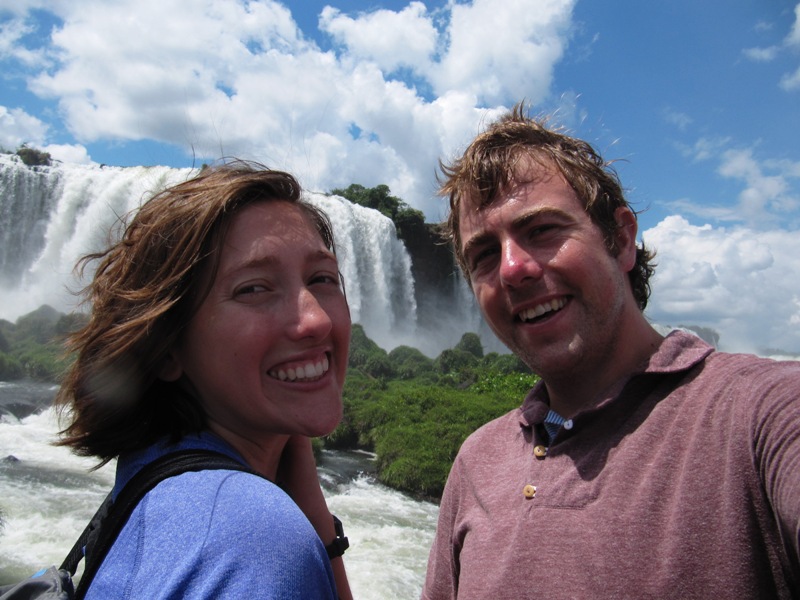
Us at the falls

Us at the falls

The awe-struck feeling that hit me when looking out into the valley was intense. My heart started throbbing rapidly, my ears became deaf by the thunder of the falling water and all that I could do was stare out, mouth open and probably a little drool hanging off my lip.  I was dumbfounded by the beauty of it all.

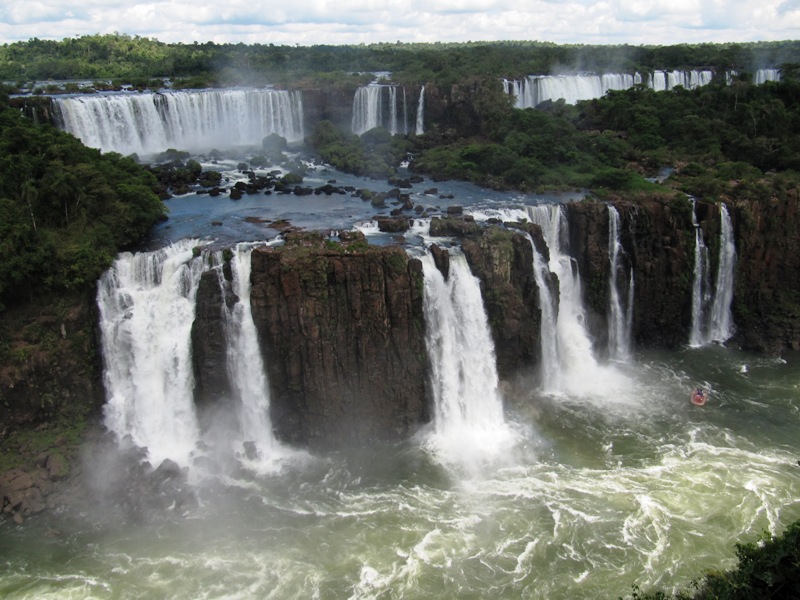
Foz do Iguaçu 2

Foz do Iguaçu with boat underneath

There is not just waterfall, there are hundreds.  A huge lake drains over cliffs that are 100-350ft.  The volume of water is breathtaking, 62,000 cu. ft. per second!  That is basically the entire volume of Lake Arrowhead in 2.5 seconds and Lake Anza in 0.5 seconds.  You look down and there are boats driving underneath the “smaller” waterfalls.  In a rush of excitement Carmen and I boarded one of these boats and we realized that this off-shoot waterfall was not small! volkswagen volumes of water dumped on us every second. With my yells “¡Ya estoy muy sucio!” and “Otra vez.” The driver dunked me another time.

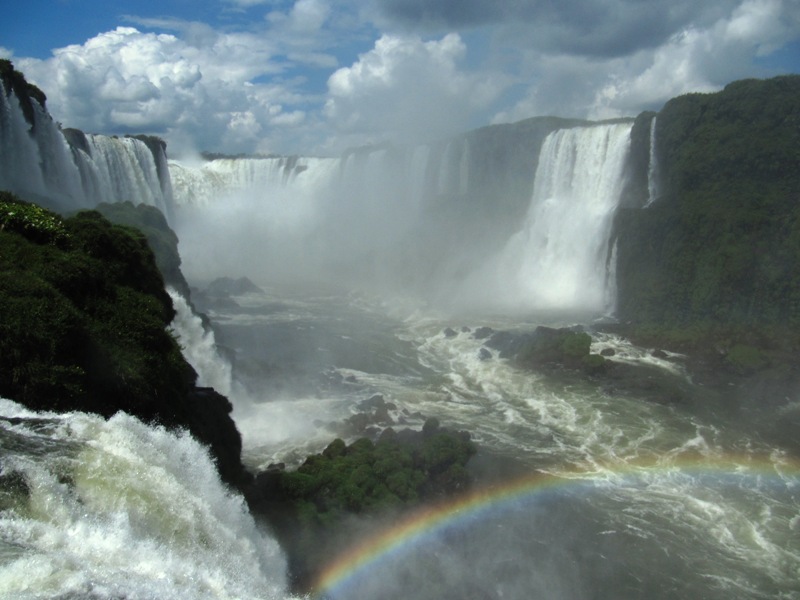
Rainbow and Garganta do Diabo in distance

Rainbow and Garganta do Diabo in distance

The last platform is the grand finally-  a concrete walkway and vista right in the mouth of the Garganta do Diabo (Devil’s Throat).  You stand so close that it is impossible to stay dry or even take pictures.  This is not because we stood underneath the waterfall, but because the mist engulfed us in a wet cloud.  This also made for some colorful rainbows.

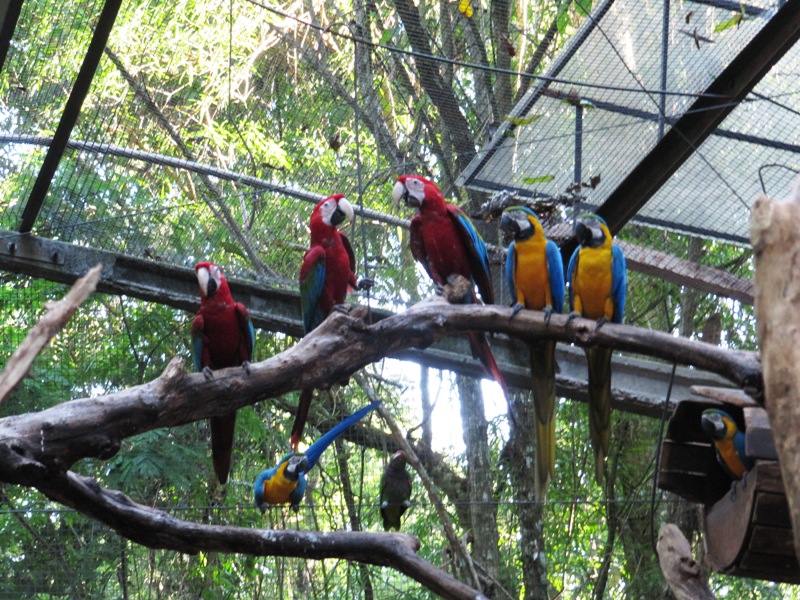
Ominous makaws

Ominous makaws

A five minute walk from the Brazil-side entrance is a phenomenal bird park.  I usually dislike zoos, but I was fascinated to see one dedicated to tropical birds.  There were so many colors and patterns, I had no idea that this many birds even existed.  In one of the “experience” cages Carmen and I stood in a small hangar with thirty or so macaw parrots of bright red, purple, blue and orange.  Suddenly they all dove off of their perches right at us.  They swooped and we dropped to the ground covering our heads imagining that this was a colorful version of the Hitchcock film, “The Birds.”  We survived and were entertained to find out that they were just flying to the other side.

Foz do Iguaçu is a beautiful place.  It is memorable in every way, an essential destination to every South American trip.  I am so ecstatic that Carmen and I had this opportunity.

Post Navigation